
Assessing the Economic and Geopolitical Viability of a Venezuelan Energy Revival
The geopolitical setup is clear. Following the dramatic capture of President Nicolás Maduro, the Trump administration has declared its intent to control Venezuela's oil production and sales indefinitely. It has invited U.S. majors to rebuild the sector, framing the move as a strategic opportunity to harness the world's largest proven reserves. Yet this grand strategic premise collides with a harsh economic reality. The central question is whether a revival is viable given today's market conditions and the sector's shattered infrastructure.
Venezuela's asset base is staggering. It sits atop an estimated 303 billion barrels of proven oil reserves, the largest on the planet. This is a reserve base that dwarfs even Saudi Arabia's. Yet its current production tells a different story. Output stands at a mere 750,000 barrels per day, a fraction of its historical peak and far below the levels needed to justify a massive investment. The gap between potential and present is the first hurdle.
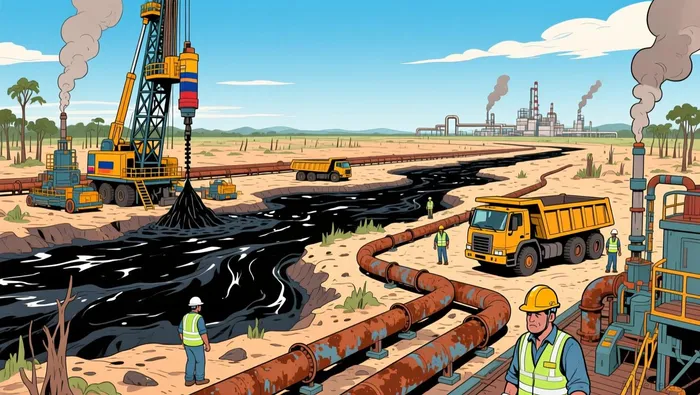
The second, and more critical, hurdle is economics. The cost to produce Venezuelan heavy crude is high. Independent analysis estimates the breakeven cost at around $80 per barrel. This is the price needed to cover the expense of extracting and processing the heavy, sulfur-rich oil from the Orinoco Belt. In stark contrast, the crude trades at closer to $50 today. This $30 per barrel deficit creates an immediate and severe profitability problem. For any company, investing billions to restore production when the market price is below the cost to produce is a non-starter.
The scale of the required investment underscores the challenge. While a political transition could see output ramp up to 1.3 to 1.4 million barrels per day within two years, independent research suggests it would take $183 billion over more than a decade to restore production to a 1990s-era level. This isn't a quick fix; it's a multi-decade, multi-billion-dollar capital program. The economic math simply doesn't work when the return on that capital is negative at current prices. The strategic opportunity is real, but the economic viability is severely constrained.
Company-Specific Positioning and Heavy Crude Economics
The competitive landscape among U.S. majors is defined by a stark asymmetry between immediate operational access and long-term claims. ChevronCVX-- stands alone as the only major U.S. oil company currently operating in Venezuela, giving it a clear near-term advantage. Its joint venture produces approximately 200,000 barrels per day, a foothold that positions it to be the first to scale activities as the political situation stabilizes. In contrast, ExxonMobilXOM-- and ConocoPhillipsCOP--, while holding substantial historical claims, lack current licenses and would face a lengthy re-entry process. ConocoPhillips, for instance, has outstanding claims for seized assets that are approaching $10 billion, a figure that underscores the scale of potential recovery but also the legal and political hurdles ahead.
This operational gap is critical because the economics of Venezuela's heavy crude create a formidable barrier for all entrants. The oil, extracted from the Orinoco Belt, is not a simple commodity. It is a dense, high-sulfur heavy crude that requires significant processing. First, it must be diluted with lighter hydrocarbons to make it flow through pipelines-a costly step that adds to the production expense. Second, refining this heavy, sour crude is inherently more complex and expensive than processing lighter grades, placing further pressure on the economics of the final product.
These processing demands are directly reflected in the brutal break-even math. Independent analysis estimates the cost to bring a barrel of Venezuelan heavy crude to the surface at around $80 per barrel. This figure represents the minimum price needed to cover extraction, dilution, and initial transport costs. Yet the crude currently trades at closer to $50. This $30 per barrel deficit means that even Chevron, with its operational lead, would be producing at a loss on every barrel sold at today's market price. The high break-even cost, driven by the need for dilution and expensive refining, is the economic engine that makes a revival so difficult. For all the strategic talk of billions in investment, the fundamental reality is that the market is not paying enough to cover the cost of production.
The Capital, Timeline, and LNG Market Implications
The path to a revived Venezuela is one of immense capital and time. While the strategic vision often speaks of a return to historic output near 3 million barrels per day, the hard numbers reveal a more constrained reality. Restoring production to that level would require a staggering roughly $183 billion in cumulative oil and gas CAPEX from 2026. This is not a near-term project but a multi-decade commitment, with analysts projecting a full return to 3 million bpd by 2040. The immediate capital need is also substantial; simply maintaining current output around 1.0–1.1 million barrels per day would demand more than the industry standard of roughly $5.5 billion per year.
This sets a clear timeline. Expectations of a quick rebound are running into hard infrastructure barriers. According to J.P. Morgan Global Research, a more realistic ramp-up scenario sees production reaching 1.3 to 1.4 million barrels per day within two years of a political transition. This modest near-term gain contrasts sharply with the historic peak and underscores the scale of the repair job. Experts from ANZ and Rystad Energy confirm that even restoring modest volumes quickly would require billions in spending, with growth beyond 1.4 million bpd demanding sustained commitments to pipelines and upgraders. The central gating factor remains infrastructure repair, leaving investors exposed to continued civil unrest and policy uncertainty.
The implications extend beyond oil to the global LNG market. Venezuela holds the world's seventh largest natural gas reserves, estimated at 6,300 billion cubic meters. While current production is entirely consumed domestically, the potential for regional exports is tangible. A pipeline to Colombia, with a nameplate capacity of 5 bcm/year, could offset Colombia's current LNG needs of 2.5–3 bcm/year. This would reduce a key neighbor's reliance on imported gas and could be a near-term use for the resource.
More broadly, Venezuelan gas could serve as a backfill for Trinidad and Tobago's LNG facilities, which are facing declining domestic feedstock. Success in developing fields like the Dragon field could see Trinidad's LNG exports increase by up to 6 bcm/year. The bottom line is that while the oil revival faces severe economic and capital hurdles, the gas story introduces a different, potentially more immediate, dynamic. It shifts the focus from a massive, multi-year oil investment to a series of regional gas projects that could have a measurable, if still uncertain, impact on LNG flows within a shorter timeframe.
Forward-Looking Catalysts, Risks, and What to Watch
The path forward hinges on a delicate balance between a few potential catalysts and a persistent cloud of risk. The most immediate catalyst is the U.S. government's control over oil sales. President Trump has announced plans to seize and sell between 30 million and 50 million barrels of sanctioned oil, with proceeds intended to fund reconstruction. This could provide a near-term cash infusion and a tangible demonstration of the new regime's ability to monetize assets. However, the scale of this plan faces a hard physical constraint. Storage and logistics are significant hurdles, with estimates suggesting only a fraction of that volume would be readily available for sale, potentially limiting the immediate financial impact.
The primary risk, however, is one of time and stability. The required investment is multi-decade and multi-billion-dollar, demanding a level of political certainty that is currently absent. As analysts note, investors would be exposed to continued civil unrest and policy uncertainty. Any resurgence of instability would directly threaten the capital already committed and deter further spending. This creates a vicious cycle: the very investment needed to stabilize the sector is itself vulnerable to the instability it aims to resolve.
This risk is compounded by the state of the global oil market. The sector is currently oversupplied by approximately 2 million barrels per day, a condition that keeps prices depressed. This oversupply directly undermines the economic case for a high-cost project. With Brent trading around $60, the break-even price for Venezuelan crude is likely the highest for major global producers, estimated at around $80 per barrel. The $20 per barrel deficit between market price and cost creates a severe profitability problem, reducing the incentive for majors to commit billions of dollars to a project that would be unprofitable at current levels.
For investors, the key is to watch for specific milestones that signal a shift in this dynamic. The first is the actual execution of the U.S. oil sale plan. The volume and price realized will be a critical early test of the new regime's operational capability and market access. The second, more structural, signal is the development of a clear legal and fiscal framework. As analysts emphasize, producers and traders would wait for a proper legal and fiscal framework before committing to long campaigns. Any progress on this front, including resolution of long-standing claims like ConocoPhillips' approaching $10 billion bill, would be a major positive catalyst. Finally, monitor the trajectory of global oil prices. A sustained move above $80 would be a fundamental requirement for the economics to work, but given the current oversupply, that seems distant. For now, the setup remains one of high potential reward balanced against severe and immediate economic and political headwinds.





Comentarios
Aún no hay comentarios