
Assessing Dogecoin's Holder Dynamics: What Does the Growing Wallet Base Mean for Long-Term Value?
Network Growth: A Surge in Participation
Dogecoin's user base has expanded significantly, driven by both retail enthusiasm and merchant adoption. By 2025 Q3, active Dogecoin addresses-those with transactions in the last 30 days-surpassed 152,000, up from 117,000 in 2024. This growth reflects broader accessibility, with over 3,000 businesses now accepting DOGE as payment. Low transaction fees (averaging $0.0021 per transfer) and a community-driven ethos have made Dogecoin an attractive option for microtransactions and tipping, particularly in emerging markets.
However, the rise in active wallets does not necessarily translate to equitable distribution. While the network's user base is expanding, the underlying ownership structure tells a different story.
Ownership Concentration: Centralization Risks Persist
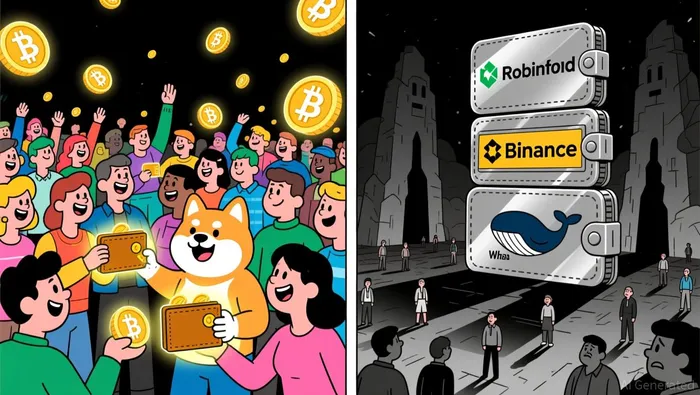
Despite its grassroots image, Dogecoin's supply is dominated by a handful of large holders. As of 2025, the top 10 wallets control 40% of the total supply, with the top 100 wallets holding over 60%. Robinhood, for instance, holds 19.45% of the circulating supply alone, while Binance and other exchanges collectively account for a significant portion. This concentration raises concerns about market manipulation and liquidity risks, as large holders could theoretically influence price movements through coordinated selling or buying.
The disparity between user growth and ownership centralization is stark. While 5.4 million wallets exist, the top 1,000 wallets hold over 75% of DOGE. This imbalance suggests that the network's expansion is not matched by a proportional diversification of ownership-a red flag for investors prioritizing decentralization.
Institutional Adoption and Technological Progress: A Path to Legitimacy?
Dogecoin's trajectory has been further shaped by institutional interest and technological upgrades. CleanCore Solutions, for example, holds over 710 million DOGE tokens in its corporate treasury, signaling growing confidence from traditional finance players. Three major asset managers-Bitwise, Grayscale, and 21Shares-have filed for Dogecoin ETFs, with potential SEC approval expected by October 2025. Such developments could catalyze price appreciation, as seen historically with BitcoinBTC-- and EthereumETH--.
Technologically, Dogecoin is evolving beyond its meme coin roots. The OP_CHECKZKP proposal aims to integrate zero-knowledge proofs, enabling interoperability with Ethereum-based smart contracts. Meanwhile, Project Sakura-a planned shift to proof-of-stake promises improved scalability and energy efficiency. These upgrades could position Dogecoin as a hybrid asset: retaining its low-cost, high-liquidity appeal while addressing scalability concerns.
Balancing Growth and Centralization: Implications for Long-Term Value
The interplay between network growth and ownership concentration presents a nuanced outlook. On one hand, rising active wallets and merchant adoption indicate a maturing ecosystem. On the other, centralized ownership risks undermine the decentralization principles that underpin many cryptocurrencies. For Dogecoin to achieve long-term value, it must address this dichotomy.
Institutional adoption and technological innovation offer a potential bridge. If ETF approvals materialize and smart contract capabilities expand, Dogecoin could attract a new class of investors seeking both utility and legitimacy. However, the network's inflationary supply model-unlike Bitcoin's deflationary design-remains a structural challenge. Competitors like Shiba Inu (SHIB), which supports smart contracts, also pose a threat to Dogecoin's market position.
Conclusion
Dogecoin's growing wallet base is a positive sign for adoption, but it must be weighed against the risks of concentrated ownership. While institutional interest and technological progress provide a counterbalance, the coin's long-term value will depend on its ability to decentralize ownership further and differentiate itself in a crowded market. For investors, the key takeaway is clear: Dogecoin's potential lies not in its meme origins but in its capacity to evolve into a robust, decentralized infrastructure.






Comentarios
Aún no hay comentarios