
Assessing Dividend Sustainability in Canadian Equities: The Strategic Value of TD Canadian Equity Index ETF's CAD 0.195 Payout
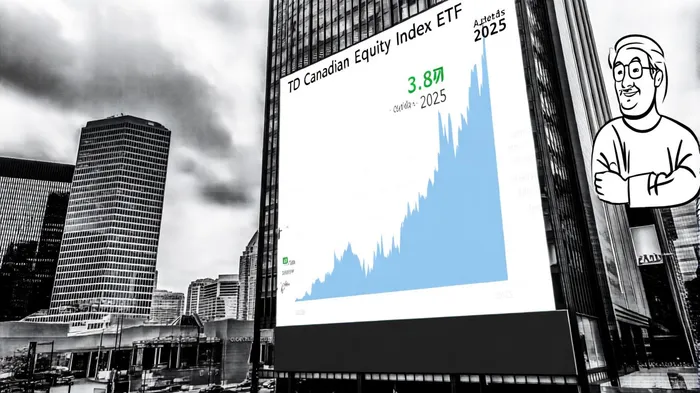
The recent CAD 0.195 dividend from the TD Canadian Equity Index ETF (TTP) has sparked renewed interest in the sustainability of Canadian equity dividends. As investors grapple with a shifting macroeconomic landscape, the strategic value of TTP's payout hinges on three pillars: its historical dividend trajectory, the fund's structural efficiency, and the resilience of its underlying index.
Dividend Growth and Historical Volatility
TTP's dividend history reveals a pattern of aggressive but uneven growth. For instance, the 159.03% surge in December 2022 to $0.3756 per share[3] contrasts sharply with the more modest 8.33% increase to $0.195 in March 2025[3]. This volatility underscores the fund's exposure to the broader Canadian equity market, which includes cyclical sectors like energy and mining[1]. However, the average three-year dividend growth rate of 17.69%[3] suggests a long-term upward trend, bolstered by the fund's role as a proxy for the Solactive Canada Broad Market Index. This index, which includes firms like 5N PLUS INC and ABRASILVER RESOURCE CORP[1], benefits from diversification across sectors and market capitalizations, reducing the risk of systemic shocks to dividend payouts.
Structural Efficiency: Expense Ratio and AUM Dynamics
A critical factor in dividend sustainability is the fund's expense ratio. While the exact 2025 Management Expense Ratio (MER) remains undisclosed[1], third-party analyses position TTP as one of the lowest-cost Canadian broad-market ETFs, with an MER of 0.05%[2]. This low cost structure is vital for preserving cash flows, as ETFs distribute dividends from the underlying assets' earnings after deducting fees. With Assets Under Management (AUM) reaching CAD 3.89 billion in September 2025—a 6.78% monthly increase[3]—TTP's scale further enhances its ability to maintain payouts. Larger AUM reduces per-unit operational costs, creating a buffer against market downturns.
Index Composition and Sectoral Resilience
The Solactive Canada Broad Market Index's composition[1]—spanning energy, mining, finance, and utilities—provides a natural hedge against sector-specific risks. For example, the inclusion of energy firms aligns with Canada's resource-driven economy, which has historically demonstrated robust cash flow generation. Meanwhile, financials and utilities, which typically offer stable dividends, anchor the index during periods of market stress. This diversification is a key differentiator for TTP compared to narrowly focused ETFs, enhancing its capacity to sustain payouts even in a low-growth environment.
Forward-Looking Considerations
Despite these positives, challenges remain. The absence of a disclosed payout ratio[1]—a metric commonly used for corporate stocks—reflects the unique nature of ETFs, which distribute dividends based on the underlying holdings' performance rather than a fixed payout ratio. Investors must instead evaluate the health of the index's constituents and the fund's expense efficiency. Additionally, while TTP's forward dividend yield of 2.31%[3] appears attractive, it must be contextualized against rising bond yields and inflation, which could pressure equity valuations.
Conclusion
The TD Canadian Equity Index ETF's CAD 0.195 dividend, while modest, is underpinned by a combination of structural efficiency, diversified index exposure, and strong AUM growth. For income-focused investors, TTP offers a compelling blend of accessibility and resilience, though its sustainability will ultimately depend on the broader Canadian equity market's ability to navigate macroeconomic headwinds. As the fund's expense ratio and index composition continue to evolve, close monitoring of these factors will be essential for assessing its long-term dividend viability.







Comentarios
Aún no hay comentarios