
Assessing the Dividend Sustainability of abrdn Global Premier Properties Fund: A Cautionary Tale for Income Investors
In the realm of income generation through global real estate, the abrdn Global Premier Properties Fund (AWP) has long been a magnet for yield-hungry investors, offering a monthly dividend of $0.04 per share, translating to an annualized yield of approximately 13.26% . However, as of September 2025, the fund's financial performance and structural challenges raise critical questions about the sustainability of this payout.
Performance vs. Payout: A Tenuous Balance
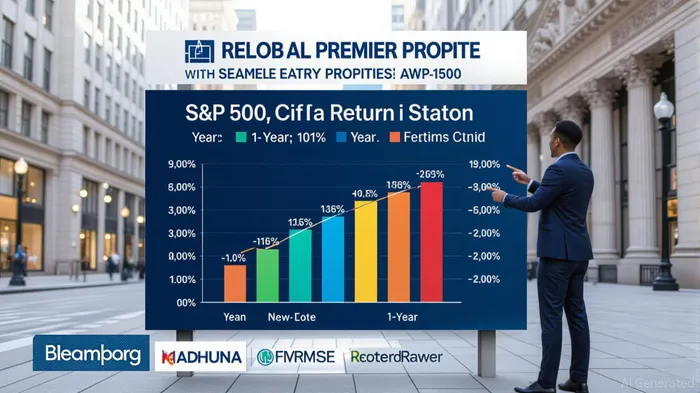
AWP's year-to-date (YTD) return of 13.42% as of September 11, 2025, outperforms the S&P 500's 11.96% [2]. Yet, over a 1-year horizon, the fund's 0.35% return lags far behind the S&P 500's 18.57% [2]. This disparity underscores a troubling trend: while AWP's short-term gains may appear robust, its long-term trajectory is marred by negative 0.89% annualized returns over five years [1]. Such underperformance complicates the fund's ability to generate consistent earnings to support its high distribution rate.
AWP's leverage of 17.00% (total debt of $65.228M as of September 2023) and an expense ratio of 1.62% [3] further strain its financial flexibility. While leverage can amplify returns in bullish markets, it exacerbates losses during downturns—a risk amplified by the fund's exposure to global real estate, which remains vulnerable to interest rate hikes and liquidity constraints.
The High-Yield Illusion
AWP's 13.26% distribution rate, though enticing, is not fully supported by its earnings. According to a report by StockAnalysis, the fund relies heavily on capital gains distributions and return of capital to meet its monthly $0.04 payout [1]. This managed distribution policy, while designed to maintain consistency, erodes the fund's net asset value (NAV) over time. For instance, AWP's NAV has deteriorated amid rising interest rates, which have increased borrowing costs and reduced real estate valuations [1].
Analysts caution that such practices create a “sustainability gap.” When a fund's distributions exceed its operating cash flow, it signals a reliance on non-earnings sources—capital gains (which are volatile) and return of capital (which effectively returns investors' own money). This dynamic raises concerns about the fund's ability to maintain its payout during periods of market stress or declining asset values.
A Cautionary Outlook for Income Investors
The fund's structure and performance highlight a broader challenge in global real estate investing: balancing high yields with long-term stability. While AWP's dividend may appear attractive on paper, its reliance on capital gains and return of capital suggests a precarious foundation. For income-focused investors, this underscores the importance of scrutinizing not just the yield itself, but the mechanisms behind it.
Conclusion
AWP's $0.04 dividend, while alluring, serves as a cautionary tale for investors prioritizing income generation. The fund's high yield is not underpinned by robust earnings or asset growth, but rather by a combination of leverage, capital gains, and return of capital. As global real estate markets navigate macroeconomic headwinds, the sustainability of such payouts remains uncertain. Investors must weigh the immediate appeal of high yields against the structural risks that could undermine long-term returns.





Comentarios
Aún no hay comentarios