
Assessing DAX Volatility Amid SAP's Earnings Outlook
SAP's Strategic Resilience and Financial Momentum
SAP's recent results show cloud revenue surged 24% year-over-year in Q2 2025 to €5.13 billion, driven by a 34% growth in its Cloud ERP Suite (SAP's recent results). Free cash flow jumped 83% to €2.36 billion, reflecting the success of its 2024 transformation program. These figures, coupled with AI innovations like Joule and SAP Business Data Cloud, position the company to capitalize on the enterprise "intelligence revolution." However, macroeconomic headwinds-such as trade tensions and sluggish sales in the U.S. public sector-remain a drag.
The Zacks Consensus Estimate for Q3 2025 projects earnings of $1.69 per share, a 25.2% year-over-year increase, with revenue expected to reach $10.6 billion, according to a Nasdaq preview. If SAP meets or exceeds these expectations, it could further solidify its role as a DAX anchor. Yet, the company's current cloud backlog of €18.05 billion-up 22%-suggests strong future revenue visibility, which may already be priced into its stock.
Sectoral Spillover Risks and DAX Divergence
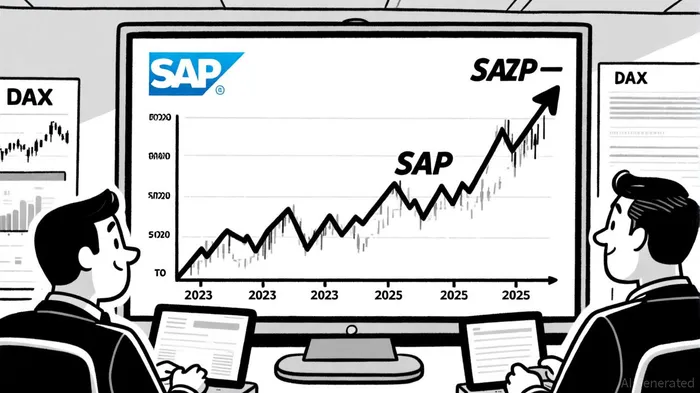
The DAX's volatility is increasingly tied to SAP's performance, but sectoral correlations reveal a nuanced picture. For instance, following SAP's Q2 2025 earnings release, the index rallied due to a surge in the automotive sector-spurred by optimism over a U.S.-Japan trade deal-while SAP shares fell despite strong results, as reported by Business News This Week. This divergence highlights a decoupling risk: SAP's stock movements may no longer align with broader DAX dynamics, particularly as its weighting nears the 15% EU UCITS cap, as noted in a Börsen‑Zeitung report.
Historically, the DAX's 10-day volatility has averaged 12.49 in 2025, down 13% from its peak, according to Simply Wall St. However, SAP's dominance introduces a new layer of instability. Index-tracking funds face regulatory constraints if SAP's weighting exceeds the cap, potentially forcing forced sales that could depress its stock price; the Börsen‑Zeitung report previously referenced discussed similar mechanics. This scenario mirrors Linde's exit from the DAX in 2023 after surpassing the threshold. Such regulatory pressures could amplify short-term volatility, especially if SAP's earnings fail to justify its valuation.
Investor Positioning and Regulatory Uncertainty
Investor positioning has also shifted. SAP's 75% stock price surge over the past year has attracted both institutional and retail investors, creating a concentration risk. Deutsche Börse and the German government are reportedly discussing regulatory adjustments to accommodate SAP's size, but any changes face resistance from fund managers wary of reduced index diversification (coverage in Börsen‑Zeitung). This uncertainty could prompt hedging strategies or portfolio rebalancing, further amplifying DAX volatility.
Moreover, SAP's underperformance relative to the DAX over the past year-despite its strong cloud growth-suggests investor skepticism about its long-term sustainability (analysis cited by Simply Wall St). If Q3 results fall short of expectations, the resulting sell-off could spill over into other sectors, particularly those with weaker fundamentals like Financials, as noted in the Business News This Week coverage.
Implications for Q3 and Beyond
As SAP prepares to report Q3 earnings, the market will scrutinize its guidance for 2025. A beat could reinforce its leadership in the DAX, while a miss might trigger a broader reassessment of the index's health. Given SAP's outsized influence, investors must balance its growth potential with the risks of overconcentration.
In the long term, SAP's success in AI and cloud innovation will likely sustain its market position. However, the DAX's stability hinges on diversifying its exposure to avoid a "magnificent seven" scenario seen in U.S. indices, a risk highlighted by Börsen‑Zeitung. Until then, SAP's earnings will remain a pivotal driver of German equity market volatility.







Comentarios
Aún no hay comentarios