
Assessing the CSI Semiconductor Index's Recent Decline: Opportunity or Warning Signal?
The CSI Semiconductor Index has experienced a notable correction in 2025, raising critical questions for investors: Is this a warning signal of systemic challenges, or a buying opportunity amid structural shifts in China's tech sector? To answer this, we must dissect the interplay of cyclical headwinds, regulatory pressures, and the AI-driven renaissance reshaping the industry.
Cyclical Headwinds: Cooling Markets and Inventory Adjustments
The index's decline reflects broader macroeconomic trends. Traditional growth engines like electric vehicles (EVs) and industrial semiconductors are slowing. U.S. EV sales dropped 6.3% year-over-year in Q2 2025, while global light vehicle production is projected to fall 1.7% for the year, according to a FinancialContent report. This downturn stems from maturing markets, expiring subsidies (e.g., the U.S. Clean Vehicle Tax Credit), and inventory overhangs. Similarly, the industrial sector faces flat demand, with companies like NXPNXPI-- and Texas InstrumentsTXN-- grappling with reduced order volumes, as noted in that FinancialContent report. These cyclical pressures are compounding an "oversupply hangover" that lingers into 2025, per the same report.
However, the market remains bifurcated. While automotive and industrial segments struggle, AI and high-performance computing (HPC) continue to thrive. AI server shipments grew over 20% year-over-year in 2025, driven by demand for GPUs and advanced node semiconductors, according to a SemiconInside analysis. NVIDIANVDA--, for instance, dominates 93% of server GPU revenue, while TSMCTSM-- benefits from sustained wafer demand for AI chips, as reported in a Reuters article. This duality underscores the index's complexity: it is not a monolithic decline but a sector-specific recalibration.
Regulatory Challenges: China's 2025 Semiconductor Origin Rule
China's regulatory landscape has further complicated the outlook. The 2025 semiconductor origin rule redefines the country of origin for integrated circuits based on wafer fabrication rather than packaging. This policy disproportionately impacts U.S. firms like Intel and MicronMU--, which now face 84%-125% tariffs on chips imported into China, according to a Bloomberg report. Conversely, local Chinese foundries such as SMIC and HuaHong are poised to gain market share, as domestic production becomes more cost-competitive, the SemiconInside analysis argues.
This regulatory shift aligns with Beijing's broader push for self-reliance, accelerated by U.S. export controls. For example, TSMC's recent order to halt advanced chip shipments to Chinese clients has forced domestic firms to accelerate R&D in analog and logic chips, Reuters reported. While this creates opportunities for SMIC and Cambricon, it also introduces short-term pain for companies reliant on foreign manufacturing.
Investor Positioning: Valuation Risks and Policy-Driven Optimism
Investor sentiment toward the CSI Semiconductor Index is mixed. On one hand, Chinese chip stocks have surged to multi-year highs, with SMIC trading at over 160 times forward earnings and Cambricon valued at five times Nvidia's multiple - a dynamic highlighted in the Bloomberg report. This optimism is fueled by policy tailwinds, including Beijing's $180 billion in subsidies for domestic semiconductor R&D and capital expenditures, according to a China Legal Experts report.
On the other hand, these valuations leave little room for error. Deloitte notes that R&D spending in the sector is growing at 12% annually, outpacing EBIT growth, raising concerns about long-term profitability; that observation is discussed in the China Legal Experts piece. Moreover, geopolitical fragmentation-such as U.S. tariffs on electronics and EU export controls-adds uncertainty to global supply chains, a risk flagged in the FinancialContent report.
Opportunity or Warning Signal?
The CSI Semiconductor Index's decline is neither a clear warning nor a guaranteed opportunity. For investors, the key lies in differentiation:
1. AI-Exposure Firms: Companies like NVIDIA and TSMC remain attractive due to their dominance in AI infrastructure. The global AI server market, valued at $128 billion in 2024, is projected to reach $1.56 trillion by 2034 at a 28.2% CAGR, according to a GM Insights report.
2. Chinese Domestic Players: SMIC and HuaHong could benefit from regulatory tailwinds, but their success hinges on overcoming technical hurdles (e.g., U.S. equipment bans) and scaling production at advanced nodes.
3. Cyclical Laggards: Firms exposed to EVs and industrial markets face near-term headwinds but may rebound if inventory corrections stabilize by mid-2026.
Conclusion
The CSI Semiconductor Index's decline reflects a market at a crossroads. Cyclical slowdowns in traditional sectors and regulatory headwinds in China are undeniable risks. Yet, the AI revolution and policy-driven domestic substitution present compelling long-term opportunities. For investors, the path forward requires a nuanced approach: hedging against cyclical volatility while capitalizing on the AI-driven renaissance. As the sector navigates these dual forces, patience and selectivity will be paramount.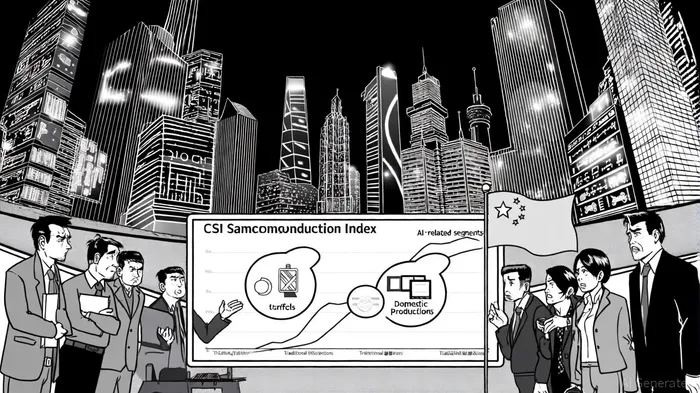





Comentarios
Aún no hay comentarios