
Assessing Commodity Volatility: CBOT Grains and Soy Complex in a Shifting Global Supply-Demand Landscape
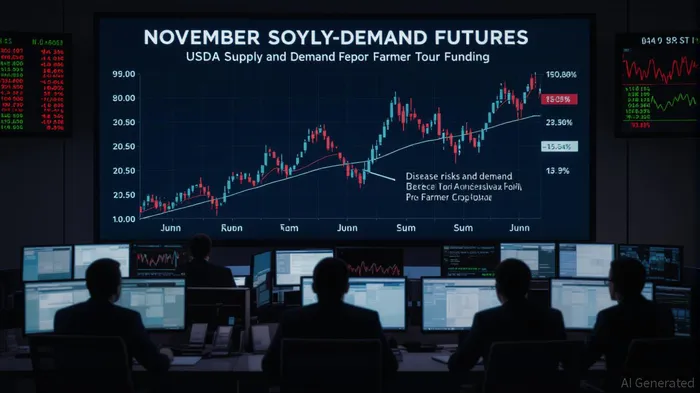
The CBOT grains and soybean complex in 2025 have become a microcosm of global economic fragility, where short-term price swings are driven by a volatile cocktail of export demand shifts, crop tour revelations, and geopolitical brinkmanship. For investors, understanding these dynamics is critical to navigating a market where optimism and pessimism can flip overnight.
Export Demand: A Tale of Two Giants
The U.S. and Brazil are locked in a high-stakes race for global grain dominance. While the U.S. remains a key supplier to Mexico and Japan, Brazil’s 2025/26 soybean production of 175 million tons and corn output of 5.1 billion bushels have eroded American market share, particularly in China. China’s soybean imports in June 2025 hit a record 12.26 million tons, with 86.6% sourced from Brazil [3]. This shift is not merely a function of supply but of strategic diversification: China is actively building redundancies in its supply chain, sourcing from Ethiopia and Uruguay to mitigate U.S. trade tensions [3]. Meanwhile, India’s soybean oil imports surged 93% year-on-year in 2025’s first half, reflecting its growing appetite for edible oils [3]. These trends underscore a fragmented demand landscape where U.S. exporters must contend with both regional competitors and shifting buyer priorities.
Crop Tours: Yield Optimism vs. Disease Realities
The 2025 Pro Farmer Crop Tour painted a paradoxical picture: record yield potentials in Iowa soybean pod counts (1,562.31 per 3’x3’ square) and corn estimates (182.7 bushels per acre) clashed with alarming disease threats like tar spot and southern rust [4]. These findings triggered a rollercoaster in futures markets, with soybean prices swinging between surplus-driven declines and supply-shock fears. The USDA’s August 12 report, which revised soybean production downward by 43 million bushels due to lower harvested acreage, further amplified volatility, sending November soybean futures surging past key technical levels [2]. The disconnect between USDA projections (53.6 bushels per acre) and Pro Farmer’s 53-bushel estimate highlighted the market’s sensitivity to incremental data, even as disease pressures loomed [4].
Geopolitical Tensions: Tariffs, Trade Wars, and Supply Chain Chaos
The U.S.-China trade war has left a lasting scar on CBOT markets. Retaliatory tariffs—34% on U.S. agricultural imports and 25% on Canadian and Mexican goods—have disrupted $30 billion in annual trade flows, with soybean exports to China projected to lose $2–3 billion by mid-2025 [1]. Brazil’s zero-tax wheat policy and Russia’s aggressive exports have compounded U.S. competitiveness woes [1]. Meanwhile, the Red Sea crisis has forced ships to take longer, costlier routes, adding to supply chain bottlenecks [1]. These geopolitical frictions are not abstract risks; they are concrete headwinds for U.S. farmers, who are already adjusting planting decisions to favor corn over soybeans and wheat [4].
Short-Term Volatility: A Playbook for Investors
The interplay of these factors has created a market where short-term price movements are both chaotic and predictable. For instance, the USDA’s August 12 report triggered a 4% surge in soybean futures as traders recalibrated expectations [2]. Similarly, the U.S.-China 90-day tariff pause in August 2025 briefly reignited optimism, though the lack of pre-purchased U.S. soybeans for the 2025 harvest kept long-term concerns alive [5]. Investors must also monitor the ethanol sector, where renewable diesel mandates are driving soybean oil demand but creating uncertainty around crush margins [1].
Conclusion: Navigating the Storm
The CBOT grains and soybean complex in 2025 is a theater of competing forces: U.S. resilience vs. Brazilian dominance, yield optimism vs. disease risks, and trade wars vs. supply chain innovation. For investors, the key lies in hedging against short-term volatility while positioning for long-term structural shifts. Diversification across geographies, commodities, and trade policies will be essential. As the global supply-demand landscape continues to evolve, the ability to parse data—whether from crop tours, export reports, or geopolitical developments—will separate the astute from the overwhelmed.
**Source:[1] Assessing the Risks and Opportunities in U.S. Grain [https://www.ainvest.com/news/assessing-risks-opportunities-grain-futures-oversupply-geopolitical-uncertainty-2508][2] August 2025 USDA Supply & Demand [https://www.roachag.com/Resources/august-2025-usda-supply-demand][3] Global Soybean Market – July 2025 [https://cropgpt.ai/global-soybean-market-july-2025][4] Pro Farmer Estimates Corn and Soybean Crops Smaller Than USDA [https://www.farmjournal.com/pro-farmer-estimates-corn-and-soybean-crops-smaller-than-usda][5] Summer 2025 Grain Market Update: Corn and Soybean [https://www.hertz.ag/blog/detail/grain-markets-summer-2025]







Comentarios
Aún no hay comentarios