
Assessing Cardano's Resilience: A Chain Split, AI Vulnerabilities, and the Future of Governance in Proof-of-Stake Networks
The Chain Split Incident: A Test of Resilience
In late 2025, Cardano's network experienced a temporary chain split triggered by a "malformed" delegation transaction exploiting a deserialization bug in its software library. The transaction, executed by stake pool operator Homer J using AI-generated code, created two divergent chains: one containing the "poisoned" transaction and another "healthy" chain. While the network did not stall, the incident raised concerns about orphaned transactions and potential double-spends, prompting exchanges to pause deposits and withdrawals as a precaution.
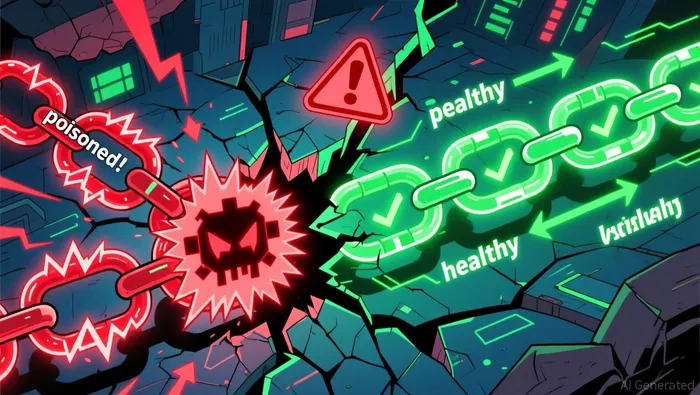 The resolution highlighted Cardano's emergency response protocols. Developers coordinated with stakeholders to release node updates (10.5.2 and 10.5.3) addressing the bug, enabling the healthy chain to overtake the poisoned one as nodes upgraded. A working group was established to reconcile data and ensure a smooth transition as part of the resolution strategy. Notably, most wallets remained unaffected because they rejected the malformed transaction, underscoring the importance of node versioning in mitigating such risks.
This incident, while technical in nature, exposed vulnerabilities in Cardano's infrastructure. The FBI's involvement in investigating the attack, coupled with founder Charles Hoskinson's characterization of it as a potential cyberattack, underscores the need for institutional investors to assess not only protocol-level security but also the geopolitical and regulatory risks associated with adversarial actors.
Governance in PoS Networks: Decentralization vs. Centralization Risks
Cardano's governance model, built on its Proof-of-Stake (PoS) Ouroboros protocol, emphasizes energy efficiency and stakeholder participation. Stake pool operators (SPOs) play a pivotal role in maintaining network security and decentralization by enabling ADAADA-- holders to delegate stake without technical expertise according to platform documentation. However, the model is not without flaws.
A critical concern for institutional investors is the concentration of voting power. Despite Cardano's transition to a community-driven governance model-marked by the first onchain Constitutional Committee election in Q2 2025 as reported by Messari-Project Catalyst, the platform's decentralized funding mechanism, has faced criticism for systemic inequities. The top 1.5% of wallet holders control 56% of voting power, while the bottom 50% hold just 1% as documented in a detailed analysis. Decentralized exchanges like Minswap and WingRiders have further exacerbated concerns by using user-deposited ADA to manipulate proposal outcomes as noted in governance critiques.
Efforts to address these issues, such as quadratic voting in Fund 14, aim to reduce the influence of large stakeholders. Yet, the "1 ADA = 1 vote" mechanism inherently favors wealthier participants, challenging the principles of true decentralization. For institutional investors, this duality-between Cardano's innovative governance framework and its susceptibility to centralization-demands a nuanced risk assessment.
AI Vulnerabilities and Institutional Investor Concerns
Cardano's integration of AI-related infrastructure, such as Veridian (a decentralized identity platform) and CUDOS Intercloud (a cost-effective GPU access solution), positions it at the intersection of blockchain and AI innovation. However, these advancements introduce new vulnerabilities. For instance, the AI sector's recent volatility-exemplified by C3.ai's 27% stock decline and leadership changes as reported in financial news-highlights the risks of overvalued assets and operational instability.
Institutional investors must also consider how AI governance models, particularly in decentralized systems, address security and accountability. Cardano's Veridian and Originate initiatives aim to enhance traceability and identity management, but their efficacy in mitigating AI-specific risks remains untested at scale. The broader AI sector's struggles with profitability and governance, as seen in C3.ai's Microsoft partnership, suggest that institutional capital may flow cautiously into AI-integrated blockchain projects unless robust safeguards are demonstrated.
Macroeconomic Context: Fiscal Policy and Crypto Liquidity
The 2025 U.S. government shutdown serves as a cautionary tale for institutional investors. During this period, BitcoinBTC-- fell by over 10%, while altcoins like EthereumETH-- dropped more than 15% as analyzed by financial experts. This event reinforced crypto's high-beta nature and its sensitivity to fiscal uncertainty. For Cardano, a chain split occurring amid such macroeconomic turbulence could amplify investor anxiety, particularly if liquidity dries up or market sentiment turns bearish.
Institutional-grade assets increasingly prioritize stability and risk management during fiscal instability according to market analysis. Cardano's ability to align with these priorities-through governance reforms, infrastructure upgrades, and regulatory engagement-will determine its appeal to institutional capital. The Cardano Foundation's advocacy for innovation-friendly regulations as highlighted in Q2 2025 reports and its collaboration with entities like Input | Output as documented in state-of-the-market analysis signal a strategic focus on long-term viability.
Conclusion: Balancing Innovation and Risk
Cardano's resilience lies in its capacity to adapt to technical, governance, and macroeconomic challenges. The chain split incident demonstrated the network's ability to recover through coordinated upgrades and community collaboration. However, institutional investors must remain vigilant about centralization risks in governance and the nascent nature of AI integrations.
The broader macroeconomic environment, particularly U.S. fiscal policy, adds another layer of complexity. While Cardano's energy-efficient PoS model and governance innovations position it as a compelling long-term asset, its success will depend on addressing systemic vulnerabilities and aligning with institutional risk thresholds. For investors, the key takeaway is clear: Cardano's future hinges not just on technological progress but on its ability to navigate the intricate interplay of governance, security, and macroeconomic dynamics.






Comentarios
Aún no hay comentarios