
Assessing Argentina's Market Volatility: Can Javier Milei's Shifting Political Strategy Restore Investor Confidence?
Argentina's economy in 2025 is navigating a fragile equilibrium between growth and instability. While analysts project a 6.5% year-on-year expansion in Q2 2025—the third consecutive quarter of growth after a Q3 2024 downturn—structural challenges persist. High interest rates, rising financial costs, and sector-specific vulnerabilities continue to weigh on domestic consumption and industrial output [4]. Amid this backdrop, President Javier Milei's political recalibrations—driven by electoral setbacks and legislative pushback—have become a focal point for investors assessing Argentina's emerging market risk premiums.
Political Reforms and Economic Reforms: A Delicate Balance
Milei's administration has pursued a radical libertarian agenda, including sweeping austerity measures, the abolition of currency controls, and deep public spending cuts. These reforms have yielded tangible results: Argentina's fiscal deficit was eliminated for the first time in over a century, and inflation dropped to moderate levels, reducing the country's risk premium to 561 points in early 2025—the lowest since 2018 [1]. However, the political landscape has grown increasingly volatile. The Senate's overturning of Milei's veto on disability benefits and his coalition's crushing defeat in the Buenos Aires provincial election (losing 13 percentage points to the Peronist coalition) have introduced uncertainty about policy continuity [2].
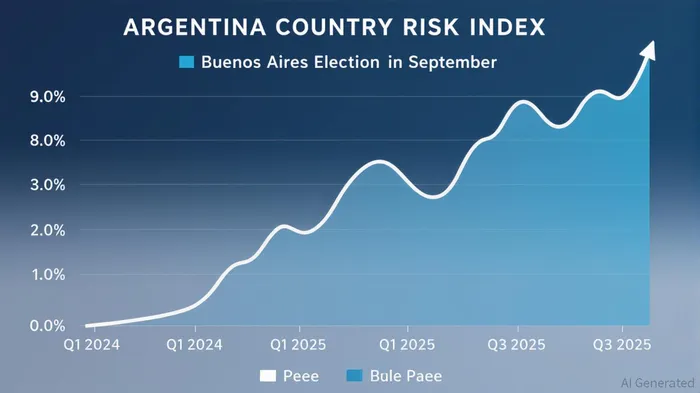
The Buenos Aires election, in particular, marked a turning point. The province, home to 40% of Argentina's population and a third of its GDP, delivered a clear rejection of Milei's austerity policies, which disproportionately affected pensioners and the disabled [6]. The peso depreciated 7%, and country risk indices spiked immediately after the results, signaling investor unease [2]. While Milei has vowed to maintain his economic agenda, analysts argue that his political survival now hinges on forming alliances with provincial leaders and recalibrating his approach to social spending [3].
Strategic Recalibrations and Market Reactions
Milei's response to these challenges has been twofold: 1) Strengthening political alliances to secure legislative support, and 2) Introducing modest adjustments to social policies without abandoning core economic reforms. For instance, the government announced incremental increases in pensions and healthcare spending for 2026, a move aimed at placating public discontent while maintaining fiscal discipline [4]. These recalibrations have had mixed effects on investor confidence.
On one hand, the RIGI program—offering 30-year tax concessions for large-scale investments in energy, infrastructure, and technology—has attracted foreign capital, particularly from the U.S. and EU [1]. On the other, the overvalued peso and deep public sector cuts have exacerbated poverty (now over 50%) and sparked social unrest [5]. The administration's reliance on IMF support for a third program further complicates its credibility, as negotiations remain contingent on political stability [3].
Emerging Market Risk Premiums: A Test of Resilience
Argentina's emerging market risk premiums, which had fallen to 563 points in early 2025 [3], have since fluctuated in response to Milei's political maneuvers. The Buenos Aires election caused a sharp spike in risk premiums, but subsequent policy adjustments and IMF negotiations have stabilized the trajectory. However, the October 2025 mid-term elections remain a critical test. A strong performance by La Libertad Avanza (LLA) could reinforce investor confidence, while further losses may trigger a re-rating of Argentina's risk profile.
The key question for investors is whether Milei can balance his libertarian economic vision with the political realities of a fractured electorate. His ability to form alliances, address social grievances, and maintain fiscal discipline will determine Argentina's path toward long-term stability.
Conclusion
Javier Milei's political recalibrations reflect a strategic attempt to reconcile economic reform with political survival. While his austerity measures have improved Argentina's macroeconomic fundamentals, the recent electoral setbacks underscore the fragility of his agenda. Investors must weigh the short-term gains in risk premiums against the long-term risks of political instability and social unrest. For now, Milei's ability to navigate these challenges will remain a defining factor in Argentina's market volatility.







Comentarios
Aún no hay comentarios