
Assessing the AI Sector's Resilience Amid Oracle's Earnings Woes and the Fed's Rate-Cutting Path
The artificial intelligence (AI) sector, once a paragon of growth optimism, now faces a pivotal test as Oracle's mixed earnings reports and the Federal Reserve's rate-cutting trajectory collide with broader market skepticism. Investors are recalibrating their strategies, balancing the allure of AI-driven innovation with concerns over valuation sustainability and macroeconomic risks. This analysis examines the sector's resilience through the lens of strategic sector rotation and risk-adjusted returns, drawing on Oracle's recent financial performance and the Fed's evolving policy stance.
Oracle's AI and Cloud Momentum: A Double-Edged Sword
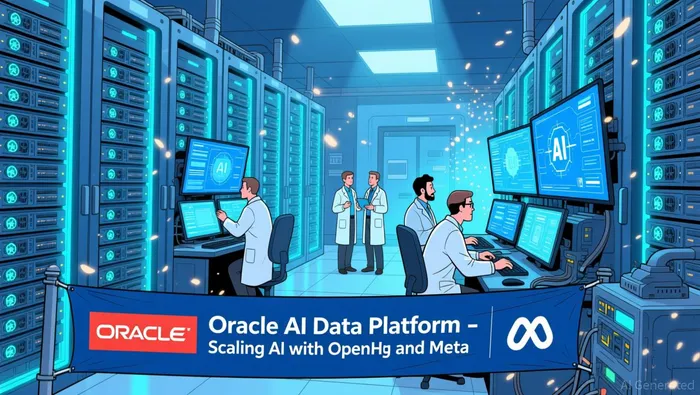
Oracle's fiscal 2025 results underscored its aggressive push into AI and cloud infrastructure. Cloud infrastructure revenue surged 49% year-over-year to $2.7 billion in Q3 2025, driven by surging demand for AI training and inferencing. Total cloud revenue hit $6.2 billion, with GPU consumption for AI training rising 244% in the past year. These figures reflect Oracle's strategic pivot to AI, including the launch of the OracleORCL-- AI Data Platform, which integrates models like OpenAI's ChatGPT and Meta's Llama.
However, Oracle's financial health is under scrutiny. Capital expenditures for FY 2025 reached $21.2 billion, with plans to double data center capacity in 2025. This aggressive expansion has pushed Oracle's debt load to $104 billion, with analysts warning of low-margin risks in its AI infrastructure strategy. A $300 billion OpenAI data-center contract, while lucrative, has raised concerns about customer concentration. Despite these challenges, Oracle's remaining performance obligations hit $138 billion in Q4 2025, signaling long-term revenue visibility.
The Fed's Rate-Cutting Path: Tailwinds and Turbulence
The Federal Reserve's 2025 rate-cut projections have created a mixed environment for the AI sector. Easing monetary policy has historically supported risk assets, with AI-driven productivity gains seen as a structural tailwind for corporate earnings. For instance, the Fed's September 2025 rate cuts coincided with a global equity rally, as AI innovation and lower borrowing costs fueled optimism.
Yet, the sector's resilience is being tested. In November 2025, the Nasdaq 100 lagged the S&P 500 (excluding tech) by nearly 4 percentage points, reflecting investor fatigue over speculative valuations. The AI sector's volatility-exacerbated by delayed economic data and Fed uncertainty-has prompted a rotation toward value stocks and sectors like Financials and Industrials. This shift mirrors historical patterns during rate-cut cycles, where growth stocks face heightened scrutiny as investors demand clearer monetization pathways.
Strategic Sector Rotation: From Hype to Pragmatism
The AI sector's underperformance in late 2025 highlights a broader trend: investors are moving from speculative bets to pragmatic allocations. Oracle's Q4 2025 results, which showed cloud infrastructure growth of 52% year-on-year but revenue falling short of estimates, exemplify this shift. Analysts now emphasize the need for tangible productivity gains over infrastructure spending, a theme echoed in sector rotation strategies.
This recalibration is evident in market behavior. Large-cap value stocks rose 2.7% in November 2025, while large-cap growth stocks declined 1.8%. The S&P 500's 30% AI exposure has made it particularly sensitive to sentiment shifts, with investors favoring equal-weight indices and sectors demonstrating clearer earnings visibility. Oracle's focus on embedded AI agents in SaaS products and healthcare verticals may yet attract long-term capital, but short-term volatility persists.
Risk-Adjusted Returns: A Mixed Picture
Historical data on the AI/tech sector's risk-adjusted returns during Fed rate-cut cycles reveals a complex landscape. While the sector has historically benefited from lower borrowing costs-such as the 2025 AI-driven GDP growth boost-volatility remains a key concern. In November 2025, the VIX volatility index spiked as Fed rate-cut expectations fluctuated, with market-implied odds of a December cut dropping to 40% before rebounding to 80%. Sharpe ratios for the AI/tech sector during 2015–2025 remain unquantified in available sources, but the sector's performance suggests a trade-off between growth potential and risk. Oracle's FY 2025 CapEx plan, while ambitious, raises questions about leverage sustainability. Analysts like Gil Luria of D.A. Davidson have labeled Oracle's AI strategy a "bad business with very low margins," underscoring the sector's uneven risk profile.
Conclusion: Navigating the AI Investment Cycle
The AI sector's resilience hinges on its ability to deliver tangible economic value amid macroeconomic headwinds. Oracle's earnings woes highlight the challenges of balancing aggressive AI infrastructure spending with financial prudence, while the Fed's rate-cutting path offers both opportunities and risks. Investors must weigh the sector's long-term growth potential against near-term volatility, favoring companies with clear monetization strategies and diversified revenue streams.
As the AI investment cycle matures, strategic sector rotation will likely continue, with capital shifting toward sectors demonstrating robust risk-adjusted returns. For Oracle and its peers, the path forward requires not just technological innovation but also disciplined capital allocation-a test of resilience that will define the sector's trajectory in the coming years.





Comentarios
Aún no hay comentarios