
Assessing Agricultural Commodity Risks in South Asia: A Case Study of Pakistan's Rice Sector
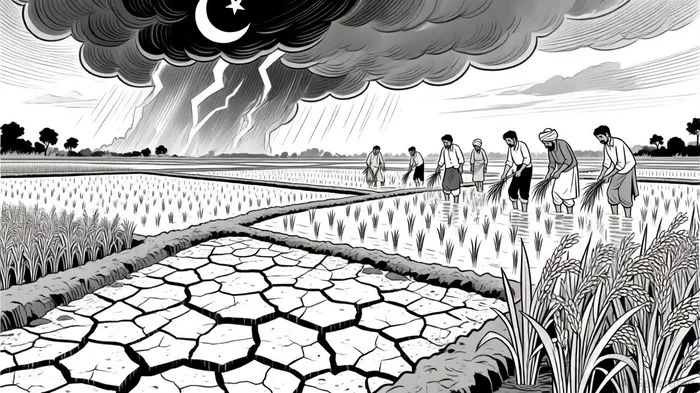
The global agricultural commodity market is increasingly shaped by the interplay of geopolitical shifts and climate volatility. Nowhere is this more evident than in South Asia, where Pakistan's rice sector has emerged as both a strategic asset and a high-risk investment. As the fourth-largest rice exporter in the world, Pakistan's rice industry contributes nearly 10% to its total exports[1], yet it faces mounting challenges from India's market re-entry, climate-induced production shocks, and evolving investor expectations. For global investors, understanding these dynamics is critical to navigating the region's agricultural landscape.
Geopolitical Risks: Market Competition and Strategic Vulnerabilities
Pakistan's rice exports surged to $3.89 billion in FY2023-24, driven by India's temporary ban on non-Basmati rice exports[1]. This created a vacuum that Pakistan swiftly filled, expanding its market share in Southeast Asia, the Middle East, and Africa. However, India's re-entry in late 2024 has reintroduced fierce competition. With India exporting 20.5–22 million metric tons annually—40% of global exports—Pakistan's non-Basmati rice now faces price pressures, particularly in traditional markets like Indonesia and Malaysia[2].
Geopolitical tensions further complicate the outlook. Pakistan's reliance on energy imports and its strategic location at the crossroads of South and Central Asia expose it to global economic instability. The World Economic Forum's Global Risks Report 2025 highlights Pakistan's vulnerability to political instability and economic shocks, which could disrupt trade flows and investor confidence[4]. Additionally, logistical bottlenecks, such as port congestion in Karachi, add operational risks for exporters[2].
Climate-Driven Risks: Production Shocks and Adaptation Gaps
Climate change poses an existential threat to Pakistan's rice sector. In 2024-25, flash floods damaged 60% of Punjab's rice crops, reducing production by 1.4%[4]. Rising temperatures and erratic rainfall patterns are eroding yields, with heat stress during flowering stages threatening spikelet fertility[2]. These challenges are compounded by water scarcity in Punjab and Sindh, where rice cultivation depends on irrigation[5].
While adaptation strategies like heat-tolerant rice varieties (e.g., Honglian hybrids) and drip irrigation have shown promise, adoption remains uneven. A 2025 study notes that only 30% of smallholder farmers have access to climate-resilient seeds, and financial constraints limit the uptake of water-saving technologies[5]. Without scaled investment in agritech and infrastructure, Pakistan risks losing its competitive edge in quality-driven markets like the EU, where demand for premium Basmati rice has grown by 15% in 2024-25[2].
Investor Responses: ESG Integration and Risk Mitigation
Global investors are recalibrating their strategies to address these risks. Environmental, Social, and Governance (ESG) criteria are now central to investment decisions, with agritech firms like Concave AGRI leveraging precision farming to enhance yield predictability and quality control[3]. Additionally, weather-indexed insurance schemes and government subsidies for climate-resilient seeds are being promoted to stabilize farmer incomes[5].
However, gaps persist. A 2025 report by the U.S. Department of State underscores the need for stronger legal protections and consistent policy frameworks to attract foreign capital[6]. Investors are also wary of Pakistan's exposure to climate-related disasters, which could trigger supply chain disruptions and devalue long-term assets.
Conclusion: Balancing Opportunities and Exposure
Pakistan's rice sector remains a compelling but precarious investment. While its premium Basmati rice and strategic market diversification efforts offer growth potential, the confluence of geopolitical competition and climate risks demands rigorous risk assessment. Investors must prioritize partnerships with agritech innovators, advocate for policy reforms to enhance climate resilience, and diversify supply chains to mitigate exposure. For now, Pakistan's rice industry stands at a crossroads—its ability to adapt will determine whether it thrives as a global agricultural leader or succumbs to the pressures of an increasingly volatile world.







Comentarios
Aún no hay comentarios