
Assessing the Accuracy of 2025 XRP Price Predictions: Lessons for 2026 and Beyond
The cryptocurrency market's penchant for volatility has long made price predictions a double-edged sword-offering both guidance and caution. As 2025 drew to a close, the XRPXRP-- price forecast landscape revealed a stark divide between optimismOP-- and reality. Analysts, institutions, and AI models had projected a bullish trajectory for XRP, citing regulatory clarity, institutional adoption, and technical indicators. Yet, by early January 2026, XRP's price had settled at $2.13, far below many of the year's most ambitious targets. This article critically evaluates the accuracy of 2025 XRP price predictions, dissects the factors that derailed them, and outlines actionable insights for investors navigating the 2026 market.
The 2025 Predictions: A Mix of Optimism and Caution
The year 2025 began with a wave of optimism for XRP, driven by the U.S. Securities and Exchange Commission's (SEC) settlement with Ripple Labs in late 2024. This resolution removed a critical legal overhang, enabling secondary market trades of XRP and spurring institutional interest in spot ETFs. Analysts at Standard Chartered and others projected a moderate range of $3.40–$5.50, citing growing adoption in cross-border payments and tokenization trends. Technical analysts added fuel to the fire, identifying Fibonacci extension levels and flag pattern breakouts as catalysts for a surge toward $6.19 or even $10–$26.50 under favorable conditions.
However, these forecasts were not universally bullish. AI models like ChatGPT and Anthropic's Claude offered more conservative ranges of $6–$8 and $8–$14, respectively, contingent on $10 billion in ETF inflows. Meanwhile, speculative voices-such as YoungHoon Kim's claim that XRP could hit $3 in 48 hours-were widely dismissed as unrealistic without a major market catalyst according to reports.
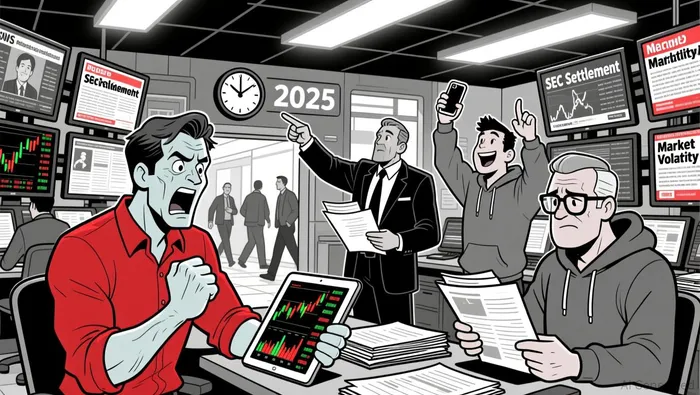
Why the Predictions Missed: A Post-Mortem
By December 2025, XRP's price had failed to meet even the most moderate expectations. A software engineer in the XRP community, Vincent Van Code, admitted his $30–$50 price range for 2025 was overly optimistic, attributing the shortfall to delayed legal processes and macroeconomic headwinds, including BitcoinBTC-- whale activity and low trading volumes. Similarly, Dustin Layton's $50 target for year-end 2025 proved unattainable, underscoring the risks of extrapolating short-term trends into long-term forecasts.
The disconnect between predictions and reality highlights several systemic issues. First, the SEC settlement, while significant, did not immediately translate into sustained institutional demand. Second, broader macroeconomic factors-such as interest rate uncertainty and a bearish altcoin market-weighed on XRP's performance. Third, speculative narratives, like Kim's $3-in-48-hours claim, created short-term volatility without foundational support, leading to false breakouts and leveraged losses.
Lessons for 2026: Navigating a More Realistic Outlook
For 2026, investors must adopt a more nuanced approach to XRP. The key takeaway from 2025 is that regulatory clarity alone is insufficient to drive price appreciation; sustained adoption and macroeconomic stability are equally critical. AI models and analysts now suggest a stabilized price range of $2.50–$3.00, contingent on ETF inflows and Ripple's expansion of its On-Demand Liquidity (ODL) product. However, significant upside beyond $5 will require broader institutional adoption and a shift in market sentiment toward altcoins.
Investors should also remain skeptical of short-term predictions, particularly those lacking empirical support. The 2025 experience demonstrates that even high-IQ figures or AI models can misjudge market dynamics when they overlook structural risks. For instance, ChatGPT's warning against acting on speculative forecasts-such as the likelihood of false breakouts-proves prescient in hindsight.
Conclusion: Balancing Caution and Opportunity
The 2025 XRP price predictions serve as a cautionary tale for investors. While regulatory progress and technical indicators can create favorable conditions, they are not guarantees of price performance. For 2026, a balanced strategy that prioritizes long-term fundamentals-such as Ripple's ecosystem growth and ETF demand-over short-term speculation will likely yield better outcomes. As the market matures, investors must also recognize the limitations of predictive models and the importance of diversification in mitigating risk.







Comentarios
Aún no hay comentarios