
Assessing AbbVie's Dividend Sustainability Amidst Earnings Volatility
For income investors navigating a high-interest-rate environment, dividend sustainability is paramount. AbbVie Inc.ABBV-- (ABBV), a global healthcare giant, offers a compelling case study. Despite earnings volatility and a seemingly unsustainable payout ratio, the company’s robust free cash flow and strategic reinvestment suggest its 3.1% yield remains relatively secure for now.
A Legacy of Dividend Growth
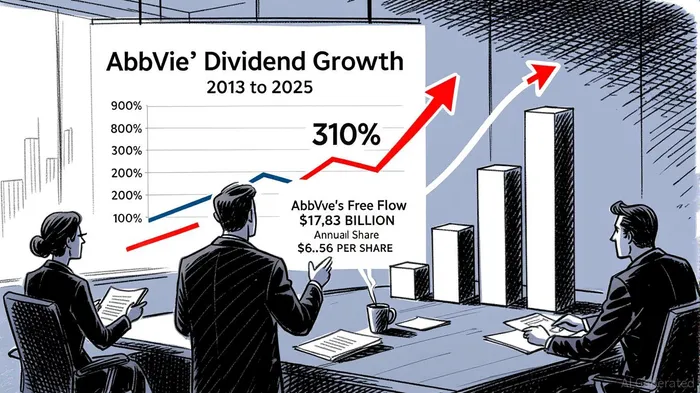
AbbVie has increased its dividend for 11 consecutive years, with a cumulative growth of 310% since 2013 [1]. Its current annual dividend of $6.56 per share, paid quarterly, yields 3.09%—a figure that outpaces 78% of its sector peers [1]. This consistency reflects the company’s commitment to shareholder returns, even as it navigates the decline of legacy products like Humira and the costs of innovation.
Earnings Volatility and Payout Ratios
AbbVie’s second-quarter 2025 results highlight the tension between growth and sustainability. While worldwide net revenues rose 6.6% to $15.423 billion, GAAP earnings per share (EPS) fell 32.5% year-over-year to $0.52 due to one-time charges related to acquired intangible assets [2]. Adjusted EPS, however, grew 12.1% to $2.97, driven by strong performance in its immunology and neuroscience portfolios [2].
The company’s earnings payout ratio—a metric that compares dividends to net income—is alarmingly high at 303.81% [2]. This means AbbVieABBV-- is paying out more in dividends than it earns in earnings, a red flag for some investors. Yet this metric obscures a critical detail: AbbVie’s free cash flow (FCF). In 2024, the firm generated $17.83 billion in FCF, and analysts project $20 billion for 2025 [1][3]. Using this metric, the FCF payout ratio (dividends divided by FCF) is approximately 46.9%, a far more sustainable figure [1].
Strategic Reinvestment and Liquidity
AbbVie’s ability to sustain its dividend hinges on its capacity to generate FCF and allocate capital wisely. The company’s growth engines—Skyrizi and Rinvoq—posted 62.2% and 41.8% revenue increases in Q2 2025, respectively [2], offsetting the 58.1% decline in Humira sales. Meanwhile, neuroscience and oncology segments showed resilience, with Botox Therapeutic and Venclexta contributing to revenue growth [2].
The firm’s liquidity is further bolstered by its $20 billion FCF projection for 2025 [3], which provides a buffer against near-term earnings volatility. AbbVie has also raised its 2025 adjusted EPS guidance to $11.88–$12.08, reflecting confidence in its pipeline and cost management [2].
Risks and Considerations
While AbbVie’s FCF supports its dividend, risks persist. The high earnings payout ratio (303.81%) indicates reliance on cash reserves and debt to fund payouts [2]. Additionally, the company’s aggressive M&A strategy—such as its $63 billion acquisition of Allergan in 2020—has increased leverage, with debt-to-EBITDA ratios rising to 3.5x [3]. Future growth will depend on the success of emerging therapies and the ability to integrate acquisitions without overextending balance sheets.
Conclusion: A High-Yield Bet with Caveats
For income investors, AbbVie presents a paradox: a high yield supported by strong FCF but shadowed by earnings volatility and leverage. The 3.1% yield is attractive in a high-rate environment, particularly for those prioritizing long-term income over immediate safety. However, investors should monitor the company’s FCF trends and debt levels. If AbbVie can maintain its FCF growth and execute its R&D and M&A strategies effectively, its dividend remains a viable option for diversified portfolios.
Source:
[1] AbbVie Inc. (ABBV) Dividend Date & History,
https://www.koyfin.com/company/abbv/dividends/
[2] AbbVie Reports Second-Quarter 2025 Financial Results,
https://investors.abbvie.com/news-releases/news-release-details/abbvie-reports-second-quarter-2025-financial-results
[3] AbbVie Inc. Q2 2025 Analysis: Skyrizi & Rinvoq Drive Growth,
https://monexa.ai/blog/abbvie-inc-q2-2025-analysis-skyrizi-rinvoq-drive-g-ABBV-2025-07-28





Comentarios
Aún no hay comentarios