
Assessing Abbott Laboratories' Earnings Performance and Revenue Disappointment: What Investors Should Do Now
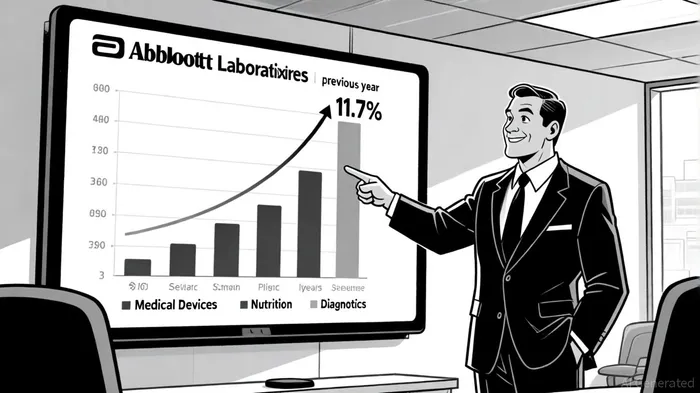
Abbott Laboratories' Q3 2025 earnings report, released on October 15, 2025, presented a mixed bag of results for investors. While the company exceeded revenue and EPS expectations, its performance was tempered by a sharp decline in Diagnostics sales and a modest beat on the top line. This analysis evaluates the strategic implications of these results, offering guidance for investors navigating the healthcare sector's evolving dynamics.
Revenue and EPS: A Tale of Two Segments
Abbott reported Q3 2025 revenue of $10.64 billion, surpassing the consensus estimate of $10.55 billion and reflecting a 4.9% year-over-year increase, according to a Yahoo Finance preview. Adjusted diluted EPS came in at $1.21, outperforming the $1.20 analyst estimate. However, the underlying performance was uneven.
The Medical Devices segment was a standout, generating $4.74 billion in sales-a 11.7% year-over-year growth driven by double-digit gains in Diabetes Care, Electrophysiology, and Structural Heart products, as noted in the Yahoo Finance preview. This segment's strength underscores Abbott's strategic pivot toward high-growth medical technologies, including its $2.0 billion in continuous glucose monitor sales reported in the same preview.
Conversely, the Diagnostics segment faced headwinds, with sales declining 6.6% to $55 million, primarily due to a 46% drop in pandemic-related testing revenue. Excluding this drag, Diagnostics sales grew 3.3% organically, indicating resilience in non-COVID-19 diagnostics. This duality highlights the challenges of relying on short-term demand spikes in a sector increasingly focused on chronic care and innovation.
Guidance and Analyst Sentiment: Optimism Amid Caution
Abbott reaffirmed its full-year 2025 guidance, projecting 7.5% to 8.0% organic sales growth excluding pandemic-related sales, according to the company guidance release. This optimism is supported by 18.1% operating margins and 23.0% adjusted margins, reflecting improved operational efficiencies reported in the release.
Analyst ratings post-earnings reflect a cautiously bullish outlook. Citigroup's Joanne Wuensch upgraded the stock to Buy with a $155 price target, while Jefferies' Matthew Taylor echoed this sentiment with a $145 target, as noted in a Benzinga analyst note. However, Mizuho's Anthony Petrone maintained a Neutral rating at $135, emphasizing the need for sustained momentum in Diagnostics. The average price target across analysts now stands at $143.12, a 8.9% premium to the current stock price of $131.40.
Strategic Implications for Investors
Segment Diversification as a Strength: Abbott's diversified portfolio-spanning medical devices, nutrition, and diagnostics-acts as a buffer against sector-specific downturns. The Medical Devices segment's robust growth, particularly in diabetes care and cardiovascular products, positions the company to capitalize on aging demographics and rising chronic disease prevalence, a dynamic highlighted in the Yahoo Finance preview.
Innovation as a Long-Term Catalyst: Recent product approvals, such as the TriClip in Japan for tricuspid regurgitation and the Navitor transcatheter valve system, demonstrate Abbott's commitment to R&D-driven growth. These innovations could drive margin expansion and market share gains in high-margin medical devices.
Diagnostics as a Near-Term Risk: While the Diagnostics segment's decline is a near-term drag, the organic growth of 3.3% suggests underlying demand for non-pandemic diagnostics. Investors should monitor Abbott's ability to pivot toward emerging technologies, such as point-of-care testing and AI-driven diagnostics, to mitigate this risk.
Dividend and Share Buybacks: Abbott's $0.59 per share quarterly dividend and consistent buyback program offer income-focused investors a compelling value proposition, particularly in a low-yield environment.
What Investors Should Do Now
Given the mixed results, investors should adopt a strategic, long-term perspective. The Medical Devices segment's momentum and the company's strong balance sheet (with 114,000 employees and operations in 160 countries, according to the MarketBeat earnings report) justify a bullish stance. However, the Diagnostics segment's vulnerability to macroeconomic shifts and regulatory changes warrants caution.
Actionable steps:
- Buy for growth: Investors aligned with the healthcare sector's shift toward chronic care and medical devices should consider adding AbbottABT-- to their portfolios, leveraging the current price discount relative to analyst targets.
- Monitor Diagnostics recovery: Closely track Q4 2025 results for signs of stabilization in Diagnostics, particularly in non-pandemic testing and partnerships with emerging markets.
- Diversify exposure: Pair Abbott with complementary healthcare stocks (e.g., Medtronic, Johnson & Johnson) to hedge against sector-specific risks.
---





Comentarios
Aún no hay comentarios