
ASML: The Unstoppable Engine of the AI S-Curve
For the AI paradigm to scale, it needs a fundamental rail. That rail is built by a single company: ASMLASML--. The Dutch manufacturer is the essential, bottlenecked infrastructure layer for the entire semiconductor industry's scaling, and its extreme ultraviolet (EUV) lithography machines are the single point of control for producing the most advanced chips. In the race to build the AI infrastructure, ASML is the indispensable bottleneck.
The company holds a monopoly on the technology. ASML is the only company in the world capable of making extreme ultraviolet (EUV) lithography machines, which are essential for manufacturing the advanced chip designs powering AI. This isn't a competitive advantage; it's a monopoly on a non-replaceable process. The technology itself operates at a scale that defies imagination, using light with a wavelength of just 13.5 nm-a range approaching x-rays. This precision is what drives Moore's Law forward, enabling chipmakers to pack billions of transistors into ever-smaller, more powerful, and more energy-efficient designs.
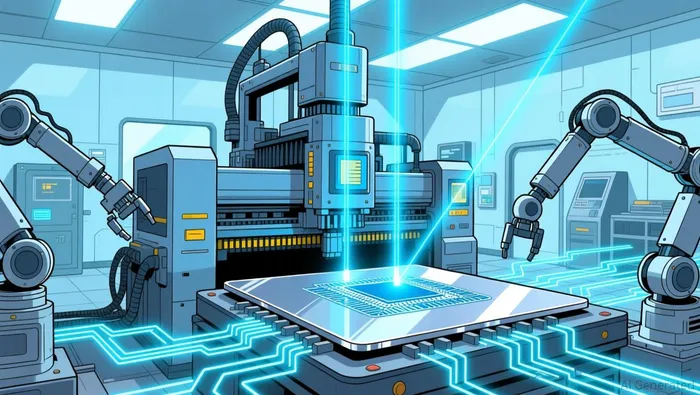
The next generation of this infrastructure is already in motion. ASML's EXE systems, based on High NA (numerical aperture) technology, are designed to support high-volume chip manufacturing for sub-2 nm logic and leading-edge memory nodes. These systems will enable geometric scaling into the next decade, directly supporting the next wave of AI chip development. The company's investment in this technology was monumental, with over €6 billion spent on R&D over 17 years to industrialize what was once a scientific dream.
The bottom line is one of fundamental control. As AI chips demand ever-smaller features, the semiconductor industry has no alternative but to invest in ASML's machines. The company's position is not about being a supplier; it's about being the sole enabler of the scaling that makes the AI paradigm possible. For any investor looking at the exponential growth curve of AI, ASML represents the non-negotiable infrastructure layer that must be built first.
The Exponential Adoption Curve and Supply-Demand Dynamics
The story behind ASML's valuation is not about its latest quarterly report. It's about the multi-year capital expenditure cycle fueling the entire semiconductor industry and the structural supply constraints that make ASML the indispensable bottleneck. The company is not just a supplier; it is the infrastructure layer for the next paradigm shift in computing, and its financial profile reflects a powerful, cash-generating machine built on exponential adoption.
The demand engine is clear. The semiconductor industry is targeting sales of roughly $772 billion in 2025 and $975 billion in 2026, a growth trajectory that requires massive factory investment. Updated projections show semiconductor capex growth around 16.3% in 2025 and 11.7% in 2026. This isn't a minor uptick; it's a sustained, multi-year build-out. ASML's revenue has historically tracked this cycle directly, spiking when fabs accelerate and slowing when they digest capacity. The exception in 2023 was a one-off distortion from Chinese front-loading, but the underlying correlation remains intact. For ASML, this means its growth is leveraged to the capital-spending decisions of its core customers.
That concentration is a double-edged sword, but in this case, it's a source of pricing power. Three giants-TSMC, Samsung, and Intel-account for 60%–70% of ASML's revenue, with memory leaders like Micron and SK hynix driving another significant chunk. The combined capex trajectory of these key players is still robust, projected to grow at a high-teens rate into 2026. This creates a powerful, predictable demand stream for ASML's tools, which are often the only ones capable of producing the most advanced chips. The result is an exceptional financial profile: the company guides for a gross margin around 52% and a trailing free-cash-flow-to-revenue margin of about 27.7%. This isn't typical industrial equipment profitability; it's the margin of a company with a near-monopoly on a critical, non-substitutable input.
The bottom line is that ASML operates on an exponential curve. Its revenue growth is tied to the industry's capex cycle, which is itself driven by the insatiable demand for AI and high-performance computing. The high margins and cash flow are protected by the structural supply constraints of its technology and the concentration of demand among a few, capital-rich customers. For an investor, this setup means the stock's valuation is a bet on the continuation of that capex cycle and the company's ability to maintain its dominant position. The recent price action, trading near its highs, reflects this long-term compounding thesis, where every 10% revenue increase can add billions to free cash flow once the cycle stabilizes.
The Unassailable Competitive Moat
ASML's position in the global tech supply chain is not just dominant; it is a near-monopoly that is structurally unassailable. The company has built a technological fortress around the most advanced semiconductor manufacturing process, extreme ultraviolet (EUV) lithography. Its dominance is absolute: ASML holds a near-monopoly on the industry, with 90% market share and is the sole supplier and critical enabler for advanced semiconductors. For any chipmaker aiming to produce the most cutting-edge processors, ASML's machines are the only game in town. This isn't a fleeting advantage; it is the result of a 30-year, $9 billion R&D race that has created immense financial and technical barriers to entry.
The moat is engineered at every level. The core challenge of EUV is staggering: it requires a fundamental shift to light at 13.5 nanometers, which is absorbed by almost all materials. This forced ASML to solve unprecedented engineering problems, from creating a plasma source hotter than the sun to fabricating mirrors with surface precision measured in fractions of a nanometer. The company overcame these hurdles through a unique ecosystem of strategic partnerships. Its deep collaborations with suppliers like Carl Zeiss AG for optics and its own Cymer division for light sources were not just vendor relationships; they were essential alliances that integrated critical components into ASML's development. This collaborative model, backed by massive investment from customers like Intel and Samsung, created a self-reinforcing cycle of innovation and capital that competitors could not replicate.
The result is a complete lack of viable competition for the critical infrastructure layer. Major peers Nikon and Canon have effectively given up on EUV due to its extreme difficulty and cost, focusing instead on older, less advanced lithography technologies. This leaves ASML with no real rival for the machines needed to produce the most advanced chips. The company's sole dominance in EUV lithography is not accidental; it is the direct outcome of early vision, sustained commitment, and the creation of a unique, insurmountable ecosystem. For the foreseeable future, ASML is the indispensable pick-and-shovel provider for the entire silicon gold rush, a position that translates directly into pricing power and a resilient, high-margin business model.
Valuation, Catalysts, and Key Risks
The investment case for ASML is a classic bet on a technological S-curve. The company, with a market cap of roughly $409 billion, trades at a forward P/E near 36x. This premium is not a valuation error; it is a price paid for a monopoly on the most advanced chipmaking tools. The justification lies in the multi-year capex cycle driving its industry. The semiconductor equipment market is expected to grow roughly 16% in 2025 and about 11% in 2026, a trajectory that ASML's revenue has historically tracked. The real story is the capital-spending decisions of giants like TSMC, Samsung, and Intel, whose combined capex is projected to grow at a high-teens rate into 2026. For ASML, every 10% revenue increase can realistically add $1.5–$2.0 billion of incremental free cash flow once capex stabilizes, creating a powerful compounding engine.
A major near-term catalyst is the potential inclusion in the S&P 500. While Vertiv is the more immediate candidate, ASML's size and dominance make it a perennial inclusion candidate. The "inclusion bounce" from index-tracking funds is a proven phenomenon, capable of driving significant demand and providing a tailwind for the stock. This event risk adds a layer of potential upside that is not fully reflected in the current valuation.
Yet, the primary risk is regulatory pressure, a direct headwind to its exponential growth thesis. China accounts for roughly 42% of ASML's total revenue, but export controls have already caused a ~23.6% year-on-year sales decline in that region. This is a material drag on growth, forcing the company to navigate a complex geopolitical landscape. The risk is not just about lost sales, but about the potential for further restrictions that could limit access to a massive market and slow the global chip supply chain expansion that underpins ASML's long-term demand.
Management's guidance frames this tension. The company has stated that 2026 net sales are not expected to fall below 2025 levels. This is a critical baseline of stability. It suggests that the AI-driven order momentum from other regions-where revenue is surging, like Taiwan up 175% year-on-year-is expected to more than offset the China headwind. The investment case, therefore, hinges on this pivot. If ASML can successfully redirect its growth engine and maintain that 2026 floor, its premium valuation could be justified by the sheer scale of the underlying capex cycle. If the regulatory and China risks prove more persistent, the exponential growth thesis faces a severe test.





Comentarios
Aún no hay comentarios