
ASML's Strategic Position Amid Easing China Dependency and Rising EUV Demand
ASML Holding NV, the Dutch semiconductor equipment giant, has long been a linchpin in the global chipmaking industry. Yet its fortunes have been inextricably tied to the geopolitical and economic dynamics of its largest market: China. Recent developments, however, suggest a strategic pivot that could bolster its long-term earnings resilience. While China's contribution to ASML's revenue has softened, the company's focus on advanced EUV lithography and AI-driven innovation is creating a more diversified and robust revenue stream.
Easing China Dependency: A Mixed Blessing
In Q3 2023, China accounted for 46% of ASML's revenue, a figure that, while impressive, underscored the company's vulnerability to regulatory shifts and U.S.-China trade tensions. By 2025, this share had declined to over 25%, reflecting a deliberate strategy to reduce exposure to a market increasingly constrained by geopolitical friction. This shift is not without challenges: Chinese chipmakers continue to invest in domestic capacity, but regulatory hurdles and U.S. export controls have dampened demand.
ASML's CEO, Christophe Fouquet, has acknowledged that Chinese sales will likely decline further in 2026, though the company remains confident that total sales will not fall below 2025 levels. This cautious optimism is rooted in the broader diversification of ASML's customer base, particularly in the U.S., Europe, and South Korea, where demand for advanced lithography remains robust. The reduction in China dependency, while partly a response to external pressures, also mitigates risks associated with a single market's volatility.
EUV Dominance: The Engine of Growth
The real story of ASML's resilience lies in its EUV (extreme ultraviolet) lithography systems, which are indispensable for manufacturing cutting-edge chips. In 2025, EUV revenue is projected to grow by 30% year-over-year, driven by increased shipments of Low Numerical Aperture (NA) systems and the early rollout of High NA models. This growth is fueled by demand from industry leaders like TSMC, Samsung, and Intel, which are expanding their advanced-node capacities to meet the surging needs of AI and high-performance computing.
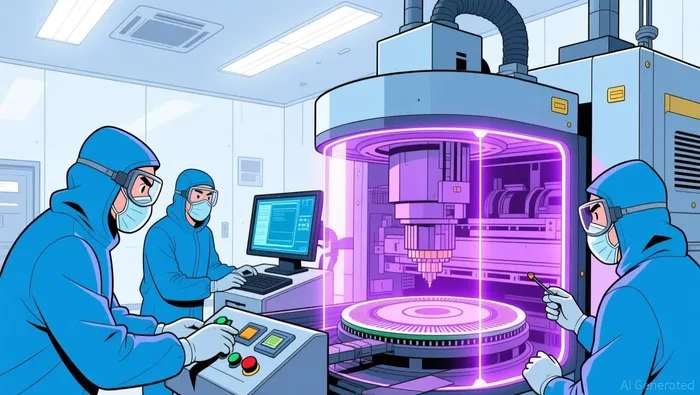
ASML's technological edge is further amplified by its NXE:3800E systems, which achieve a throughput of 220 wafers per hour-up from 120 in earlier models. This productivity leap allows customers to scale capacity without proportionally increasing capital expenditures, thereby improving margins for both ASMLASML-- and its clients. In Q3 2025, EUV systems accounted for €3.6 billion of ASML's €5.4 billion in net bookings, a testament to the segment's dominance.
Strategic Alliances and AI-Driven Innovation
ASML's partnership with French AI firm Mistral highlights its commitment to leveraging AI to enhance product efficiency. By integrating AI into its lithography processes, ASML aims to optimize throughput and reduce defects, further solidifying its competitive moat. This innovation is critical as the industry transitions to sub-2nm nodes, where EUV systems will be the sole viable technology.
ASML's financials reinforce this strategic direction. For FY2025, ASML reported Q2 net sales of €7.7 billion and a gross margin of 53.7%, outperforming expectations. Analysts like Goldman Sachs remain cautiously optimistic, maintaining a €935 price target despite near-term headwinds.
Conclusion: A Resilient Growth Story
ASML's strategic recalibration-reducing China dependency while accelerating EUV adoption-positions it as a resilient player in a fragmented semiconductor landscape. While regulatory uncertainties and cyclical downturns remain risks, the company's technological leadership and diversified customer base provide a strong foundation for sustained growth. For investors, ASML represents a compelling case of a business navigating geopolitical headwinds through innovation and adaptability.





Comentarios
Aún no hay comentarios