
ASML's Strategic Position in the AI-Driven Semiconductor Boom: Building Unassailable Competitive Moats
The semiconductor industry is undergoing a seismic shift driven by artificial intelligence (AI), quantum computing, and advanced chip architectures. At the heart of this transformation lies ASML HoldingASML-- NV, the Dutch multinational corporation that dominates the extreme ultraviolet (EUV) lithography market. With over 90% of the global EUV market share[1], ASML's technological leadership and supply chain dominance position it as a critical enabler of the AI-driven semiconductor boom. This analysis explores how ASML's unassailable competitive moats—rooted in proprietary technology, strategic partnerships, and financial resilience—are cementing its role as the linchpin of next-generation chipmaking.
Technological Leadership: The EUV Monopoly
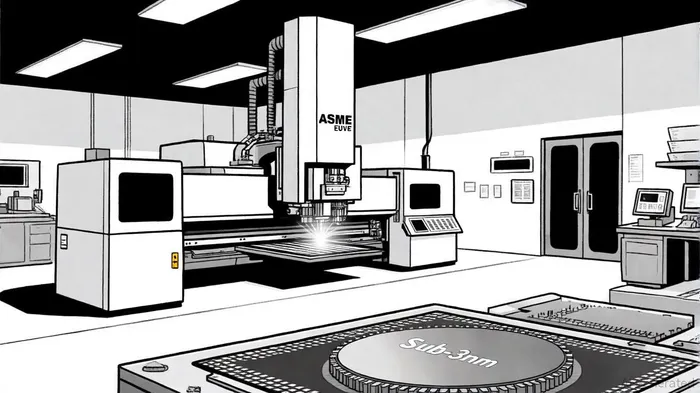
ASML's EUV lithography systems are the bedrock of advanced semiconductor manufacturing, enabling the production of chips with sub-3nm transistors[2]. These systems use a laser-driven plasma light source to generate EUV light at 13.5 nanometers, a wavelength critical for patterning the dense logic circuits required by AI accelerators and high-performance computing (HPC) chips[3]. The company's recent shipment of 0.55 numerical aperture (NA) EUV scanners to IntelINTC-- in late 2023 marked a milestone, increasing patterning density by 2.9× compared to older 0.33 NA tools[4]. This advancement not only accelerates Moore's Law but also strengthens ASML's pricing power in an industry where EUV machines cost between $220 million and $400 million per unit[5].
The EUV lithography market is projected to grow at a 11.8% compound annual rate (CAGR) from 2025 to 2034, reaching $12.6 billion in value[6]. ASML's monopoly in this space is underpinned by its R&D investments, which accounted for 18% of its 2024 revenue[7]. The company is already developing "Hyper NA" systems, which will further shrink transistor sizes and enable breakthroughs in quantum computing and AI[8].
Supply Chain Dominance: Controlling the AI Chip Value Chain
ASML's EUV machines are indispensable for manufacturing advanced AI chips. In 2024, 83% of the company's logic sales were tied to AI chip production[9], and it controls 100% of the output for chips used in large language models (LLMs) and neural networks[10]. This dominance is reinforced by the lack of viable alternatives: no competitor has developed a working EUV system, and traditional deep ultraviolet (DUV) lithography cannot meet the demands of sub-5nm nodes[11].
The company's supply chain resilience is another key moat. Despite U.S.-China trade tensions, ASMLASML-- has reduced its exposure to China to just 20% of revenue[12], mitigating risks from geopolitical disruptions. Meanwhile, its global manufacturing footprint—spanning the Netherlands, the U.S., and Singapore—ensures reliable delivery of EUV systems to customers like TSMCTSM--, Samsung, and Intel[13].
Strategic Partnerships: Future-Proofing the AI Ecosystem
ASML's recent collaborations underscore its proactive approach to securing long-term relevance. In March 2025, it partnered with imec, a leading research center, to advance silicon photonics, memory, and AI-driven packaging technologies[14]. This five-year agreement, backed by European funding, aligns with the EU's push for semiconductor sovereignty and sustainability.
Equally significant is ASML's $1.3 billion investment in Mistral AI, a frontier AI company, in September 2025. By integrating Mistral's models into its lithography systems, ASML aims to optimize performance and reduce time-to-market for customers. The partnership also grants ASML a seat on Mistral's Strategic Committee, ensuring alignment with AI's evolving demands.
Financial Resilience and Long-Term Outlook
ASML's financials reflect its market strength. In 2024, the company reported Q4 EUV bookings of €3.0 billion, and its 2025 revenue is projected to reach €30–35 billion. With a long-term target of €60 billion by 2030, ASML is leveraging AI-driven demand to scale its operations. Its robust cash flow—supported by high-margin EUV sales—enables continued R&D spending, further widening its technological lead.
Conclusion: A Cornerstone of the AI Era
ASML's strategic position in the semiconductor supply chain is unparalleled. Its EUV monopoly, coupled with strategic partnerships and financial resilience, creates a durable competitive moat that is difficult to replicate. As AI and HPC drive demand for increasingly complex chips, ASML's role as the sole provider of cutting-edge lithography tools will only grow. For investors, the company represents a high-conviction bet on the future of technology—a business where innovation and market power converge to deliver outsized returns.





Comentarios
Aún no hay comentarios