
ASML's Strategic Position in the 2026 Semiconductor Super Cycle
The semiconductor industry is entering a pivotal inflection point in 2026, driven by the confluence of artificial intelligence (AI) infrastructure expansion and the reallocation of manufacturing capacity toward high-margin memory solutions. At the center of this transformation is ASML Holding NVASML--, whose leadership in extreme ultraviolet (EUV) lithography and strategic investments in AI integration position it to capitalize on a nascent "memory super cycle." This analysis examines how ASML's technological dominance, financial strength, and partnerships with key players in the DRAM and AI ecosystems create a compelling long-term growth narrative.
The 2026 Semiconductor Landscape: AI and DRAM Dynamics
The DRAM market is projected to grow at a constrained pace in 2026, with supply expansion for traditional DRAM and NAND remaining below historical averages at 16% and 17% year-on-year, respectively. This is driven by a deliberate shift in manufacturing priorities toward high-bandwidth memory (HBM) and DDR5 modules, which are critical for AI servers and high-performance computing (HPC) applications. According to Gartner, DRAM will remain in undersupply until Q1 2026, with server DRAM prices rising 4.3% in Q4 2025 before a projected 14.3% decline by Q3 2026. Meanwhile, HBM prices are expected to climb through Q2 2026 as HBM4 shipments scale, reflecting the sector's pivot toward AI-specific memory solutions.
This reallocation of capacity is intensifying supply constraints across the broader semiconductor industry. Major manufacturers like Samsung Electronics and Micron Technology are prioritizing AI-related components over traditional memory used in consumer electronics, leading to price hikes and supply limitations in PC and smartphone markets. Foundries, particularly TSMC, are also under pressure to raise prices for sub-5nm offerings by 3% to 10% to offset rising R&D and production costs. These dynamics underscore a structural shift in demand, with AI infrastructure becoming the primary growth engine for the sector.
ASML's Strategic Positioning: EUV Lithography and AI Integration
ASML's dominance in EUV lithography is a cornerstone of its ability to navigate this evolving landscape. The company's High-NA EUV systems, which feature a numerical aperture (NA) of 0.55 and a resolution of 8 nm, are critical for manufacturing sub-2 nm logic chips and leading-edge DRAM nodes. These systems reduce process steps by over 40% on critical layers, improving yield and efficiency in high-volume manufacturing.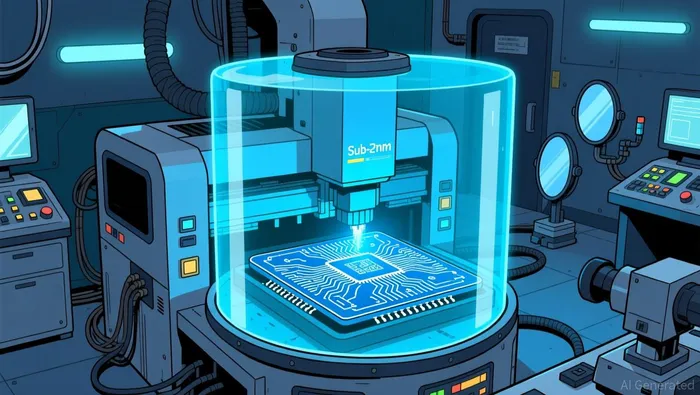 The first High-NA EUV system, the TWINSCAN EXE:5000, was delivered in late 2023 and is expected to enter mass production in 2025–2026. This technology is particularly vital for patterning advanced DRAM structures, meeting the high-density requirements of AI workloads.
ASML's strategic partnerships further solidify its position. The company has collaborated with SK Hynix and Intel to deploy High-NA EUV systems, with SK Hynix already installing its first EXE:5200 tool. Additionally, ASMLASML-- and imec established a joint High-NA EUV Lithography Lab to de-risk the technology and accelerate its adoption in high-volume manufacturing. These initiatives are supported by ASML's robust financials: in Q3 2025, the company reported €7.5 billion in total net sales, a 51.6% gross margin, and €2.1 billion in net income. Such financial strength enables sustained R&D investments, including a 30% year-on-year increase in EUV sales in 2025.
A key differentiator for ASML is its integration of AI into its product portfolio. The company's €1.3 billion investment in Mistral AI for an 11% stake aims to enhance system performance, precision, and speed through AI-driven optimization. This partnership reflects ASML's recognition of the growing importance of software and AI in next-generation lithography systems, potentially allowing it to capture additional value from improvements in customer yield and time-to-market. Analysts have raised price targets for ASML to €1,065.77, citing confidence in its ability to meet the surging demand for AI and DRAM-related manufacturing.
Long-Term Growth Drivers: AI and DRAM Super Cycle
The convergence of AI adoption and DRAM demand is creating a "super cycle" for the semiconductor industry. ASML's CEO has highlighted that customer demand in both leading-edge logic and advanced DRAM is growing, driven by the lithography intensity of AI workloads. High-NA EUV systems are expected to reduce defects, lower costs, and shorten cycle times for chipmakers, making them indispensable for the next phase of Moore's Law.
Moreover, ASML's R&D investments are aligned with this trajectory. In Q1 2025, the company spent €1.2 billion on R&D, underscoring its commitment to maintaining leadership in EUV lithography. The transition to High-NA EUV is not merely a technical upgrade but a strategic enabler for the industry's shift toward AI-driven memory solutions. As IDC notes, the global memory shortage crisis is already impacting smartphone and PC markets, with manufacturers facing supply limitations. ASML's ability to scale its advanced lithography systems will be critical in addressing these bottlenecks while capturing value from the high-margin AI and DRAM segments.
Conclusion: A Compelling Investment Thesis
ASML's strategic positioning in the 2026 semiconductor super cycle is underpinned by its technological leadership, financial resilience, and forward-looking partnerships. The company is uniquely positioned to benefit from the reallocation of manufacturing capacity toward AI and DRAM, with High-NA EUV systems serving as a key enabler for the industry's next phase of innovation. As AI infrastructure expands and memory demand intensifies, ASML's ability to deliver cutting-edge lithography solutions and integrate AI into its workflows will drive long-term value creation. For investors, this represents a rare opportunity to participate in a structural shift within the semiconductor industry, where ASML's dominance is both a catalyst and a beneficiary of the AI-driven super cycle.





Comentarios
Aún no hay comentarios