
ASML's Resilience Amid Geopolitical Tensions: A Strategic Buy Opportunity?
Geopolitical Headwinds and Revenue Realities
ASML's exposure to U.S.- and Dutch-led export controls has intensified in 2025, with restrictions now extending to deep ultraviolet (DUV) immersion tools, further limiting its access to Chinese foundries. China's contribution to ASML's revenue has halved, dropping from 24% in 2024 to 12% in Q3 2025. This decline underscores the fragility of relying on a single market amid escalating trade tensions. However, ASML's pivot to EUV systems-critical for advanced chip nodes-has cushioned some of the blow. Management projects a 15% revenue growth in 2025, driven by EUV shipments, though delays in qualification and installation timelines may defer benefits into 2026.
Strategic Adaptations: Supply Chain Resilience and Dual Sourcing
To mitigate supply chain risks, ASMLASML-- has adopted a dual-sourcing strategy for critical components, particularly rare earth elements, and expanded upstream visibility. These measures align with broader industry trends toward strategic flexibility, as highlighted in a Morgan Stanley analysis. The company has also diversified its manufacturing footprint, investing €5.3 billion in 2025 to scale EUV production in the Netherlands and Germany, with capital expenditures expected to remain above €5 billion annually through 2027. While these investments bolster long-term resilience, they come at the cost of eroding gross and operating margins due to rising logistics expenses.
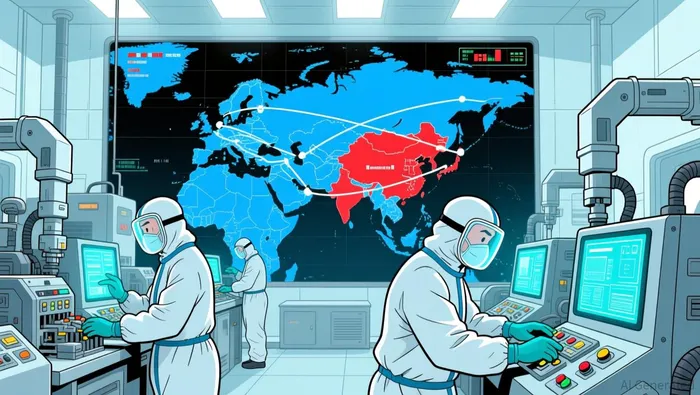
Comparative Strengths and Technological Moats
ASML's near-monopoly on EUV lithography positions it uniquely compared to industry peers. Unlike Chinese competitors constrained by access to advanced tools, ASML's technological leadership-exemplified by its High-NA EUV systems-ensures its indispensability for cutting-edge chip production. A Wedbush report notes that ASML's strategic partnerships, such as its investment in Mistral AI, further solidify its role in the AI-driven semiconductor ecosystem. In contrast, firms like Huawei face existential challenges due to restricted access to leading-edge manufacturing equipment.
Investment Considerations: Balancing Risks and Rewards
While ASML's long-term growth is underpinned by AI-driven demand and its technological edge, near-term risks persist. U.S. lawmakers' scrutiny of ASML's China dealings has contributed to stock volatility, and margin pressures from high capital intensity could dampen investor sentiment. Analysts remain divided: some caution against overvaluation amid cyclical market normalization, while others highlight ASML's ability to navigate geopolitical turbulence through innovation.
Conclusion: A Calculated Bet
ASML's resilience in 2025 hinges on its capacity to balance geopolitical constraints with strategic agility. While the company's revenue growth may lag peers in the short term, its dominance in EUV lithography and proactive supply chain adaptations position it to outperform in a post-cyclical environment. For investors, the question is not whether ASML is a "buy," but whether its long-term moat justifies the current valuation amid evolving risks.





Comentarios
Aún no hay comentarios