
ASML's Q3 2025 Earnings: A Glimpse into AI's Power and China's Shadow
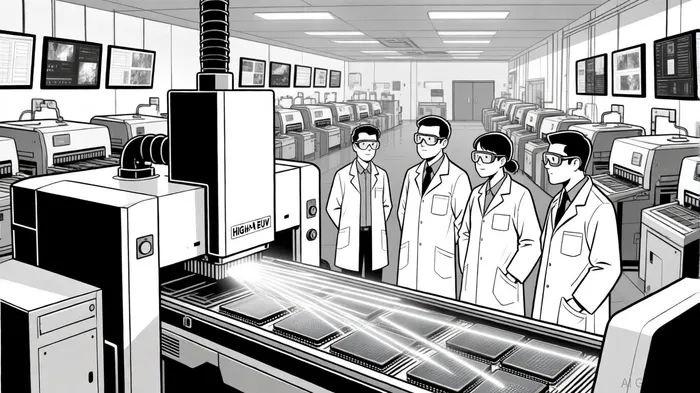
ASML's Q3 2025 earnings report, released on October 15, 2025, underscores the company's dominance in the AI-driven semiconductor revolution while highlighting the fragility of its China exposure. With net sales of €7.5 billion and a gross margin of 51.6%, the Dutch chipmaker capitalized on surging demand for extreme ultraviolet (EUV) lithography systems, which accounted for €3.6 billion of its €5.4 billion in bookings for the quarter, according to ASML's Q3 financial results. This performance reflects the accelerating global shift toward AI infrastructure, where ASML's EUV systems are indispensable for producing the advanced chips powering generative AI and high-performance computing.
AI as the New Growth Engine
The AI semiconductor market is now a cornerstone of ASML's strategy. According to a Visible Alpha analysis, EUV sales are projected to rise by 41% in 2025 to €11.1 billion, driven by demand for chips in data centers and edge computing. ASML's partnership with Mistral AI to integrate machine learning into its systems further cements its role in this transformation, aiming to optimize yield and performance for customers like Intel and TSMC, the company said in its Q3 financial results. The company's R&D investments-€1.1 billion in Q3 alone-underscore its commitment to maintaining a technological edge, particularly in High-NA EUV lithography, where cumulative R&D costs have already exceeded $10 billion, according to a PredictStreet article.
However, the AI boom is not without its caveats. While ASML's installed base management revenue grew 27% year-over-year to €2.0 billion in Q3, reflecting strong recurring revenue from existing systems, the company faces a critical challenge: geopolitical fragmentation.
China's Decline and the Geopolitical Tightrope
ASML's 2026 outlook is clouded by the anticipated collapse of China demand. The company warned that export controls and U.S.-China tensions will likely slash sales to Chinese customers by a "significant margin" compared to the robust 2024-2025 period, according to a CNBC report. This follows broader industry trends: Deloitte notes that geopolitical risks are reshaping semiconductor supply chains, with companies like Intel and TSMC adopting reshoring strategies to mitigate disruptions.
Yet ASMLASML-- is not standing idle. The company is diversifying its product portfolio, including the launch of the TWINSCAN XT:260 for advanced packaging-a move to reduce reliance on front-end lithography and tap into the $150 billion generative AI chip market, a Visible Alpha analysis suggests. Additionally, ASML has secured strategic equity investments to safeguard its High-NA EUV roadmap and is leveraging AI-driven supply chain intelligence to navigate export compliance complexities, according to a TraxTech analysis.
Is ASML Still a Long-Term Play?
The answer hinges on two factors: the durability of AI demand and ASML's ability to offset China's decline. On the first front, the semiconductor industry is on track to grow at a 7.5% compound annual rate through 2030, with AI chips accounting for 35% of value by 2027, according to Deloitte. ASML's EUV systems, particularly High-NA, are uniquely positioned to benefit from this trend.
On the geopolitical front, the risks are acute. A 30% U.S. tariff on European imports, if implemented, could delay orders from U.S. clients like Intel, Christophe Fouquet, ASML's CEO, has warned in commentary cited by industry coverage. Yet the company's guidance suggests confidence: it expects 2026 sales to remain at or above 2025 levels, assuming EUV demand continues to outpace declines in China, the CNBC report noted.
Historically, however, the impact of ASML's earnings releases on stock performance has been mixed. A backtest from 2022 to 2025 shows that the median 1-day to 30-day post-earnings performance was negative relative to the benchmark, with no statistically significant patterns emerging. This suggests that while earnings reports provide critical insights, they may not consistently drive directional price movements for a buy-and-hold strategy.
Conclusion
ASML's Q3 results affirm its status as the linchpin of the AI semiconductor era. Its technological leadership, strategic diversification, and robust order book-€5.4 billion in Q3-provide a buffer against near-term geopolitical headwinds. However, investors must weigh the company's reliance on a single market (China) against its long-term growth in AI-driven lithography. For now, ASML's resilience and innovation suggest it remains a compelling long-term play, albeit one that demands close monitoring of U.S.-China dynamics and the pace of AI adoption.





Comentarios
Aún no hay comentarios