
ASML's Path to Dominance in 2026: A Lithography Super Cycle Driven by AI and DRAM Demand
The semiconductor industry is entering a pivotal phase in 2026, marked by a structural upcycle driven by artificial intelligence (AI) and a surge in DRAM demand. At the center of this transformation is ASMLASML--, the Dutch lithography giant, whose technological leadership and strategic positioning are poised to redefine the sector. With analysts forecasting a "virtuous cycle" of chip complexity and lithography intensity, ASML's dominance in extreme ultraviolet (EUV) lithography is set to accelerate as demand for advanced manufacturing tools surges.
The DRAM Upcycle: A Tailwind for ASML
DRAM manufacturers are spearheading a capacity expansion that could add up to 250,000 wafers per month in 2026, according to Bernstein analyst David Dai. This surge is driven by the industry's shift to the 1c node, which increases lithography intensity to 28%-a significant jump from previous nodes (20–24%). For ASML, this means higher demand for its EUV tools, which are critical for manufacturing these advanced nodes. The migration to 1c also delays the adoption of the 4F² structure, a design that could reduce EUV usage, as suppliers prioritize manufacturability over cost in a strong demand environment.
This dynamic aligns with ASML's long-term strategy. The company's EUV systems, which simplify chip manufacturing and reduce costs, are now essential for producing smaller, faster, and more powerful chips. As DRAM producers ramp up investments, ASML's market share in the lithography segment is expected to expand, with Bank of America projecting a "sharp inflection" in its DRAM-related revenue by 2027.
AI-Driven Logic Manufacturing: 3nm as the New Benchmark
Beyond memory, ASML is capitalizing on the AI revolution through its role in advanced logic manufacturing. The 3nm node, which underpins most GPUs and AI accelerators over the next two years, carries the highest lithography intensity of any process node. This creates a direct correlation between AI demand and ASML's equipment sales. Analysts have raised their price targets for ASML, with some projecting a valuation of €1,500 by 2027.
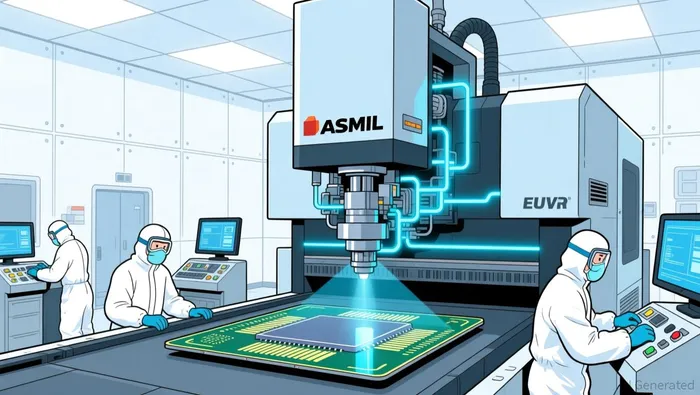 The structural forces driving this trend are clear. As chip features shrink, the number of layers required to manufacture a chip increases, leading to more lithography passes and higher demand for ASML's machines. Additionally, the adoption of 3D stacking technologies-where multiple chips are stacked vertically-further amplifies lithography demand, as each layer must be manufactured individually.
Strategic Initiatives: Capacity, Innovation, and Financial Discipline
ASML's strategic initiatives in 2026 reflect its confidence in the upcycle. The company is expanding its capacity to meet surging demand from DRAM suppliers and foundries like TSMC. This includes investments in EUV and deep ultraviolet (DUV) lithography systems, as well as the shipment of its first product for Advanced Packaging, a key enabler of 3D chip designs.
Financially, ASML has demonstrated discipline through aggressive share buybacks, with over €36 million repurchased in recent months. Its robust balance sheet-supported by a 28.2% pre-tax profit margin and a €2.1 billion cash cushion-provides flexibility to navigate macroeconomic uncertainties. The company's long-term financial strategy also targets revenues of €44 billion to €60 billion by 2030, a goal underpinned by its leadership in EUV and its alignment with AI-driven demand.
Navigating Risks and Regulatory Challenges
Despite its strengths, ASML faces headwinds. China-related sales are projected to decline in 2026 due to geopolitical tensions and regulatory restrictions. However, the company's dominance in EUV lithography-technology that is nearly impossible to replicate-provides a buffer against these risks. Additionally, global government investments in semiconductor manufacturing for national security reasons are creating a multi-year "fab construction supercycle," with leading-edge facilities requiring ASML's equipment.
Conclusion: A Lithography Super Cycle in Motion
ASML's path to dominance in 2026 is underpinned by a confluence of industry trends: a DRAM upcycle, AI-driven logic manufacturing, and structural shifts toward chip complexity. With analysts upgrading price targets and institutional investors revising growth expectations, the company is positioned to outperform industry benchmarks. As the semiconductor upcycle gains momentum, ASML's strategic initiatives and technological moat ensure it remains at the forefront of this transformation.







Comentarios
Aún no hay comentarios