
ASML's Leadership Shift and Its Implications for Semiconductor Innovation
ASML Holding NV (ASML) remains at the forefront of the semiconductor industry, driven by its relentless focus on R&D and strategic partnerships. As of 2025, the company has navigated a series of leadership changes while reinforcing its commitment to advancing next-generation lithography and sustainable innovation. For investors, the interplay between these organizational shifts and ASML's R&D strategy offers critical insights into its long-term growth potential.
Strategic Leadership Continuity: A Foundation for Stability
ASML's recent leadership updates underscore a balance between continuity and fresh direction. Marco Pieters, a 25-year veteran of the company, has been appointed as Executive Vice President and Chief Technology Officer (CTO), with a planned elevation to the Board of Management in 2026, according to an ASML announcement. Pieters' deep experience in applications and technology leadership positions him to maintain ASML's aggressive R&D trajectory. His appointment follows the reappointment of Roger Dassen as Chief Financial Officer and Frédéric Schneider-Maunoury as Chief Operations Officer, ensuring financial and operational stability during a pivotal phase of semiconductor innovation.
The Supervisory Board also saw key transitions, including the departure of Annet Aris and the nomination of Karien van Gennip, while Terri Kelly assumes the role of Vice-Chair, as noted in a Purdue announcement. These changes signal a deliberate effort to blend institutional knowledge with new perspectives, a hallmark of ASML's governance model. For investors, this structured approach to leadership reinforces confidence in the company's ability to execute long-term strategies without disruptive shifts.
R&D as a Strategic Pillar: High-NA EUV and Beyond
ASML's 2025 R&D strategy is anchored in its High-Numerical Aperture (High-NA) Extreme Ultraviolet (EUV) lithography systems, which are now entering deployment with industry leaders like Intel, Samsung, and TSMC, according to a FinancialContent article. The TWINSCAN EXE:5000 and its successor, the EXE:5200B, are critical to enabling sub-2nm semiconductor manufacturing-a domain where demand for advanced chips is projected to surge in AI, high-performance computing, and IoT applications.
Collaborative innovation is central to ASML's R&D model. A landmark five-year partnership with imec, a global leader in nanoelectronics research, leverages ASML's full product portfolio-including 0.55 NA EUV, 0.33 NA EUV, and DUV immersion tools-to accelerate sub-2nm R&D, as announced by ASMLASML--. This collaboration extends beyond technical development, incorporating funding for projects with environmental and societal benefits, aligning with growing investor interest in sustainable technologies.
Meanwhile, ASML's expanded partnership with Purdue University addresses a critical industry challenge: the global semiconductor talent shortage. By co-developing workforce training programs and next-generation manufacturing technologies, ASML is future-proofing its ecosystem against labor constraints while fostering innovation in lithography and computational techniques.
Long-Term Growth: Innovation, Partnerships, and Market Positioning
ASML's dual focus on technological leadership and strategic alliances positions it to dominate the semiconductor value chain for years to come. The High-NA EUV roadmap, supported by early customer adoption, ensures a steady revenue stream from capital equipment sales. Meanwhile, partnerships with imec and Purdue create a pipeline of cutting-edge research and skilled professionals, reducing the risk of innovation bottlenecks.
For investors, the reappointment of seasoned executives like Dassen and Schneider-Maunoury provides assurance that ASML will maintain disciplined capital allocation and operational efficiency. This is particularly important as the company invests heavily in R&D-ASML's 2025 R&D budget is expected to exceed €4 billion, a testament to its commitment to staying ahead of the curve, as noted in the FinancialContent article referenced earlier.
Conclusion: A Compelling Case for Resilience and Growth
ASML's leadership changes and R&D strategy exemplify a company poised to navigate the complexities of the semiconductor industry with agility and foresight. By combining internal expertise with external collaboration, ASML is not only addressing immediate technical challenges but also laying the groundwork for sustained dominance in an era of sub-2nm manufacturing. For long-term investors, this strategic continuity-coupled with a clear vision for sustainability and talent development-makes ASML a compelling bet on the future of technology.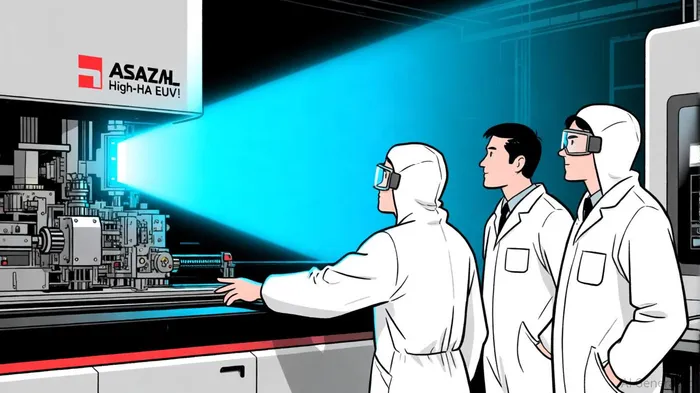





Comentarios
Aún no hay comentarios