
ASML: The Exponential S-Curve of Chipmaking Infrastructure
The AI revolution is hitting a physical wall. While NvidiaNVDA-- designs the brains, it needs ASMLASML-- to build the factories. This is the core of ASML's role: it sits at the physics bottleneck for advanced chipmaking, and that position is becoming more critical than ever.
ASML's extreme ultraviolet (EUV) lithography machines are the only technology capable of manufacturing the most advanced chips. Without EUV, producing cutting-edge chips like Nvidia's H200 would be impossible. The company holds a technological monopoly, building systems that cost over $200 million each and are essential for etching features just a few nanometers wide. This isn't just about making faster phones; it's about enabling the entire paradigm shift in computing. Every new generation of AI hardware relies on ASML's ability to push Moore's Law forward.
The demand tailwind for this infrastructure is massive and multi-year. Heavy spending on AI infrastructure is forecast to reach between $3 trillion and $4 trillion over the next five years. This isn't a short-term fad but a sustained investment cycle that directly fuels the need for ASML's EUV tools. The company is building the fundamental rails for the next computing era, and the scale of spending confirms its indispensable role.
Analyst recognition is now catching up to this reality. Sanford C. Bernstein recently upgraded ASML to a buy/top-pick, citing "unprecedented" AI demand for EUV tools. This move, which helped drive a mid-day rally, signals a growing acknowledgment that ASML is a foundational infrastructure play, not just a cyclical equipment supplier. For investors, the thesis is clear: ASML is positioned at the exponential S-curve of AI, where its technology is the non-negotiable bottleneck for the entire industry's growth.
Bernstein's 'Big Years' Forecast: 2026-2027 Catalysts
Sanford C. Bernstein's recent upgrade to a top pick for 2026 is built on a clear forecast of two strong years ahead. The analyst raised his price target to €1,300 from €800, implying around 32% upside. The core catalyst is an emerging DRAM upcycle, which Bernstein believes the market is underestimating. The three largest DRAM manufacturers are collectively adding as much as 250,000 wafers per month of greenfield capacity in 2026. This massive build-out is a direct, near-term tailwind for ASML's EUV tool sales.
The benefit is amplified by the technology transition itself. The move to the new 1c DRAM node requires significantly more lithography steps, with litho intensity for 1c estimated at 28%. This is notably higher than previous nodes, which saw 20–24% intensity. In other words, each new 1c chip requires more EUV exposures, meaning more ASML tools per wafer. This technical shift turns a general memory boom into a disproportionate growth engine for the company's core product.
A key risk to this thesis-concerns over a shift to a new 4F² DRAM structure that could reduce EUV usage-appears to be easing. Bernstein notes that suppliers are now prioritizing manufacturability over cost in a strong demand environment, delaying or easing concerns about this disruptive technology change. This reduces near-term uncertainty and supports higher EUV usage through the second half of the decade.
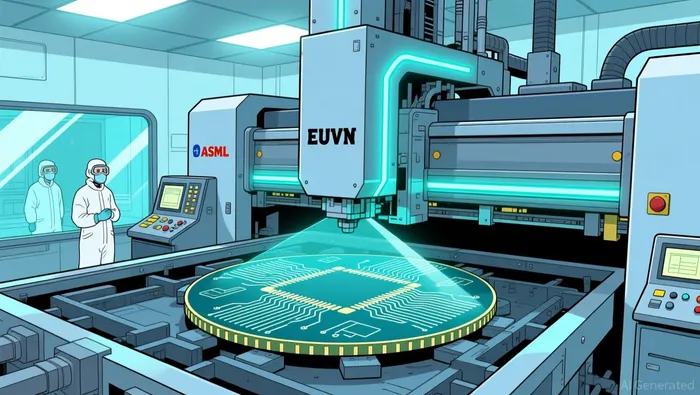
Beyond memory, the logic demand story is equally compelling. Leading foundries are expanding capacity for advanced nodes to meet AI demand, with 3-nanometre production highlighted as a key driver. This node carries the highest lithography intensity, making it the most lucrative for ASML. Taken together, the analyst sees these trends positioning 2026 and 2027 as "big years for EUV and for ASML," lifting his expected earnings growth to an 18% compound annual rate over the period.
Momentum and Valuation: Premium for a Monopoly
ASML's valuation reflects its dominant position, trading at a clear premium for its growth. The company's trailing price-to-earnings ratio stands at 51.85, a figure that sits significantly above the semiconductor equipment peer average of roughly 44.6. This gap is the market pricing in a monopoly. Investors are paying more today because they see a company with a technological moat that is essential to the next computing paradigm, not just a cyclical supplier.
That premium is supported by rapid financial momentum. The company's earnings are accelerating, with Q3 2025 EPS reaching $24.57, a 34% year-over-year increase. This growth rate is the fuel for the high multiple. The stock's price action over the past year shows this dynamic in real time: the P/E ratio has climbed from around 33 at the end of 2024 to its current level, mirroring the surge in underlying profitability.
Analysts argue the market is still catching up to the full growth runway. The stock now trades at what some call a "trough premium" versus its historical average. While the current multiple is elevated, it is roughly 1x that of its own historical average, suggesting the market may still be undervaluing the exponential adoption curve ahead. For a company building the fundamental rails of AI and advanced computing, the premium is less about today's earnings and more about the certainty of tomorrow's demand. The valuation is a bet on ASML's continued role as the non-negotiable bottleneck, where its monopoly on EUV technology ensures it captures the value of the entire industry's expansion.
Risks and the Next S-Curve
The path ahead is clear, but not without friction. The key risk that could flatten the growth curve is a technology shift in memory that reduces the need for EUV tools. Specifically, the potential migration to a new 4F² DRAM structure has been a long-standing concern, as it could lower lithography intensity. While Bernstein notes this near-term risk is easing as suppliers prioritize manufacturability in a strong demand environment, it remains a watchpoint. The ultimate catalyst for the next phase of growth is the pace of adoption of the next chip node, like the 1c DRAM. This node requires 28% lithography intensity, a significant jump that directly fuels EUV demand. If adoption lags, the current high-capacity expansion cycle could stall.
The broader, more existential risk is a technology shift beyond EUV lithography itself. ASML's monopoly is built on its decade-long lead in extreme ultraviolet systems. The company is already developing high-NA EUV, its next-generation tool, to etch even smaller features. The market's bet on ASML is a bet that it can maintain this technological lead for the next paradigm shift. If competitors or alternative approaches emerge that bypass the need for EUV, the entire growth S-curve would reset. For now, the physics of chipmaking still points to ASML as the indispensable bottleneck. But the company's future depends on its ability to stay ahead of that curve, not just ride it.





Comentarios
Aún no hay comentarios