
ASML: The AI Infrastructure Rail Builder on the S-Curve
The AI revolution is being built on a foundation of physical infrastructure, and ASMLASML-- is the undisputed builder of the rails. While much of the investment narrative focuses on the chips and the data centers, the company that manufactures the tools to make those chips is the true enabler. ASML holds a commanding 90% market share in advanced lithography machines, a position backed by a decade-long technological lead that creates a formidable barrier to entry. This isn't just a market share; it's a near-monopoly on the most critical manufacturing step for the world's most advanced semiconductors.
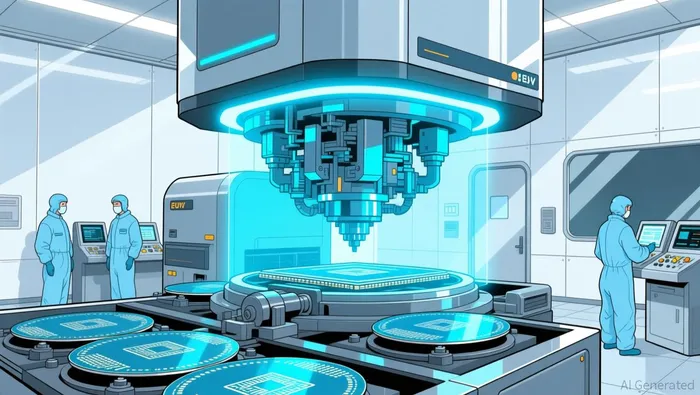
The company's dominance is defined by its exclusive control over extreme ultraviolet (EUV) and the next-generation High-NA EUV systems. These machines are the only way to print the intricate, sub-2-nanometer features required for today's AI accelerators and high-bandwidth memory. As ASML's CEO noted, the momentum from AI investments is now extending to more customers, both in leading-edge Logic and advanced DRAM. This broad-based adoption signals that the demand for ASML's equipment is not a fad but a fundamental shift in the industry's scaling requirements. Every new AI chip node, every memory upgrade, requires more of these machines, cementing ASML's role as the indispensable infrastructure provider.
The financial results reflect this structural advantage. For the first nine months of 2025, revenue grew 21% to nearly €23 billion, driven by this relentless demand. More importantly, the company's service revenue-long-term maintenance and upgrades for its installed base-rose 39%, accounting for a quarter of sales. This creates a durable, high-margin revenue stream that locks in customers for decades. The bottom line is that ASML is positioned for exponential growth as the AI paradigm scales, not just for a few years, but for the entire technological S-curve of the next decade.
The Financial Engine: High Margins and the Service Flywheel
ASML's financial model is built on a foundation of exceptional profitability and a strategic pivot to recurring revenue. The company's gross margin is a standout, hovering around 52.7% for the first nine months of 2025. This high-margin engine is now being powered by a second, rapidly growing stream: its service business. The Install Base Management segment, which handles service and field options, grew 39% year-over-year to reach €6 billion in sales. This segment now accounts for approximately 26% of total sales and, more importantly, generates a disproportionate share of gross profit. This shift is the core of ASML's new financial flywheel. The company's machines, which can last nearly three decades, create a durable, long-tail revenue opportunity. Each sale isn't just a one-time transaction; it's the start of a decades-long service relationship. This installed base ensures a high-margin, recurring revenue stream that decouples the company's profitability from the cyclical nature of new equipment sales. As one analysis notes, this service unit now generates about 30% of the company's total gross profit, a figure that rivals the margins of top software businesses.
The strategic importance of this transition is clear. While hardware sales face near-term turbulence-evidenced by a significant expected decline in China demand and a delayed adoption of its next-generation High-NA EUV systems-the service flywheel keeps spinning. This creates a powerful buffer. Even if new equipment orders slow, the ongoing service revenue supports profitability and cash flow. It's a classic infrastructure play: ASML is building the fundamental rails for the next semiconductor paradigm, and its financial model is evolving to capture the long-term value of that installed base.
Catalysts, Risks, and the 2026 Inflection
The path to sustained growth for ASML hinges on navigating a sharp near-term pivot. The company's financial engine is robust, with Q3 total net sales of €7.5 billion and a strong gross margin. Yet the primary catalyst for 2026 is now also its most significant headwind: the expected unwinding of a massive, geopolitically-driven buying spree in China.
China's role has been transformative. It accounted for 42% of total net sales in Q3, up sharply from 27% in Q2. This surge, which contributed heavily to ASML's cumulative €5 billion revenue from China in 2016-2019, has now peaked. Management expects sales there to decline significantly in 2026 compared to the extraordinary levels of 2024 and 2025. This is a direct result of the country's recent stockpiling of DUV machines, a move likely driven by export controls and uncertainty. The risk is clear: a market that was the source of the company's recent explosive growth is now a major drag.
The counterbalance is the relentless adoption of High-NA EUV, the next frontier in chip manufacturing. Intel is already using these systems for its 14A fabrication process, a clear validation of the technology. However, the path is not smooth. The delayed adoption by a key customer like TSMC creates near-term uncertainty for sales volume. This creates a seesaw dynamic: a major market is fading while a new, capital-intensive technology ramps up.
Despite this China headwind, management is confident in the overall trajectory. They have stated they do not expect 2026 total net sales to be below 2025. This guidance is anchored by strong demand from other regions and the resilient service business. The company's ability to offset a sharp China decline with growth elsewhere and its installed base of systems will be the critical test of its diversification strategy.
The bottom line is an inflection point. ASML is transitioning from a period of China-fueled hyper-growth to one where its success depends on the global adoption of its most advanced technology. The stock's momentum will be dictated by whether the High-NA EUV ramp can fully absorb the loss of China's DUV orders. The company's financial runway is solid, but the 2026 outlook will reveal the durability of its new growth paradigm.
Valuation and the Long-Term S-Curve
ASML's valuation sits at a critical inflection point, balancing a premium multiple against a decades-long growth trajectory. The stock trades at a price-to-earnings ratio of 34, which appears reasonable given its dominant market position and high margins. This multiple reflects the market's pricing of ASML not just as a cyclical equipment seller, but as the essential infrastructure layer for the AI build-out. Analysts see significant upside, with consensus price targets ranging from $935 to $1,331, and some firms like Bank of America have set a target as high as $1,331. The setup is one of a company whose current earnings are being multiplied by expectations of future demand.
The long-term market opportunity is what justifies that premium. ASML's own guidance suggests a potential annual sales run-rate of €44 to €60 billion by 2030. This projection is driven by the exponential growth of the semiconductor industry, which is the foundational enabler for AI, data centers, and advanced computing. The company's role is not just to sell machines but to provide the tools that allow the entire industry to shrink and scale, making its growth a function of the broader technological S-curve.
The key watchpoint for sustainability is the transition from a capital-intensive, cyclical equipment model to a service-driven, recurring revenue stream. This shift is already underway, with ASML's services revenue rising 39% to 6 billion euros in the first nine months of 2025. This unit now accounts for a significant portion of the company's gross profit, creating a more stable and predictable earnings base. This evolution from selling a product to managing a long-term asset is the hallmark of a mature infrastructure business, and it will determine whether ASML's growth can smooth out the traditional semiconductor cycle.
In essence, the investment case is a bet on the duration of the AI infrastructure build-out. ASML's valuation embeds a multi-year growth story, and its strategic pivot to services is designed to capture that growth with greater stability. The company is building the rails, and its financial model is shifting to reflect the long-term, service-oriented nature of the industry it serves.







Comentarios
Aún no hay comentarios