
ASML's 2026 Test: Navigating the China S-Curve and the AI Paradigm Shift
ASML's 2026 outlook is a critical test of its ability to navigate a fundamental technological and geographic pivot. The company's core business is at an inflection point, shifting from a model heavily reliant on a single market to one driven by a new technological super-cycle. The structural shift is already visible in the demand mix. In the third quarter, memory bookings surged 186% to €2.54 billion, reducing logic's share from 84% to 53%. This pivot toward memory reflects the broader semiconductor trend where AI adoption is driving higher lithography intensity across both logic and DRAM, potentially signaling the early stages of a new memory super-cycle.
Yet this technological momentum is colliding with a severe geopolitical headwind. Management has issued a stark warning: it expects China customer demand, and therefore its China total net sales in 2026, to decline significantly compared to its very strong business there in 2024 and 2025. In Q3 alone, China accounted for 42% of total net sales, making it the company's largest market. This creates a direct tension-a collapsing demand curve in its biggest market versus an exponential adoption curve in AI-driven memory and logic.
The company's financial engine is powerful but under strain. Q3 sales of €7.5 billion and a gross margin of 51.6% demonstrate the profitability of its advanced lithography systems, particularly the €3.6 billion in EUV bookings. However, the margin contraction from Q2 was driven by a higher share of lower-margin DUV systems and shipment timing, a reminder of the operational friction in managing this transition.
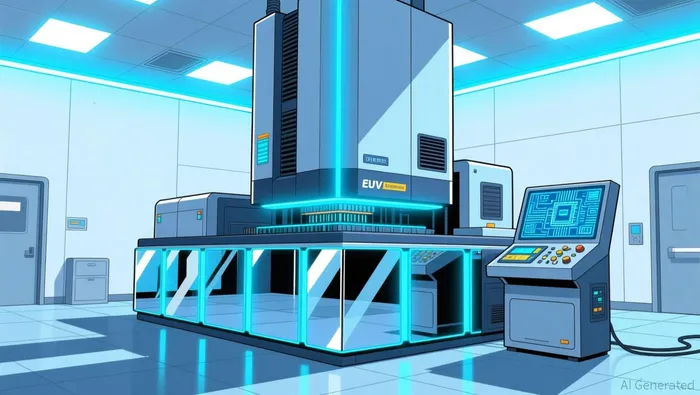
The 2026 test is clear. ASMLASML-- does not expect total net sales to fall below 2025 levels, but that is a floor, not a growth target. The company must offset a significant drop in China with accelerating demand for advanced nodes driven by AI. The success of this pivot will determine whether ASML remains the indispensable infrastructure layer for advanced computing or becomes a victim of its own geographic concentration. The coming months will reveal if the AI super-cycle can truly lift the entire ship.
Adoption Rate Metrics: The AI Super-Cycle's Engine
The AI super-cycle is not a distant forecast; it is being built today, one wafer at a time. The concrete metrics of adoption reveal a powerful, multi-layered engine driving exponential growth. At its core is the relentless shift toward advanced lithography, with EUV systems acting as the primary margin lever. In the third quarter, €3.6 billion of the €5.4 billion in net bookings came from EUV systems, underscoring their dominance. This isn't just about selling tools; it's about processing the future. Customers have already processed more than 300,000 wafers on High NA systems, a clear signal that the technology is maturing and being integrated into production lines. This adoption directly fuels profitability, with ASML's gross margin holding firm at 51.6% for the quarter. The AI super-cycle is already generating premium returns.
The strategic partnership with Mistral AI is the catalyst that embeds this growth into the next technological phase. By investing €1.3 billion as lead investor in Mistral's Series C round, ASML is not merely buying a stake-it is securing a seat at the table for the AI models that will optimize its own systems. This collaboration aims to use AI to accelerate time-to-market and improve the performance of lithography tools, creating a feedback loop where AI drives semiconductor advancement, which in turn requires more advanced tools. It is a move to control the software layer of the hardware stack, a critical step in maintaining a durable competitive advantage.
The timeline for the next major leap is now defined. While current EUV systems power today's chips, the transition to High-NA EUV is the next critical phase. ASML's CEO has set a clear horizon, expecting high-volume manufacturing to begin in 2027 and 2028. The company is already working with customers like Intel through 2026 to finalize system maturity, with Intel having completed acceptance testing on the first second-generation High-NA EUV system. This structured ramp ensures that the technological adoption curve remains steep, preventing a plateau in demand for the most advanced equipment.
Together, these metrics form a self-reinforcing growth paradigm. Current EUV bookings provide the cash and credibility for future investment. The Mistral partnership accelerates the development of the AI-driven tools needed to build even more advanced chips. And the defined High-NA timeline ensures that the demand for ASML's core technology will remain explosive for years to come. This is the engine of the AI super-cycle: a virtuous cycle of adoption, innovation, and capital deployment that is already delivering record financial results and setting the stage for sustained exponential growth.
The Competitive Moat and Technological Singularity
ASML's dominance in semiconductor manufacturing is not merely a market share advantage; it is a technological singularity. The company's monopoly on Extreme Ultraviolet (EUV) lithography is reinforced by a 30-year global supply chain and a high-volume manufacturing data feedback loop, creating an insurmountable moat. This is not a simple equipment monopoly. As detailed in a recent analysis, the true barrier for competitors like China's state-backed efforts is not just replicating the machine, but rebuilding the entire ecosystem of suppliers, software, and process know-how that ASML has cultivated. The complexity of the system-requiring a laser-excited tin plasma light source, reflective mirrors, and vacuum operation-means that even a complete reconstruction of the optical and system engineering would take a decade or more to approach high-volume manufacturing readiness. This is the essence of a singularity: a point of such integrated complexity that it becomes functionally impossible for a new entrant to replicate.
This moat translates into a powerful, sticky revenue stream. ASML's installed base management, which includes services, parts, and software updates for its existing machines, provides high-margin, recurring income. While this segment eased to €2.0 billion in the third quarter, it remains a critical pillar of the business, demonstrating the deep lock-in of its customers. Once a foundry invests in an ASML EUV system, the cost and risk of switching are prohibitive, ensuring a long-term service relationship that buffers the company against cyclical downturns in new equipment sales.
Looking ahead, ASML's roadmap shows its ability to continuously innovate and maintain its position at the frontier of the industry's S-curve. The company is already working with customers like Intel to finalize the maturity of its second-generation High-NA EUV systems for commercial production, with mass production expected in 2027 and 2028. More importantly, the company has plans to introduce an even more advanced technology known as Hyper NA sometime next decade, with research on the next step already underway. This forward-looking investment in the next generation of lithography ensures that ASML remains the indispensable gatekeeper for every new leap in chip performance, from advanced AI accelerators to the next generation of computing.
The bottom line is that ASML's competitive position is structural and durable. Its technological singularity is built on decades of integrated innovation, a global supply chain, and a customer base locked into its ecosystem. The installed base provides a resilient, high-margin income stream, while the aggressive R&D pipeline for Hyper NA ensures it will remain at the cutting edge for years to come. For the semiconductor industry, ASML is not just a supplier; it is the foundational platform upon which future progress is built.
Valuation, Catalysts, and the 2026 Scenarios
The investment case for ASML is a high-stakes bet on the AI super-cycle and the company's ability to navigate the next phase of its exponential growth. The valuation reflects this premium, with the stock trading at a forward P/E of 41.4. This multiple is justified by its monopoly on EUV technology and the long-term demand tailwinds from advanced chipmaking. Yet the recent surge, with shares up nearly 9% this week, has been fueled by a wave of analyst optimism. Major firms have raised their price targets, with Citi at €1,200, Cantor Fitzgerald at €1,300, and BofA at $1,331. This consensus shift underscores the market's belief that ASML is positioned to capture the next wave of semiconductor demand.
The primary near-term catalyst is the January 2026 strategy update, which will provide new multi-year targets and clarify the critical 2026 China gap. Management has already signaled that China customer demand, and therefore our China total net sales in 2026, will decline significantly compared to the very strong levels in 2024 and 2025. The January update must detail how the company plans to offset this loss, whether through accelerated adoption of High-NA EUV, expanded DRAM market share, or other growth vectors. This event will test the thesis that 2026 revenue will not fall below 2025 levels.
The key scenarios that will determine the thesis are defined by execution risks. The first is the timing of the China demand replacement. The market assumes this gap will be filled, but the pace is uncertain and could create near-term revenue volatility. The second risk is potential delays in the commercialization of High-NA EUV, the next-generation technology that is crucial for maintaining ASML's technological lead. Any setback here would challenge the narrative of sustained, high-margin growth. Finally, geopolitical constraints on critical components, such as rare earths, pose a supply-side risk to the company's manufacturing and delivery schedules.
The bottom line is that ASML's valuation is a bet on flawless execution through a pivotal transition. The January update is the critical event to assess whether the company's guidance and strategic plan can justify the premium. For now, the market is leaning into the bullish narrative, but the risks-particularly around China and technology timelines-mean the path to the new price targets is far from guaranteed.







Comentarios
Aún no hay comentarios