
ASML's 2026 China Sales Outlook and Implications for Global Chip-Making Leadership
The semiconductor industry's future hinges on ASML HoldingASML-- NV's ability to navigate geopolitical headwinds while maintaining its dominance in advanced lithography. For investors, the question of how ASML's 2026 China sales will evolve is critical-not just for the company's near-term profitability but for its long-term position in a global market increasingly defined by strategic competition.
China Sales: A Tale of Resilience and Constraints
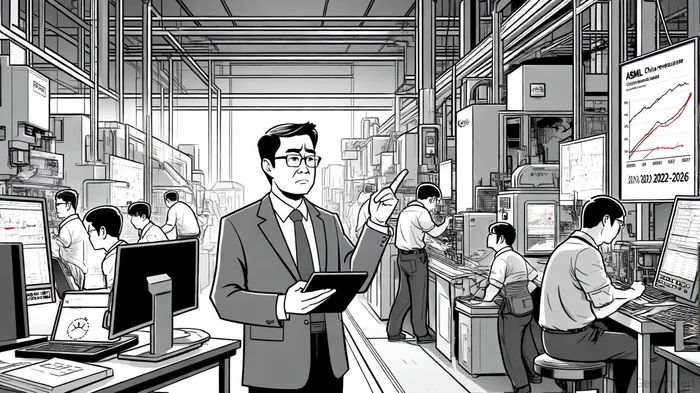
ASML's China sales have surged in recent years, driven by robust demand for mature-node manufacturing equipment. In Q4 2023, China accounted for 39% of ASML's revenue, a stark contrast to the 14% it represented in 2022[2]. This growth, however, has been tempered by U.S. and Dutch export restrictions on advanced EUV lithography systems, which took effect in early 2024. These rules are expected to reduce China's access to cutting-edge tools by 10–15% in 2024[2], a constraint that has already begun to reshape ASML's revenue mix.
Despite these restrictions, China's appetite for older DUV (deep ultraviolet) machines has remained strong, with customers stockpiling systems ahead of potential further trade barriers[5]. In Q2 2025, China's contribution to ASML's sales rose to over 25%, reflecting continued investments in capacity expansion[3]. Yet, the company's leadership has issued cautionary signals. CEO Christophe Fouquet recently noted that China's demand is expected to decline "significantly" in 2026 compared to the robust performance of 2024 and 2025[2]. This projection aligns with broader market dynamics: while the China semiconductor market is forecasted to grow at a 7–8% CAGR through 2030[1], import dependency on high-end equipment and talent shortages remain persistent challenges[4].
Strategic Risks: Geopolitical and Technological
The primary strategic risk for ASMLASML-- lies in the interplay between U.S. export controls and China's push for self-reliance. Washington's restrictions on advanced chipmaking tools aim to curb Beijing's access to technologies critical for AI, 5G, and military applications. While these rules have limited ASML's ability to export EUV systems to China, they have also inadvertently accelerated demand for older equipment-a temporary tailwind that may not persist into 2026.
A more existential risk is China's long-term ambition to develop its own EUV lithography capabilities. Despite significant R&D investments, Fouquet remains skeptical that China will produce a competitive EUV system within "many years"[3]. However, even incremental progress in this arena could erode ASML's pricing power and market share over the next decade. For now, ASML's technological moat remains intact, but investors must weigh the likelihood of a multi-decade shift in the global supply chain.
Equity Valuation: Balancing Near-Term Strength and Long-Term Uncertainty
ASML's financials underscore its current strength. In 2024, the company reported €28.3 billion in net sales and a 51.3% gross margin[1], with 2025 guidance pointing to €30–35 billion in revenue. However, the projected decline in China sales by 2026 introduces volatility. If China's contribution drops to 20% of revenue (as suggested by CFO Roger Dassen[6]), ASML's growth trajectory could face downward pressure, particularly if global semiconductor demand softens.
From a valuation perspective, ASML's P/E ratio of ~35x (as of October 2025) reflects high expectations for its dominance in EUV. Yet, this premium is justified only if the company can sustain its technological edge and navigate geopolitical risks. A 20–30% reduction in China sales by 2026, coupled with slower global chip demand, could pressure margins and force a re-rating. Conversely, if ASML successfully pivots to service and installed base revenue streams (e.g., maintenance, upgrades), it could mitigate some of these risks[3].
Conclusion: A Pivotal Crossroads
ASML stands at a crossroads in 2026. Its ability to retain leadership in EUV lithography will determine not only its profitability but also the balance of power in the global semiconductor industry. While near-term demand for mature-node tools provides a buffer, the long-term outlook depends on ASML's capacity to innovate amid tightening export controls and China's self-reliance drive. For investors, the key takeaway is clear: ASML's equity valuation must be scrutinized through the lens of both its technological moat and the geopolitical forces reshaping the industry.





Comentarios
Aún no hay comentarios