
Asia's Shifting Crypto Landscape: CBDCs, AI, and Payments Innovation
The global financial landscape is undergoing a seismic shift as Asia emerges as a leader in digital currency innovation, AI-driven fintech, and blockchain infrastructure. By 2025, India, China, and Japan are redefining the boundaries of financial technology, offering strategic investment opportunities for those attuned to their unique trajectories. From India's offline-capable CBDC to China's AI-powered crypto platforms and Japan's blockchain-driven cross-border payment systems, the region is poised to reshape global finance.
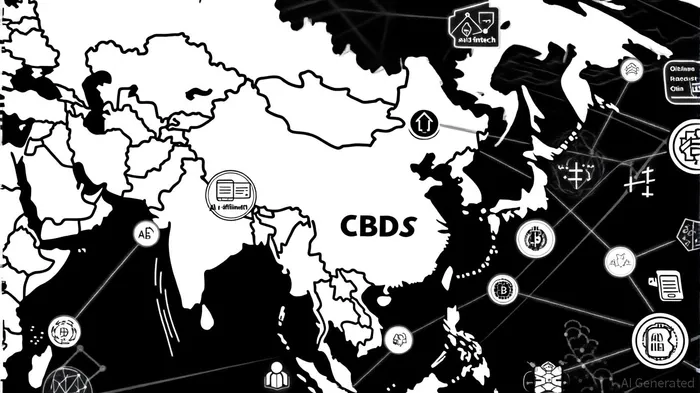
India: Bridging Inclusion and Innovation
India's Central Bank Digital Currency (CBDC) program, spearheaded by the Reserve Bank of India (RBI), is accelerating financial inclusion through its Digital Rupee initiative. A groundbreaking feature is the introduction of offline payments, enabling transactions without internet or telecom connectivity-a critical advancement for rural and underserved populations[1]. This innovation not only reduces reliance on existing systems like UPI but also positions India as a model for low-connectivity markets.
Simultaneously, India's fintech sector is pivoting toward AI-driven solutions to enhance resilience and scalability. According to a KPMG report, fintechs are prioritizing embedded finance and AI-powered tools for fraud detection, credit scoring, and personalized services[2]. Kiya.ai's AI-powered banking pods, which offer multilingual support in Hindi and other regional languages, exemplify how AI is democratizing access to financial services[2].
Investment opportunities lie in blockchain infrastructure supporting the Digital Rupee and AI-driven fintech startups. The RBI's regulatory clarity on CBDCs, coupled with a cautious stance on private cryptocurrencies, creates a fertile ground for institutional-grade blockchain projects[1].
China: AI and State-Backed Crypto Innovation
China's digital yuan (e-CNY) has expanded to over 25 cities, with 250 million users and 15 trillion yuan in transactions since its pilot launch[3]. The People's Bank of China is leveraging AI to enhance transaction security and analytics, while private-sector players are pushing boundaries. A notable example is the China Financial Leasing Group's $11.1 million crypto-AI investment platform, which uses machine learning to manage assets like BTC, ETH, and NFTs[3]. This aligns with Hong Kong's ambition to become a regional crypto hub, supported by state-backed innovation.
The AI fintech market in China is projected to grow at a 30.6% CAGR, reaching $40.3 billion by 2032[4]. This surge is driven by robo-advisors, predictive analytics, and AI-powered fraud detection systems. Shenzhen, a fintech epicenter, is leading the charge with 300 startups and a 14% increase in fintech investments[3].
Strategic opportunities include partnerships with AI-driven wealth management platforms and blockchain-based cross-border payment solutions. The government's "Made in China 2025" and AI development plans provide a regulatory tailwind for investors[4].
Japan: Blockchain Infrastructure and Global Collaboration
Japan's blockchain ecosystem is maturing rapidly, fueled by regulatory reforms and corporate investments. The reclassification of cryptocurrencies as financial instruments under the Financial Instruments and Exchange Act (FIEA) has spurred institutional adoption[5]. SoftBank's PayPay, with 70 million users, has acquired a 40% stake in Binance Japan, merging cashless payments with crypto services[6]. This partnership, along with Ripple's $200,000 grant program for XRP Ledger startups, underscores Japan's ambition to dominate decentralized finance[5].
The EDCON 2025 conference in Osaka, expected to attract 6,000 participants, will spotlight EthereumETH-- upgrades, stablecoins, and AI governance via DAOs[5]. Meanwhile, Japan's blockchain market is forecasted to grow from $1.5 billion in 2024 to $251.8 billion by 2033, driven by asset tokenization and smart contracts[7].
Investors should target blockchain infrastructure firms like EMURGO and Soramitsu, which specialize in CardanoADA-- and Hyperledger solutions, as well as cross-border payment startups leveraging Ripple technology[5].
Strategic Investment Outlook
Asia's crypto landscape offers a trifecta of opportunities:
1. India: Invest in CBDC infrastructure and AI-driven fintech startups targeting rural markets.
2. China: Target AI-powered wealth management platforms and state-backed crypto projects.
3. Japan: Allocate capital to blockchain infrastructure firms and cross-border payment solutions.
As central banks balance innovation with regulation, the next five years will determine the long-term winners in this space. Investors who align with these regional strengths will be well-positioned to capitalize on Asia's digital finance revolution.






Comentarios
Aún no hay comentarios