
Asia-Pacific Markets and the Resilience of AI-Driven Sectors Amid Global Geopolitical Risks
The Asia-Pacific region has emerged as a critical battleground for the future of artificial intelligence (AI) and semiconductor innovation, defying global geopolitical headwinds and Federal Reserve policy uncertainties. As the world grapples with U.S.-China technological rivalry, trade tariffs, and shifting monetary policies, Asia-Pacific markets have demonstrated remarkable resilience, driven by surging demand for AI infrastructure and a strategic reorientation of supply chains. This analysis identifies high-conviction investment opportunities in the region's AI-driven semiconductor sector while evaluating the macroeconomic and geopolitical risks shaping its trajectory.
AI and Semiconductor Growth: A Structural Tailwind
The Asia-Pacific semiconductor market is projected to reach USD 504.99 billion in 2025, with a compound annual growth rate (CAGR) of 8.34% from 2025 to 2030, fueled by AI and high-performance computing (HPC) demand. The global semiconductor industry, including Asia-Pacific, is expected to grow by over 15% in 2025, with AI-related applications-such as data centers, edge computing, and generative AI- accounting for a disproportionate share of this growth.
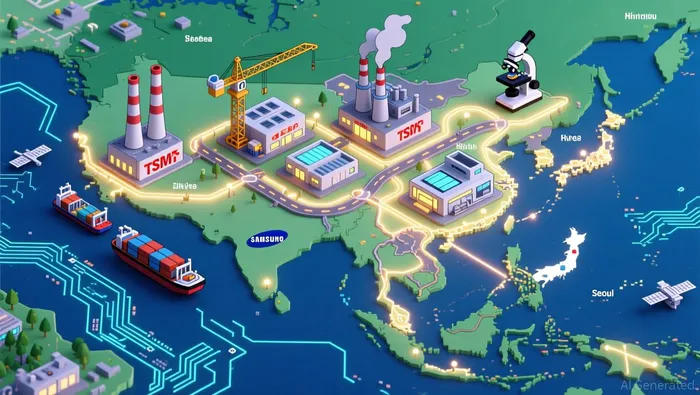
This expansion is underpinned by the region's dominance in advanced manufacturing. Countries like Taiwan, South Korea, and Japan control critical nodes in the semiconductor value chain, including extreme ultraviolet lithography and advanced packaging technologies. For instance, TSMC's announced $165 billion investment in U.S. manufacturing by 2025 underscores the sector's global strategic importance, even as regional hubs maintain their technological edge.
Geopolitical Risks and Adaptive Strategies
Geopolitical tensions, particularly U.S.-China competition, have introduced volatility into the sector. The U.S. easing of export restrictions on Chinese chip sales in 2025 temporarily boosted U.S. firms but did little to disrupt the concentration of advanced manufacturing in Asia. Meanwhile, proposed U.S. tariffs of up to 100% on semiconductors have heightened uncertainty for export-dependent economies like Taiwan, where 80% of 2024 exports to the U.S. faced Section 232 investigations.
However, Asia-Pacific firms are mitigating these risks through diversification and regional integration. Trade agreements like the CPTPP and RCEP are fostering closer economic ties, reducing reliance on U.S. and European markets. For example, Malaysia has expressed concerns over potential U.S. tariffs on BRICS nations but is leveraging its position as a logistics hub to attract AI-driven manufacturing investments.
Fed Policy and Capital Reallocation
The Federal Reserve's 2025 policy decisions have indirectly influenced the sector's resilience. While higher interest rates have dampened global tech valuations, Asia-Pacific semiconductors have outperformed U.S. counterparts due to stronger earnings growth and more attractive valuations. The weaker U.S. dollar has also boosted demand for Asian assets, with hedge funds rotating capital into the region's AI infrastructure plays.
Notably, the Nikkei 225 surged 26.3% in 2025, driven by AI semiconductor leaders like Samsung Electronics and SK Hynix. Similarly, the Hang Seng Index advanced 28.7%, reflecting China's AI catch-up through open-source models and domestic chip production. These gains highlight the sector's ability to thrive despite macroeconomic headwinds.
High-Conviction Investment Opportunities
Investors should focus on firms with strong balance sheets and AI integration capabilities. TSMCTSM--, the world's largest contract chipmaker, remains a top-tier play, with its U.S. expansion and leadership in 3nm and 2nm technologies. Samsung and SK Hynix are also well-positioned, given their dominance in memory chips and AI accelerators.
Emerging markets like India and Vietnam are gaining traction as alternative manufacturing hubs, supported by government incentives and lower labor costs. Additionally, Chinese firms such as SMIC and Baidu are capitalizing on the "Made in China 2025" initiative, despite ongoing U.S. export controls.
Balancing Risks and Rewards
While the sector's growth is compelling, risks persist. The top 5% of semiconductor firms captured $147 billion in economic profit in 2024, while the bottom 5% incurred $37 billion in losses. This disparity underscores the need for selective investing. Furthermore, nonlinear economic dynamics-such as regulatory shifts and AI overvaluation concerns- could trigger short-term volatility.
Conclusion
Asia-Pacific's AI-driven semiconductor sector is a linchpin of global technological resilience. Despite geopolitical turbulence and Fed policy uncertainties, the region's strategic manufacturing ecosystems, regional cooperation, and AI-led demand are creating a fertile ground for high-conviction investments. For investors, the key lies in targeting firms with technological moats and diversified supply chains, while remaining cognizant of macroeconomic risks.





Comentarios
Aún no hay comentarios