
Asia-Pacific Credit Trading: Talent Shifts Signal Growing Opportunities in Fixed Income Markets
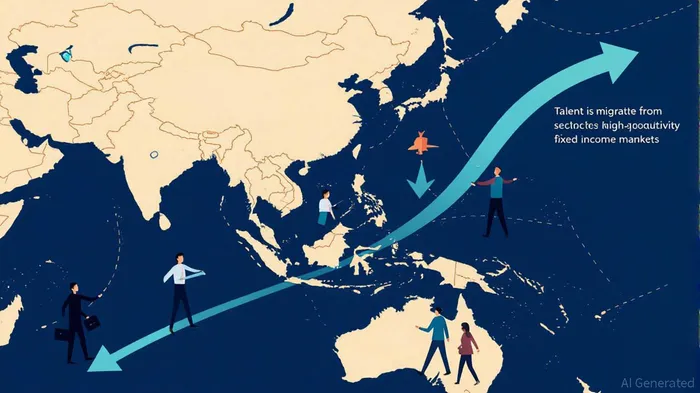
The Asia-Pacific credit trading sector is undergoing a profound transformation driven by strategic workforce reallocation, reshaping the dynamics of fixed income markets. As economies in the region pivot toward high-productivity services and navigate trade tensions, the interplay between talent shifts and capital flows is unlocking new opportunities—and challenges—for investors.
Workforce Reallocation and Structural Transformation
The Asia-Pacific region is experiencing a structural shift in labor markets, with workers moving from traditional sectors like agriculture and manufacturing to high-value services, including credit trading. This transition is fueled by rising incomes, demographic changes, and accommodative monetary policies expected in 2025, which are boosting economic activity and creating demand for specialized financial services [1]. According to the IMF's Regional Economic Outlook for Asia and Pacific, this reallocation is supported by multilateral trade agreements and a surge in intellectual property development, fostering internal connectivity and reducing external dependencies [1].
However, the process is not without hurdles. Aging populations and the need for education and training to equip workers with skills for emerging technologies remain critical challenges. For instance, Japan's financial institutionsFISI-- are offering substantial incentives to attract biotech professionals, reflecting a broader trend of cross-disciplinary talent mobility [2]. Similarly, Singapore's tightening of foreign labor policies aims to boost productivity while encouraging automation and AI adoption [3].
Talent Shortages and Rising Costs
A persistent shortage of quality talent in credit trading is pressuring banks and capital markets. As noted in Deloitte's 2025 banking outlook, institutions are grappling with higher compensation costs, including performance bonuses and technology investments, to retain skilled professionals [4]. These expenses threaten profitability, particularly in emerging markets where central banks' delayed rate cuts may test growth resilience [4].
Meanwhile, global macroeconomic shifts are amplifying these pressures. The U.S. and Europe's expected rate cuts are driving credit demand toward regions with stable risk profiles. European credit is increasingly seen as more attractive than U.S. counterparts due to cautious economic outlooks, while Asia-Pacific banks in high-growth markets could benefit from capital inflows—provided they navigate regulatory and operational challenges effectively [4].
Policy Initiatives and Market Resilience
Strategic policy interventions are playing a pivotal role in aligning workforce reallocation with fixed income market stability. In China, the 14th Five-Year Plan emphasizes technological innovation and financial deepening, creating a fertile ground for credit trading hubs. India's National Biotechnology Strategy and Mongolia's fiscal reforms are similarly fostering environments where talent and capital can thrive [5].
Singapore's 2023 investment screening mechanism and focus on automation highlight how policy frameworks can balance national security with financial innovation [3]. These initiatives are not only attracting foreign capital but also reinforcing the region's role as a global fintech leader. By 2025, the Asia-Pacific fintech market is projected to grow to $415.42 billion at a 27.45% CAGR, driven by digital financial inclusion (DFI) and embedded finance [6].
Implications for Fixed Income Markets
The reallocation of talent is directly influencing fixed income market dynamics. For example, digital financial inclusion has a non-linear positive impact on economic growth in 30 Asia-Pacific countries, particularly those with large unbanked populations [7]. This growth is translating into stronger demand for corporate and sovereign bonds, as well as structured credit products.
Conversely, trade policy uncertainties—such as U.S. tariffs on Asian exports—are creating volatility. The Asian Development Bank's April 2025 outlook notes that high tariffs on Cambodia, Vietnam, and Laos have triggered outflows from emerging Asia funds, testing market resilience [8]. Yet, structural reforms in countries like Sri Lanka and India are mitigating these risks through improved fiscal frameworks and public debt management [8].
Challenges and the Path Forward
While the region's fixed income markets are gaining resilience, challenges persist. Talent shortages in advanced fields like cell therapy manufacturing and uneven regulatory landscapes hinder progress. Additionally, geopolitical tensions and trade disruptions could delay the full realization of these opportunities.
For investors, the key lies in balancing exposure to high-growth markets with hedging against macroeconomic risks. Emerging Asia's focus on structural reforms and digital innovation suggests that fixed income instruments—particularly those tied to sustainable and tech-driven sectors—will remain attractive.
Conclusion
The Asia-Pacific credit trading sector is at a crossroads, with workforce reallocation acting as both a catalyst and a constraint for fixed income markets. As talent shifts toward high-productivity services and policy frameworks adapt to global uncertainties, the region is poised to redefine its role in the global financial ecosystem. For investors, the message is clear: strategic allocations to Asia-Pacific fixed income markets, supported by a nuanced understanding of labor dynamics and policy trends, will be critical in navigating the opportunities ahead.







Comentarios
Aún no hay comentarios