
Asia FX Under Pressure: Navigating Currency Volatility Amid US Jobs Uncertainty
The Asian foreign exchange (FX) market is at a crossroads, caught between diverging monetary policy trajectories, weak regional jobs data, and capital outflows. As the U.S. Federal Reserve adopts a cautiously hawkish stance amid delayed economic signals, Asian currencies face a dual challenge: depreciating against a resilient U.S. dollar in the short term while positioning for potential long-term rebounds. For investors, this volatility presents both risks and opportunities, demanding a nuanced approach to strategic positioning.
The Fed's Hawkish Tightrope and USD Dynamics
The Federal Reserve's December 2025 decision to cut the federal funds rate by 25 basis points to 3.50%-3.75% was accompanied by a hawkish tilt in forward guidance, signaling a "wait and see" approach to further rate cuts according to Nuveen. While the immediate market reaction saw the U.S. dollar index (DXY) weaken as investors interpreted the move as dovish, the Fed's emphasis on economic resilience and inflation normalization suggests the dollar's long-term trajectory remains uncertain according to EBC. According to JPMorgan's report, the Fed's updated Summary of Economic Projections (SEP) projects core PCE inflation to stabilize at 2.8% in 2025 before returning to 2% by 2027, reinforcing a neutral policy stance. This ambiguity creates a fragile equilibrium: the dollar may remain under pressure in the near term but could rebound if inflationary risks resurface or economic shocks emerge.
Asia's Jobs Weakness and Capital Flight
Meanwhile, Asian economies are grappling with weak labor markets and capital outflows. China's November 2025 data revealed a 16% year-on-year decline in property sector investment, a key drag on growth, despite a record $1 trillion trade surplus for the first 11 months of the year. Similarly, India's foreign portfolio inflows turned negative in Q4 2025, with equity outflows reaching $16 billion as investors sought safer havens. The Indonesian rupiah (IDR) depreciated 3.1% in Q3 2025 amid domestic policy uncertainty, while the South Korean won (KRW) faced downward pressure due to political instability according to Mufg Research.
Capital outflows are exacerbated by U.S. tariffs and divergent monetary policies. The People's Bank of China has intervened to stabilize the yuan (CNY), maintaining USD/CNY within a 7.22-7.35 range. However, the delayed release of U.S. jobs data-originally scheduled for November 2025-has heightened uncertainty, with markets pricing in a 25 basis point Fed cut in December. This uncertainty amplifies FX volatility, as seen in Japan's bond yields surging amid fiscal concerns.
Strategic Opportunities in Asian FX Markets
Despite the headwinds, tactical opportunities exist for investors who can navigate the volatility. MUFG Bank's December 2025 Foreign Exchange Outlook anticipates USD depreciation in 2026, with Asian currencies like the yuan, Singapore dollar (SGD), and Japanese yen (JPY) expected to strengthen against the dollar in Q4 2026. China's trade surplus and PBoC interventions provide a floor for the yuan, while Singapore's fiscal discipline and export resilience position the SGD as a safe bet. The yen, though volatile, could benefit from Japan's fiscal reforms and a potential unwinding of yield differentials.
For investors, currency pairs such as CNY/USD, SGD/USD, and JPY/USD offer asymmetric upside potential. A long position in CNY/USD, for instance, could capitalize on China's trade-driven revaluation and PBoC support. Similarly, SGD/USD may benefit from Singapore's robust external demand and stable policy environment.
Hedging Strategies for FX Volatility
Given the uncertainty surrounding U.S. jobs data and Fed policy, hedging is critical. Investors should consider options-based strategies to protect against sudden dollar strength. A long straddle on USD/CNY or USD/JPY could profit from volatility while capping downside risk. For those with exposure to Asian equities, forward contracts can lock in favorable exchange rates, mitigating the impact of capital outflows.
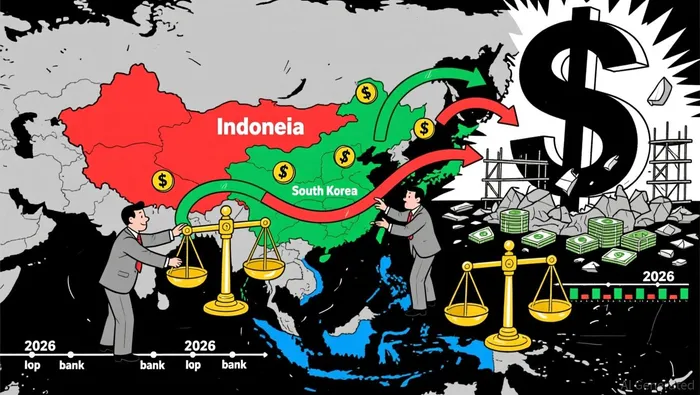
Additionally, diversifying across Asian currencies-rather than overexposing to a single pair-can reduce idiosyncratic risks. For example, pairing a long position in CNY/USD with a short in IDR/USD could hedge against regional economic divergences.
Conclusion
Asia's FX markets are navigating a complex landscape of divergent monetary policies, weak jobs data, and capital outflows. While the U.S. dollar's near-term trajectory remains uncertain, the long-term outlook for Asian currencies is cautiously optimistic. By strategically positioning in undervalued pairs and employing robust hedging techniques, investors can turn volatility into an advantage. The key lies in balancing caution with conviction, leveraging both macroeconomic fundamentals and tactical market timing.





Comentarios
Aún no hay comentarios