
Asia's Diverging Monetary Policies and Trade Dynamics in 2026
In 2026, Asia's economic landscape is being reshaped by diverging monetary strategies and evolving trade dynamics, creating distinct growth opportunities across China, India, and South Korea. As central banks navigate inflation, growth, and geopolitical risks, their policy choices are intertwining with regional trade agreements and supply chain realignments. This analysis examines how these divergent paths-driven by contrasting monetary approaches-position each economy for opportunity and risk in a year marked by both resilience and uncertainty.
China: Cautious Fine-Tuning Amid Structural Challenges
China's monetary policy in 2026 remains anchored in a "fine-tuning" approach, with the People's Bank of China (PBOC) prioritizing liquidity management over aggressive rate cuts. While the PBOC has pledged to cut interest rates and the reserve requirement ratio (RRR) to support growth, its actions have been tempered by concerns over overcapacity and weak domestic demand. This cautious stance reflects a broader strategy to balance growth targets-set at 5% real GDP-with inflation control and financial stability.
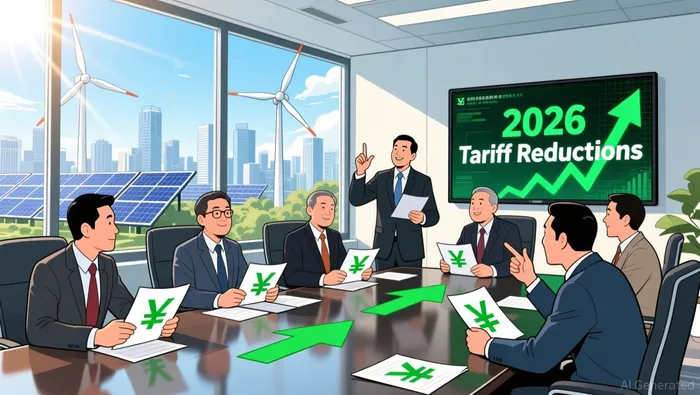
Trade dynamics further complicate this calculus. China's 2026 tariff reductions on high-tech and renewable energy goods aim to bolster domestic industries while aligning with its "dual circulation" strategy. However, U.S. tariffs and global supply chain shifts are forcing Chinese firms to reconfigure production networks, with Southeast Asia increasingly serving as a manufacturing hub. The PBOC's focus on RMB internationalization-via currency swaps and CBDCs-also underscores its intent to reduce reliance on the dollar and stabilize trade flows. For investors, China's policy environment suggests opportunities in sectors like semiconductors and green energy, though structural weaknesses remain headwinds.
India: Aggressive Easing and a Growth-First Approach
India's Reserve Bank of India (RBI) has adopted a more aggressive stance, cutting the repo rate by 125 basis points in 2025 to 5.25%, its lowest since 2022. This accommodative policy reflects confidence in India's economic momentum, with GDP growth forecasts revised upward to 7.3% for FY2025/26. The RBI's data-dependent approach-coupled with proactive liquidity management through open market operations-has supported a narrowing trade deficit and contained inflation near its 4% target.
Trade-wise, India's Free Trade Agreements (FTAs) and RCEP access are enabling deeper integration into regional supply chains without overexposure to China. Tariff adjustments and structural reforms, such as GST improvements, are enhancing export competitiveness, particularly in pharmaceuticals and textiles. However, challenges persist, including graft investigations and U.S. tariff pressures, which could temper growth in 2026. For investors, India's policy mix-combining monetary easing with fiscal stimulus-positions it as a high-growth market, though risks from external shocks and domestic governance issues require careful monitoring.
South Korea: Stability Amid Geopolitical and Currency Pressures
South Korea's Bank of Korea (BOK) has maintained a 2.50% base rate since October 2025, balancing inflation concerns with the need to support growth. This stability contrasts with the won's volatility, driven by U.S. dollar strength and geopolitical tensions, particularly U.S.-China trade dynamics. The BOK's cautious approach-coupled with fiscal stimulus-has underpinned a projected 1.8% GDP growth in 2026, fueled by AI-driven tech exports and regional trade partnerships.
Trade dynamics highlight South Korea's strategic positioning. Its agreements with China and Japan to promote regional trade, alongside RCEP integration, are mitigating U.S. tariff risks. Additionally, South Korea's focus on advanced manufacturing-such as semiconductors and lithium-ion batteries-aligns with global demand for green technologies. However, policy gaps, such as the recent Ministry of Economy and Finance restructuring, raise concerns about long-term coherence. Investors may find opportunities in South Korea's tech and export sectors, though currency risks and geopolitical uncertainties warrant caution.
Trade Dynamics and RCEP: A Regional Rebalancing
The Regional Comprehensive Economic Partnership (RCEP) is reshaping trade dynamics across the region, with China, India, and South Korea each leveraging the agreement differently. China's dual circulation strategy is driving supply chain reallocations, particularly in paper production and high-tech manufacturing. India's FTAs are enabling access to RCEP markets while avoiding China's dominance, while South Korea's tech exports are benefiting from streamlined customs procedures and reduced tariffs.
U.S. tariffs, meanwhile, are accelerating supply chain diversification. Southeast Asian nations like Vietnam and Malaysia are emerging as manufacturing hubs, drawing investment from Asian firms seeking to reduce U.S. dependency. For China, this shift underscores the need to strengthen domestic demand, while India and South Korea are capitalizing on their strategic positions in regional value chains.
Conclusion: Diverging Paths, Diverging Opportunities
In 2026, Asia's monetary and trade strategies are diverging sharply. China's cautious fine-tuning and structural reforms, India's aggressive easing and growth-first approach, and South Korea's stability amid geopolitical pressures each present unique investment opportunities. While China's high-tech and green sectors, India's export-driven economy, and South Korea's tech and manufacturing prowess offer compelling prospects, investors must weigh these against structural challenges, currency risks, and evolving trade tensions. As RCEP and regional agreements deepen integration, the interplay between monetary policy and trade dynamics will remain a critical factor in shaping Asia's economic trajectory.







Comentarios
Aún no hay comentarios