
Asia's New $240 Billion Safety Net: A Strategic Shift in Regional Financial Resilience
The recent agreement among Japan, China, South Korea, and the ten ASEAN nations to enhance the Chiang Mai Initiative Multilateralization (CMIM) to $240 billion marks a pivotal moment in Asia’s economic sovereignty. This crisis fund, reformed in May 2025 during the ASEAN+3 Finance Ministers’ meeting in Milan, signals a decisive move toward self-reliance in managing financial shocks, from pandemics to natural disasters. For investors, the implications are profound, reshaping risk dynamics and opportunities across the region.
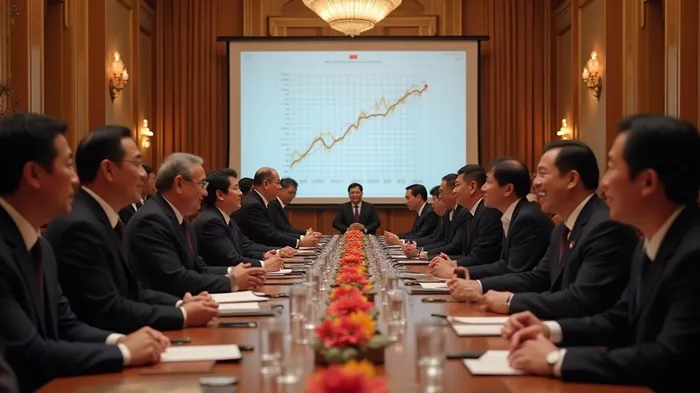
The Evolution of CMIM: From Crisis Response to Proactive Defense
The original CMIMCMCM--, established in 2000 as a response to the 1997–1998 Asian financial crisis, had long struggled with underutilization due to rigid conditions and bureaucratic hurdles. The updated framework now introduces an emergency loan system that allows member states to access funds swiftly without preconditions during sudden crises. This contrasts sharply with the previous reliance on IMF-style programs, which often came with austerity measures and lengthy negotiations.
The fund’s $240 billion size—split equally between Japan ($76.8B), China ($76.8B), South Korea ($38.4B), and ASEAN ($48B)—reflects the region’s growing economic heft. For context, . While smaller, the CMIM’s geographic focus and streamlined access mechanisms could make it more effective in addressing Asia-specific risks.
Implications for Investors: Mitigating Risk, Boosting Stability
The fund’s design directly addresses two key concerns for investors: currency volatility and sovereign credit risk. By providing a rapid liquidity backstop, the CMIM reduces the likelihood of currency devaluations or debt crises, which have historically spooked markets. For example, during the 1997 crisis, , which saw regional stock markets plummet by 50% or more. A modernized CMIM could have blunted such swings.
Investors in Asian equities and bonds should take note of the fund’s sectoral spillover effects. Sectors like green energy, infrastructure, and technology—already priorities for regional cooperation (e.g., Thailand’s partnership with South Korea’s KTR on green standards)—are likely to benefit from a more stable financial environment. Meanwhile, the reduced reliance on the IMF could ease political tensions tied to external oversight, fostering long-term economic confidence.
A Broader Trend: Regionalism in Action
The CMIM’s expansion is part of a broader push for regional economic integration, driven by geopolitical shifts and supply chain vulnerabilities. For instance, China and Japan—long rivals—have coordinated contributions to the fund, signaling a pragmatic detente. This collaboration is mirrored in trade deals like the Regional Comprehensive Economic Partnership (RCEP) and infrastructure projects under China’s Belt and Road Initiative (BRI), though the CMIM’s focus on financial resilience offers a distinct advantage.
Regional GDP growth, projected to outpace global averages, suggests that the CMIM’s stability mechanisms will underpin sustained investment flows into sectors like manufacturing, technology, and renewable energy.
Conclusion: A New Era of Asian Financial Resilience
The $240 billion CMIM represents more than an upgraded crisis fund—it’s a declaration of Asia’s economic maturity. By enabling rapid, condition-free assistance, the fund reduces the region’s reliance on external lenders like the IMF, which often come with political strings. For investors, this means lower systemic risk and greater predictability in markets from Tokyo to Jakarta.
Crucially, the CMIM’s success hinges on its execution. Historical underutilization of similar mechanisms must be avoided; the fund’s emergency loan system must prove accessible during real crises. Early signs are positive: the May 2025 agreement emphasized “proactive cooperation,” with plans to conduct stress tests for regional financial stability by 2026.
In the coming years, the CMIM could redefine Asia’s economic landscape, turning the region into a model of self-reliant crisis management. For global investors, this stability will translate into higher valuations for regional equities and bonds—particularly in sectors aligned with green tech and infrastructure—while mitigating the volatility that has historically deterred capital. The era of Asia’s financial independence has arrived.







Comentarios
Aún no hay comentarios