
Is Asbury Automotive Group's Low P/E Ratio a Hidden Buy Opportunity Amid Industry Volatility?
In the volatile landscape of the automotive retail sector, Asbury Automotive GroupABG-- (ABG) has emerged as a compelling case study for value investors. With a price-to-earnings (P/E) ratio of 8.88 as of October 2025, ABGABG-- trades at a significant discount to both the Consumer Cyclical sector average of 19.34 and its peer group average of 14.54. This valuation gap, coupled with robust earnings resilience and strategic operational improvements, raises a critical question: Is ABG's low P/E ratio a mispricing opportunity or a reflection of market skepticism?
Valuation Metrics: A Discount to Peers
ABG's P/E ratio of 8.88 is not merely below industry benchmarks-it is historically low. Analysts at Sahm Capital note that this multiple suggests the stock could be undervalued by up to 46% based on discounted cash flow (DCF) models. Such a disparity often signals market caution, particularly in cyclical industries like automotive retail, where macroeconomic headwinds and inventory volatility are persistent risks. However, for value investors, this discount may represent an opportunity to acquire a company with strong fundamentals at a fraction of its intrinsic value.
Earnings Resilience: The Parts/Service Segment as a Growth Engine
ABG's earnings resilience is anchored in its parts and service segment, which has demonstrated exceptional performance in 2025. In the third quarter alone, the segment reported a 15% year-over-year increase in gross profit, with same-store gross profit rising 7%. This growth was driven by a 58.8% gross profit margin-a 172-basis-point expansion from the prior year.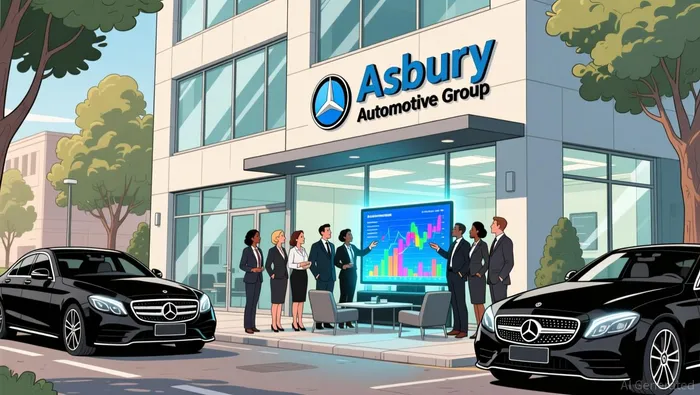 Such margins highlight the segment's ability to generate stable cash flows, even as new vehicle sales face cyclical pressures.
The strength of this segment is further amplified by ABG's strategic integration of the Herb Chambers acquisition, completed in July 2025. The acquisition added 12 luxury dealerships, enhancing ABG's footprint in high-margin brands like Mercedes-Benz and BMW. According to ABG's CEO, David Hult, the integration has already improved key operating metrics, including service retention rates and customer satisfaction scores. These improvements bode well for long-term earnings stability, particularly as luxury vehicle demand remains resilient amid broader economic uncertainty.
Strategic Acquisitions: Fueling Sustainable Growth
The Herb Chambers acquisition exemplifies ABG's disciplined approach to growth. By expanding its luxury portfolio, ABG has diversified its revenue streams and reduced reliance on commoditized new vehicle sales. This strategy is paying off: Q3 2025 results showed record revenue of $4.8 billion and net income of $147.1 million-a 16% year-over-year increase. Analysts at WardsAuto attribute this performance to the acquisition's role in boosting parts and service revenue, which grew 11% on a total company basis and 4% on a same-store basis.
Moreover, the acquisition has enhanced ABG's operational efficiency. The company's customer pay segment-comprising service and repair work-saw an 8% increase in same-store gross profit. This underscores ABG's ability to monetize recurring revenue streams, a critical advantage in an industry where new vehicle sales are increasingly unpredictable.
Industry Volatility and the Case for Value Investing
While ABG's low P/E ratio may reflect market concerns about the automotive sector's cyclical nature, its earnings resilience and strategic positioning suggest a different narrative. Unlike peers that rely heavily on new vehicle sales, ABG's diversified business model-anchored by high-margin parts and service operations-provides a buffer against macroeconomic shocks. For value investors, this combination of a discounted valuation and a durable earnings engine creates an attractive risk-reward profile.
Critics may argue that ABG's valuation discount reflects legitimate concerns about industry-wide challenges, such as supply chain disruptions or shifting consumer preferences. However, the company's ability to outperform peers in its parts and service segment, coupled with its strategic acquisitions, demonstrates a capacity to adapt and thrive in volatile conditions.
Conclusion: A Compelling Case for Long-Term Value
Asbury Automotive Group's low P/E ratio is not merely a statistical anomaly-it is a reflection of a company that is undervalued relative to its fundamentals. With a parts and service segment generating robust margins, a strategic acquisition that has enhanced its luxury portfolio, and a valuation that suggests significant upside potential, ABG presents a compelling opportunity for value investors. While industry volatility remains a risk, the company's earnings resilience and disciplined growth strategy position it as a strong candidate for long-term outperformance.





Comentarios
Aún no hay comentarios