
Asara Resources' $2.3M Raise and Exit of Paguanta Signal All-In Bet on Kada Gold Project
Asara Resources has taken a clear step to reshape its capital structure and focus. The company recently issued 2.5 million new shares to raise $2.3 million. This move, while providing immediate liquidity, directly dilutes the ownership stake of existing shareholders. The funds are earmarked for a strategic pivot: to divest its interest in the Paguanta copper-silver-lead-zinc project in Chile and concentrate all remaining resources on advancing its Kada gold project in Guinea.
This shift is a classic case of focusing on a core thesis. The company's profile has long included multiple projects, but the capital raise signals a decision to double down on one. The Kada project, located in Guinea's prolific Siguiri Basin, is now the sole operational focus. Its value proposition rests on expanding a 30.3 million tonne Indicated and Inferred Mineral Resource at 0.95 grams per tonne gold. The intrinsic value of this asset is more tangible, tied to a specific, drillable resource base in a known gold province.
By contrast, the value of the Paguanta project is inherently speculative. While it holds a JORC-compliant Mineral Resource of significant scale, its worth is tied to the future success of a complex base metal development. The recent announcement that Ajax Resources has entered into new conditional terms to acquire Paguanta for a nominal upfront payment and potential deferred cash triggers suggests Asara is effectively monetizing a high-risk, capital-intensive asset at a low premium. This allows the company to shed a project that requires substantial further investment and exploration, redirecting capital and management attention to a single, more focused opportunity.
Evaluating the Remaining Asset Base
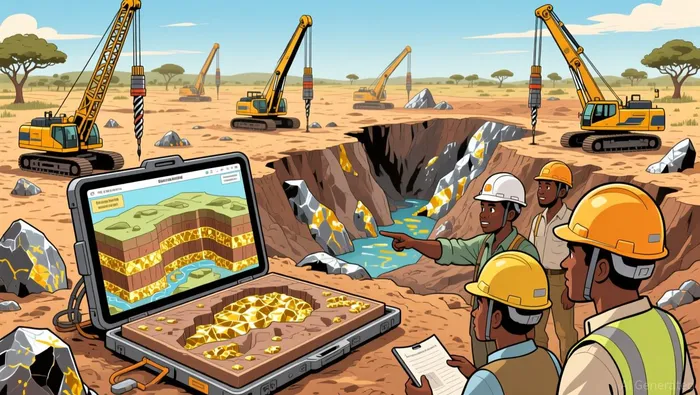
With its strategic pivot now underway, Asara's future hinges entirely on the Kada Gold Project. The asset's quality is defined by a tangible, drillable resource base. As of October 2023, the project holds an updated Indicated and Inferred Mineral Resource of 30.3 million tonnes at 0.95 grams per tonne gold, containing approximately 923,000 ounces. This is not a speculative concept but a foundational asset for expansion. The company's recent capital raise of $25 million is a direct vote of confidence in this resource, with proceeds earmarked to accelerate exploration and build on it. Location is a critical factor in assessing this resource's potential. Kada sits within the underexplored Siguiri Basin of West Africa, a region renowned for its prolific gold geology. This isn't a remote backwater; it is strategically located in West Africa surrounded by major active gold companies. This clustering effect is significant. It suggests the geological environment is favorable and that infrastructure and operational expertise are developing in the area, potentially lowering future development risks and costs for successful discoveries.
The company's commitment to unlocking value here is clear. The $25 million placement is not a one-time event but a capital allocation to a specific, aggressive exploration strategy. Funds will directly support Resource extension and infill drilling at Massan, as well as new work on recently granted Talico and Banan licenses. This is classic value-creation activity: using capital to test the boundaries of the known resource and identify new zones of mineralization. The goal is to grow the resource base, which is the primary lever for increasing the project's intrinsic value.
The bottom line is that Asara has distilled its portfolio to a single, focused opportunity. The Kada project offers a path to compound value through exploration, but it also carries the inherent risk of a junior miner's journey. Success will depend on converting this initial resource into a larger, higher-grade deposit and, ultimately, a bankable mine. The company's ability to execute its exploration plan with the newly raised capital will be the key test in the coming years.
Valuation and Risk Assessment
The capital raise has reshaped the investment equation. The company's market cap of A$116.3 million now represents the entire value of its remaining portfolio: a single, focused asset. To assess whether this price offers a margin of safety, we must calculate the implied valuation for the Kada resource alone. The project's 923,000-ounce resource is the sole basis for that valuation. At the current market cap, the market is assigning a value of roughly A$126 per ounce to this resource. That figure is notably below the typical cost to develop a gold mine, which often runs into hundreds of dollars per ounce. This suggests the market is pricing in a high probability of exploration risk-the chance that the current resource does not grow significantly through drilling.
The primary risk, therefore, is that the Kada project fails to deliver a meaningful resource upgrade. If the exploration program does not identify substantial new mineralization, the company will be left with a high-cost, low-value portfolio. The dilution from issuing 2.5 million new shares to raise capital would have been a costly mistake if the asset's intrinsic value was not substantial. The value of the capital raise is entirely contingent on the success of the exploration strategy at Kada. Without a successful outcome, the focused asset base offers little to offset the dilution.
A secondary but material risk is execution on the planned divestment of the Paguanta project. The company has entered into new conditional terms with Ajax Resources, but the deal is not yet final. Any delay or failure in this transaction could postpone the return of capital to shareholders and keep management's attention divided at a critical time. The strategic pivot to concentrate on Kada is only complete once the proceeds from Paguanta are secured and deployed. Until that happens, the company carries the dual burden of advancing a junior project while navigating a complex divestment.
The bottom line is one of high-stakes focus. The company has chosen a path of concentration, but its future value is now a binary bet on the success of a single exploration program. The current market valuation offers little cushion for failure. For a value investor, the setup demands patience and a clear-eyed view of the risks. The intrinsic value of the Kada resource is real, but its realization is not guaranteed. The company must execute flawlessly on its exploration plan to justify its current price.







Comentarios
Aún no hay comentarios