
Artisan Floating Rate Fund: A Defensive Anchor in a Volatile Rate Environment
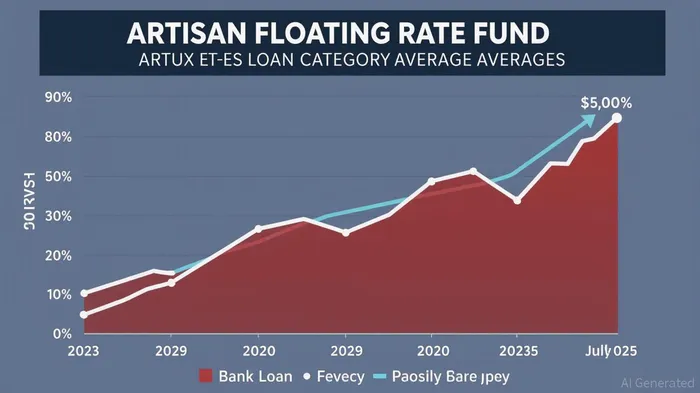
The second half of 2025 has been a masterclass in market resilience and fragility. From the abrupt selloff triggered by U.S. tariff hikes in April to the cautious recovery fueled by trade policy pauses, investors have faced a rollercoaster of volatility. Amid this turbulence, the Artisan Floating Rate Fund (ARTUX) has emerged as a standout performer, delivering 0.8% in July 2025—outpacing the Bank Loan category's 0.7% return. Year-to-date, its 3.8% gain, 0.8 percentage points above the category average, underscores its ability to navigate a rising rate environment with precision.
Strategic Positioning: Floating Rates as a Hedge
ARTUX's success stems from its core strategy: a focus on floating rate debt instruments. These securities adjust their coupon payments in line with benchmark interest rates, offering a natural hedge against rate hikes. As the Federal Reserve grapples with inflation stubbornly above 2% and a labor market that remains tight, the prospect of further rate increases—or at least prolonged high rates—has kept investors on edge. ARTUX's portfolio, with 91.1% allocated to bonds (83.2% domestic, 7.9% foreign) and 7.5% in cash, is structured to capitalize on this dynamic.
The fund's active management approach allows it to dynamically adjust its holdings, a critical advantage in a market where policy shifts can upend valuations overnight. For example, during the April selloff, ARTUX's emphasis on floating rate loans—many of which are rated below investment grade—helped cushion losses. These instruments, while riskier, offer higher yields and adjust more quickly to rate changes than fixed-rate counterparts. This flexibility has been a lifeline in a year where the Fed's policy path has been anything but linear.
A Rising Rate Tailwind
The fund's outperformance is not accidental. Floating rate loans, by design, thrive in environments where rates are climbing. As the Fed's policy rate inches higher, the income generated by these instruments increases, directly boosting the fund's returns. This is a stark contrast to fixed-rate bonds, which face price declines in a rising rate world. ARTUX's 72% portfolio turnover rate, while higher than average, reflects its ability to reposition quickly to capture these opportunities.
Consider the broader context: Treasury yields hit 4.2% in Q2 2025 as markets priced in growing fiscal pressures and inflation risks. In this environment, ARTUX's 6.75% average yield on high-yield floating rate notes (HY FRNs) becomes particularly compelling. These instruments, with their seniority in capital structures and lower volatility compared to traditional high-yield bonds, offer both income and downside protection. For investors wary of a potential economic slowdown, HY FRNs provide a buffer—historically averaging 5.2% carry (USD hedged) over the past decade.
Cost Considerations and the Active Edge
Critics may point to ARTUX's 1.22% expense ratio, 13% above the category average, as a drag on returns. However, the fund's active management justifies this premium. By avoiding underperforming credits—particularly in the CCC-rated cohort—and rotating into sectors like technology and industrials, the fund has minimized losses during market stress. For instance, during the April sell-off, ARTUX's avoidance of weak credits offset the drag of holding cash temporarily.
Moreover, the fund's 7.5% cash allocation provides liquidity to capitalize on buying opportunities during volatility. This is a strategic advantage in a market where liquidity can evaporate quickly, as seen during the tariff-driven selloff. While cash-heavy strategies often draw scrutiny, ARTUX's disciplined approach ensures it remains positioned to act when opportunities arise.
A Defensive Play for Uncertain Times
As the Fed contemplates a potential September rate cut, the market remains split between optimism and caution. While easing could support equities, the path to normalization is fraught with risks—persistent inflation, geopolitical tensions, and fiscal pressures. In this climate, ARTUX's defensive positioning becomes increasingly valuable. Its focus on floating rate debt, combined with active management and a diversified portfolio, offers a rare combination of income stability and capital preservation.
For investors seeking to hedge against rate uncertainty, ARTUX presents a compelling case. Its outperformance in 2025 is not a fluke but a reflection of a strategy tailored to the challenges of a rising rate environment. While the fund's expense ratio and turnover rate may deter some, the returns generated in volatile conditions suggest that the cost is justified.
Conclusion: Balancing Risk and Reward
The Artisan Floating Rate Fund is more than a passive play on rising rates—it is a dynamic, actively managed vehicle designed to thrive in uncertainty. Its ability to adjust to shifting policy landscapes, coupled with its focus on income-generating, rate-sensitive instruments, makes it a standout in a category where many funds struggle to differentiate. For investors prioritizing defensive positioning without sacrificing yield, ARTUX offers a compelling solution.
In a world where volatility is the new normal, the fund's strategic alignment with macroeconomic headwinds positions it as a key component of a resilient portfolio. As the Fed's next move looms, ARTUX's track record suggests it is well-equipped to navigate whatever comes next.







Comentarios
Aún no hay comentarios