
Artificial Intelligence and the Risk of a Tech Bubble in Billionaire-Driven Markets
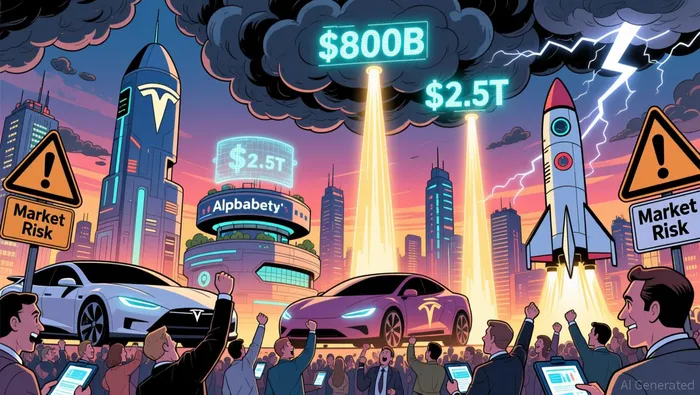
The artificial intelligence (AI) boom of 2025 has reshaped the fortunes of tech billionaires and the valuations of their flagship companies, but beneath the surface of this growth lies a growing debate about sustainability. TeslaTSLA--, SpaceX, and Alphabet-three pillars of the AI-driven economy-have seen their market values soar, fueled by speculative optimism and transformative technological promises. Yet, as the Bank of England warned in late 2025, markets are "particularly vulnerable to a sudden correction" if AI's potential fails to meet inflated expectations. This article evaluates whether AI hype has created overvaluation in these firms, the risks for investors, and the long-term sustainability of the wealth gains for top tech billionaires.
The AI-Driven Wealth Surge: Tesla, SpaceX, and Alphabet
Tesla's AI Gambit
Tesla's valuation in 2025 hinges on its AI initiatives, including autonomous driving (robotaxi services) and in-house AI chip development. Despite a projected revenue decline to $95 billion in 2025, analysts argue that Tesla's AI-driven projects could generate $5.9 billion annually by 2031, assuming a 5% market share in autonomous ride-hailing. However, the company's price-to-earnings (P/E) ratio of 279.5-far exceeding Alphabet's forward P/E of 23-raises concerns about overvaluation. With automotive margins under pressure and reliance on speculative AI narratives, Tesla's stock faces a precarious balance between innovation and reality.
Alphabet's Calculated Bet
Alphabet's AI division has demonstrated more disciplined growth, with revenues from generative AI products surging by over 200% year-over-year in 2025. The company's stake in SpaceX, now valued at $800 billion, has generated an unrealized $8 billion gain in Q1 2025 alone. Alphabet's strong cash flow-$112 billion in operating cash from the first nine months of 2025-provides a buffer against speculative risks. However, its exposure to SpaceX's rumored $1.5 trillion IPO by 2026 could amplify gains or losses depending on market sentiment according to analysts.
SpaceX's High-Stakes Valuation
SpaceX's private market valuation of $800 billion in 2025 is a testament to its dominance in satellite internet and launch services according to Fortune. Yet, its long-term sustainability depends on AI's role in optimizing logistics and automation-a factor not yet fully monetized. ARK Invest projects an enterprise value of $2.5 trillion for SpaceX by 2030, but this assumes continued success in capital-intensive ventures without clear revenue diversification.
Billionaire Fortunes and the Risks of Paper Wealth
Elon Musk's net worth surged to $645 billion in 2025, driven by Tesla and xAI, while Larry Page and Sergey Brin added $102 billion and $92 billion respectively to their fortunes. These gains, however, are largely tied to unrealized assets. For instance, Alphabet's $8 billion gain from SpaceX is classified as an "unrealized gain" on non-marketable equity securities, boosting reported net income without affecting cash flow.
The fragility of this wealth is underscored by Howard Marks' warning of an "AI-fueled stock bubble" and potential job losses in the millions. If AI adoption fails to deliver promised productivity gains by 2027, a correction could erase billions in paper wealth for billionaires and investors alike.
Financial Sustainability and Market Risks
Profitability and Debt Metrics
Alphabet's AI division remains profitable, with Google Cloud reporting a 32% revenue increase in Q2 2025. Its $100 billion cash reserves and $20 billion in debt provide financial flexibility. In contrast, Tesla's energy division-its most profitable segment-is expected to scale to 50 GWh of annual output by 2027, but automotive sales face headwinds as EV incentives phase out.
Regulatory and Adoption Risks
The AI market's projected $1.81 trillion valuation by 2030 relies on rapid adoption across industries. However, regulatory shifts-such as stricter data privacy laws and AI governance requirements-could slow growth. By 2026, agentic AI will redefine wealth management, but firms lacking robust compliance frameworks may struggle.
Lessons from the Dot-Com Bubble
Parallels to the 2000 dot-com crash are frequently drawn, but today's AI firms differ in key ways. Unlike the dot-com era, most AI companies have established revenue streams. Yet, overinvestment in infrastructure (e.g., $5-7 trillion in U.S. data center capacity from 2026–2030) risks creating an "AI air pocket" if returns fail to materialize.
Investor Implications for 2026–2030
Experts project a splintering of the AI market by 2026, with investors favoring firms that demonstrate execution-driven growth over speculative narratives. Alphabet's disciplined AI monetization and Tesla's energy division offer relative stability, while SpaceX's valuation remains a high-risk, high-reward bet.
For billionaires, the sustainability of their AI-driven wealth will depend on balancing innovation with profitability. As Goldman Sachs notes, AI capex of $527–$571 billion in 2026 will likely concentrate in a handful of firms, leaving others vulnerable to valuation corrections.
Conclusion
The AI-driven wealth surge of 2025 has created unprecedented opportunities for tech billionaires and investors, but it also carries echoes of past speculative bubbles. While Alphabet's financial discipline and Tesla's energy ambitions offer some resilience, overvaluation risks persist, particularly for firms relying on hype rather than proven monetization. As 2026 approaches, the true test of AI's transformative potential will lie in its ability to deliver sustainable, earnings-driven growth-not just inflated valuations.





Comentarios
Aún no hay comentarios