
Array Technologies: Navigating Near-Term Headwinds While Positioning for Long-Term Solar Tracker Dominance
Array Technologies (ARRY) has emerged as a pivotal player in the solar tracker industry, balancing robust near-term financial performance with strategic initiatives to secure long-term growth. However, investors must weigh the company's current momentum against a backdrop of regulatory and macroeconomic headwinds. This analysis evaluates the sustainability of Array's valuation by dissecting its recent results, near-term risks, and long-term competitive advantages.
Financial Performance: A Foundation of Resilience
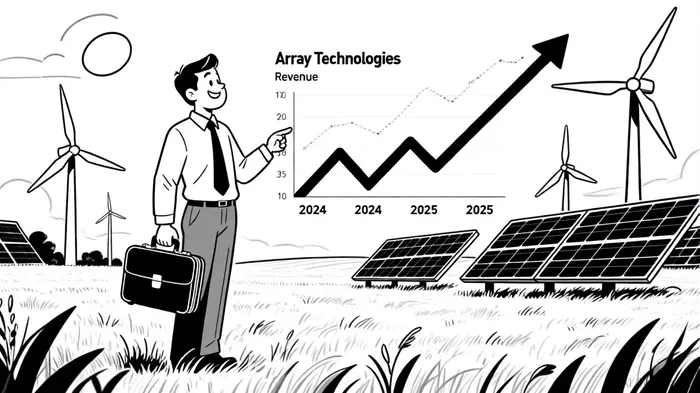
Array's Q2 2025 results underscore its operational strength. Revenue surged 42% year-over-year to $362.2 million, driven by strong order intake and margin expansion, according to the company's Q2 press release. Gross margins reached 26.8% (GAAP) and 27.8% (adjusted), while adjusted EBITDA hit $63.6 million, translating to a 17.5% margin, per the earnings call transcript. Net income grew by 68% to $43.3 million, with adjusted net income per share rising to $0.25-surpassing Wall Street's $0.19 forecast, in a QuiverQuant report. These figures reflect disciplined cost management and pricing power, even as the company navigates a challenging macroeconomic environment.
The firm's capital structure has also improved significantly. Array repaid its term loan in full, repurchased $100 million of convertible notes at a 20% discount, and issued $345 million in new notes to fund growth, according to a Yahoo Finance analysis. These actions reduced interest expenses and positioned the company to capitalize on its $1.8 billion in executed contracts and awarded orders as of Q2 2025, as noted in the earnings call highlights. Analysts have responded positively, with 18 covering the stock assigning a "Buy" rating and an average price target of $9.47-implying an 8.35% upside from current levels, per the StockAnalysis forecast.
Near-Term Headwinds: Regulatory Uncertainty and Cost Pressures
Despite these gains, Array faces near-term challenges that could temper its growth trajectory. Regulatory shifts in the U.S. and abroad are causing delays in utility-scale solar projects. For instance, uncertainty around tax credit eligibility and changes to safe harbor criteria have led customers to postpone commitments, reducing order intake activity, per the GuruFocus earnings call summary. Internationally, high interest rates-such as Brazil's 15% benchmark-complicate financing for large-scale solar installations, further stalling expansion plans, according to a Fortune Business Insights report.
Commodity price volatility and tariffs are also squeezing gross margins. Rising steel and aluminum costs, coupled with trade barriers, have increased input expenses for solar trackers, in a CanvasBusinessModel analysis. Array has mitigated some of these pressures by reconfiguring low-margin projects under legacy contracts, but the broader industry remains vulnerable to supply chain disruptions, as highlighted in a BeyondSPX analysis.
Long-Term Growth: Innovation, Market Expansion, and Strategic Acquisitions
Array's long-term prospects hinge on its ability to innovate and scale. The company has invested heavily in R&D, allocating $1.9 million in Q1 2024 and securing 22 new patents in 2024 alone, per a DCFModeling post. Innovations like the Hail XP tracker and SmarTrack software address niche market needs, such as extreme weather resilience and real-time performance optimization, per MarketBeat coverage. These advancements not only enhance product differentiation but also align with the Inflation Reduction Act's (IRA) incentives for domestic manufacturing, as Array aims to produce 100% U.S.-made trackers by mid-2025, according to a SWOTAnalysisExample note.
Geographic diversification is another pillar of Array's strategy. While the U.S. accounts for 70% of its revenue, the company is aggressively targeting Latin America, Europe, and Africa-markets where solar adoption is accelerating, according to Seeking Alpha. The $179 million acquisition of APA Solar, expected to close soon, is a case in point. This deal adds engineered foundations and fixed-tilt racking systems to Array's portfolio, expanding its total addressable market by 40% (as discussed in the earnings call highlights). Similarly, the 2022 acquisition of STI Norland has bolstered its presence in Canada and Australia, per a GlobeNewswire release.
The solar tracker market itself is poised for explosive growth. With a 2023 value of $7.88 billion and a projected 14.3% CAGR through 2032, the industry is set to reach $25.24 billion by decade's end (as estimated by StockAnalysis). Array's goal of capturing 35.2% of the global market-a 10-point lead over its nearest competitor-positions it to benefit from this expansion, according to a BeyondSPX analysis.
Valuation Sustainability: A Calculated Bet
Array's current valuation appears undervalued relative to its long-term potential. A fair value estimate of $9.30, derived from analyst price targets and discounted cash flow models, suggests the stock is trading below intrinsic value, as noted in the earlier Yahoo Finance analysis. However, this optimism is contingent on the company navigating near-term headwinds. Regulatory clarity in the U.S. and Brazil, coupled with stable commodity prices, would accelerate project execution and margin recovery. Conversely, prolonged policy delays or interest rate hikes could erode confidence.
Investors should also monitor Array's balance sheet. While its $345 million convertible note issuance strengthened liquidity, the company's leverage ratio remains elevated at 2.5x EBITDA. Prudent capital allocation-such as its recent share repurchases-will be critical to maintaining credit ratings and investor trust, as outlined in the company's GlobeNewswire financial release.
Conclusion
Array Technologies stands at a crossroads. Its Q2 2025 results and strategic acquisitions demonstrate a resilient business model capable of outperforming industry peers. Yet, regulatory and macroeconomic risks remain significant. For long-term investors, the company's R&D investments, geographic diversification, and alignment with the IRA provide a compelling case for growth. However, near-term volatility is inevitable. Those willing to weather short-term uncertainties may find Array's valuation offers an attractive entry point into a sector poised for decades of expansion.





Comentarios
Aún no hay comentarios