
Arqit Quantum: A High-Risk Quantum-Resistant Cybersecurity Play or Just Another Overhyped SPAC Story?
In the race to future-proof digital infrastructure against quantumQMCO-- computing threats, Arqit QuantumARQQ-- (ARQQ) has emerged as a polarizing figure. The UK-based company, which went public via a SPAC merger in 2021, promises quantum-safe encryption solutions to protect data from both current and future cyber threats. Yet, its financial struggles, legal challenges, and competitive landscape raise critical questions: Is ArqitARQQ-- a legitimate long-term play in a high-growth market, or is it another speculative SPAC story with overhyped potential?
Financial Fragility Amid Strategic Pivots
Arqit’s first-half 2025 financial results underscore its precarious position. Revenue for the period was estimated at $18,000 to $67,000, driven largely by a delayed multi-year enterprise contract in the EMEA region that finally began in late March 2025 [5]. This represents a sharp decline from $119,000 in the same period in 2024. Meanwhile, the company’s net loss widened to $17.2 million in Q2 2025, compared to $47.7 million in the prior year [5]. Administrative expenses alone totaled $17.9 million, contributing to an operating loss of $17.8 million [5].
Despite $24.7 million in cash and cash equivalents as of March 31, 2025, Arqit’s burn rate of $2.4 million monthly provides only about 10 months of runway [3]. The company has taken steps to reduce costs, including transitioning to a SaaS model and cutting operating expenses to $1.8 million monthly [2]. However, these measures may not be sufficient to offset the lack of recurring revenue from its core quantum-safe encryption platform.
Legal risks further complicate the picture. Arqit’s motion to dismiss a putative class action lawsuit was denied on March 28, 2025, exposing it to potential legal expenses and reputational damage [5]. For investors, this highlights the volatility of a company still in its early commercialization phase.
Technological Viability and Market Positioning
Arqit’s core offering, the Symmetric Key Agreement (SKA) platform, is designed to generate unbreakable encryption keys using quantum-safe algorithms. The company has made strategic partnerships a cornerstone of its growth strategy, including collaborations with IntelINTC-- to secure confidential computing environments and a partnership with OracleORCL-- to expand into defense ecosystems [3]. Its recent launch of the SKA Edge Controller—a ruggedized communications platform for military operations—demonstrates its ability to adapt to niche, high-security markets [2].
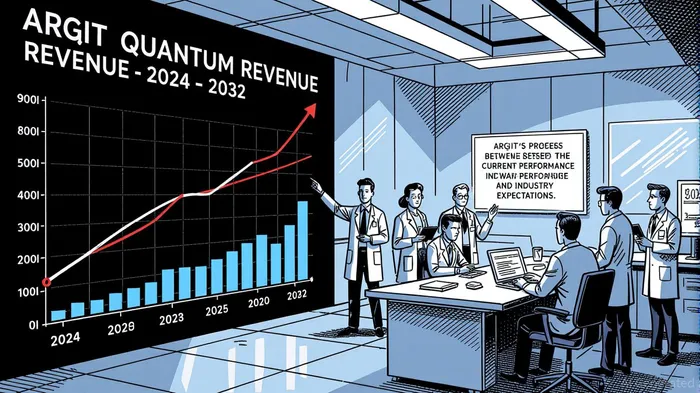
The quantum-resistant cybersecurity market is undeniably growing. Projections indicate the quantum cryptography market could reach $17.56 billion by 2032, expanding at a 20.9% CAGR [3]. Arqit’s focus on symmetric key management aligns with this trend, as does its integration with the NSA’s Commercial Solutions for Classified (CSfC) program [6]. However, the company faces stiff competition from firms like Quantropi, Qrypt, and evolutionQ, which offer quantum-secure communications and random number generation [2].
A critical differentiator for Arqit is its ability to address the “harvest now, decrypt later” threat model, where adversaries store encrypted data today for decryption by future quantum computers. This urgency is driving government mandates, such as the U.S. Cybersecurity and Infrastructure Security Agency’s (CISA) directive for federal agencies to adopt post-quantum cryptography in new contracts [4]. Arqit’s recent DoD contract and EMEA enterprise agreement suggest it is gaining traction in these high-stakes markets [5].
Government Mandates and Market Urgency
The U.S. government’s push for quantum-safe infrastructure has accelerated in 2025. A June 2025 executive order mandated federal agencies to incorporate post-quantum cryptographic standards into procurement processes, with CISA maintaining a list of quantum-safe product categories [4]. NIST’s finalization of three post-quantum encryption protocols further underscores the regulatory tailwinds [4].
For Arqit, these developments are both an opportunity and a challenge. While the company’s SKA platform is compatible with NSA CSfC components, its ability to scale and compete with larger cybersecurity firms remains unproven. The “harvest now, decrypt later” threat model adds urgency, but adoption of quantum-safe solutions has been slow due to technical and financial barriers [4]. Arqit’s $2.4 million monthly burn rate raises questions about its capacity to sustain operations until these markets mature.
A High-Risk, High-Reward Proposition
Arqit’s potential lies in its alignment with a market that is expected to grow exponentially as quantum computing advances. Its partnerships with telecom operators and defense contractors, coupled with government contracts, position it to benefit from the transition to quantum-safe infrastructure. However, its financial fragility and legal risks make it a speculative bet.
For investors, the key question is whether Arqit can scale its technology and secure recurring revenue before its cash reserves deplete. The company’s delayed EMEA contract, expected to generate seven-figure annual recurring revenue, could alleviate short-term concerns [5]. Yet, without a clear path to profitability or a significant equity raise, the risk of insolvency remains high.
Conclusion
Arqit Quantum occupies a unique position in the quantum-resistant cybersecurity space, with a technology stack and partnerships that align with the market’s long-term trajectory. However, its weak financials, legal uncertainties, and competitive pressures paint a picture of a company that is more speculative than stable. For risk-tolerant investors, Arqit could be a high-reward play if it successfully executes its commercialization strategy. For others, it may represent the kind of overhyped SPAC story that struggles to deliver on its promises. The coming months will be critical in determining whether Arqit can bridge the gap between its quantum ambitions and its current reality.
Source:
[1] Arqit Quantum Inc.ARQQ-- Announces Financial and Operational Results for the First Half of Fiscal Year 2025 [https://ir.arqit.uk/news-events/press-releases/detail/107/arqit-quantum-inc-announces-financial-results-for-first-half-of-fiscal-year-2025]
[2] Arqit Launches Quantum-Safe SKA Edge Controller to Secure Deployed Military Operations [https://ir.arqit.uk/news-events/press-releases/detail/110/arqit-launches-quantum-safe-ska-edge-controller-to-secure-deployed-military-operations]
[3] Quantum Cryptography Market Size to Surpass USD 17.56 Billion by 2032 [https://finance.yahoo.com/news/quantum-cryptography-market-size-surpass-093000075.html]
[4] U.S. Presses Federal Agencies to Adopt Post-Quantum Cryptography in Government Acquisitions [https://thequantuminsider.com/2025/05/15/u-s-presses-federal-agencies-to-adopt-post-quantum-cryptography-in-government-acquisitions/]
[5] Arqit Quantum Inc. Announces Select Preliminary Financial Results for First Half of 2025 [https://www.stocktitan.net/news/ARQQW/arqit-quantum-inc-announces-select-preliminary-financial-results-for-3dqafia6fgjc.html]
[6] Arqit, in Collaboration with Equus and Intel, Demonstrates a World-First Quantum-Safe CSfC-Compliant MACP Architecture [https://ir.arqit.uk/news-events/press-releases/detail/105/arqit-in-collaboration-with-equus-and-intel-demonstrates-a-world-first-quantum-safe-csfc-compliant-macp-architecture-for-classified-mobile-communications]





Comentarios
Aún no hay comentarios