
Under Armour's Strategic Shift: Implications of the Stephen Curry Brand Separation
The Financial Rationale: Costs and Revenue Projections
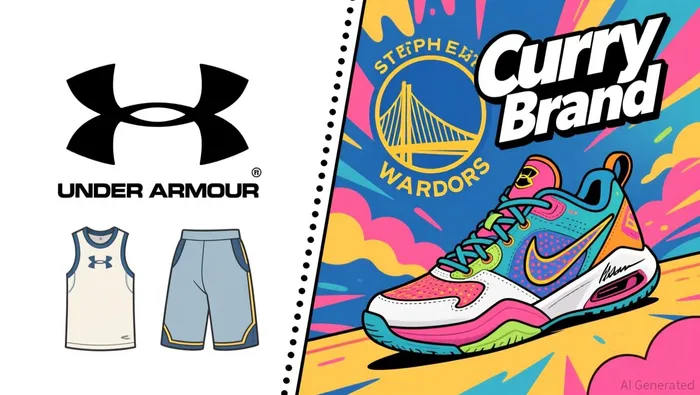
Under Armour's restructuring plan, now expanded to $255 million, reflects a disciplined approach to refocusing on its core brand. The Curry Brand, launched in 2020, for fiscal 2026. However, the company projects that this revenue stream will not offset the costs of maintaining the partnership, particularly as the sportswear market becomes increasingly fragmented. By ending the 13-year collaboration, Under ArmourUAA-- aims to streamline operations and redirect resources toward its core UA brand according to market analysis.
The final collaboration product, the Curry 13 shoe, is , with additional products available through October 2026. While this timeline suggests a gradual transition, . Analysts have noted that the move aligns with Under Armour's broader strategy to prioritize profitability over brand diversification.
Strategic Realignment: Focusing on Core Competencies
The separation of the Curry Brand underscores Under Armour's return to fundamentals. For years, the company has struggled to compete with Nike and Adidas, while newer entrants like On Holdings and Alo Yoga have captured market share with niche offerings. By ending the Curry partnership, Under Armour is signaling a shift away from celebrity-driven branding-a strategy that, while initially successful, has proven unsustainable in a crowded market.
's personal stake in the Curry Brand further complicates the financial calculus. In 2023, he received 8.8 million Under Armour shares valued at $75 million according to financial records, aligning his interests with the company's stock performance. However, the separation suggests that Under Armour's leadership now views the Curry Brand as a liability rather than an asset, given the rising costs of maintaining the partnership and the brand's limited scalability beyond basketball-specific products as reported in industry analysis.
Competitive Landscape: A Harsh Reality
Under Armour's Q3 2025 results highlight the challenges it faces in the sportswear industry. The company reported a $18.8 million loss for the quarter, . Revenue fell 5% to $1.3 billion, as projected by market analysts. These figures underscore the difficulty of competing with Nike's dominance and Adidas's aggressive digital strategies, while also fending off agile startups.
The Curry Brand's separation may free Under Armour to invest in innovation and direct-to-consumer channels, but the company's recent financial performance suggests that such efforts will take years to bear fruit. Analysts remain skeptical about Under Armour's ability to regain market share without a clear differentiator.
Long-Term Risks and Opportunities
While the Curry separation reduces short-term costs, it also eliminates a significant revenue stream. The Curry Brand's contribution to Thirty Ink-a joint venture between Curry and Under Armour-was reported at $173.5 million in 2024. Losing this partnership could stifle growth in the basketball segment, where Under Armour has historically lagged behind Nike. However, the move may also allow the Curry Brand to operate independently, potentially unlocking new revenue opportunities outside the shadow of Under Armour's struggling core business as outlined in restructuring plans.
For shareholders, the key risk lies in Under Armour's ability to execute its refocused strategy. The company's projected global basketball revenue for 2026 ($100–120 million) is modest compared to its peers, and its broader sportswear ambitions remain unproven. Without a compelling product pipeline or a stronger digital presence, Under Armour risks becoming a niche player in a market dominated by giants.
Conclusion: A Calculated Bet
Under Armour's separation from the Curry Brand is a calculated bet on long-term profitability over short-term brand equity. While the move reduces financial drag and aligns with industry trends toward leaner operations, it also exposes the company to heightened competition and revenue uncertainty. Investors must weigh the immediate costs of restructuring against the potential for a more focused, agile Under Armour. In a sportswear landscape defined by innovation and scale, the company's success will hinge on its ability to reinvent itself-not just as a challenger to Nike and Adidas, but as a brand that resonates with a new generation of athletes.







Comentarios
Aún no hay comentarios