
ARM's Strategic Pivots and AI-Driven Growth Potential in a Secular Semiconductor Boom
Raymond James' Reinstated Coverage: A Mixed Signal
Raymond James' November 2025 reinstatement of ARMARM-- coverage underscores the firm's cautious optimism. The analyst assigned a "Market Perform" rating, with no price target, citing ARM's "long-term potential in AI" but also flagging "strategic uncertainty and valuation challenges" according to Raymond James' analysis. This duality reflects the broader market's ambivalence toward ARM's evolving strategy. On one hand, the firm acknowledged ARM's growing exposure to the data center market, where 20% of its sales now come from hyperscalers like Amazon, Google, and Microsoft. On the other, it warned that ARM's potential shift to a fabless semiconductor supplier-while promising higher profit margins-could reduce its stock multiple by distancing it from its traditional licensing model.
Notably, Raymond James' analysis also included a conflicting "Moderate Buy" rating with an average price target of $179.80, reflecting Wall Street's optimism about ARM's AI-driven growth. However, the firm tempered this with a cautionary note on semiconductor valuations, which remain "rich" amid risks in non-AI sectors and software constraints that could dampen near-term growth according to industry analysis. This dichotomy highlights the delicate balance ARM must strike between short-term execution and long-term innovation.
Strategic Pivots: From Licensing to Chiplets and Beyond
ARM's strategic roadmap for 2025 is anchored in three key pillars: chiplet-based design, direct chip production, and AI-optimized architectures. According to Arm's 2025 tech predictions, the company is rethinking silicon design to prioritize performance per watt, performance per area, and total cost of ownership-metrics critical for AI workloads. The adoption of chiplets, modular semiconductor components that can be combined to create customized solutions, aligns with the industry's shift toward heterogeneous computing. By leveraging the Arm Chiplet System Architecture (CSA), ARM aims to enable partners to scale and differentiate their silicon offerings more effectively, a move that could accelerate AI adoption in data centers and edge computing.
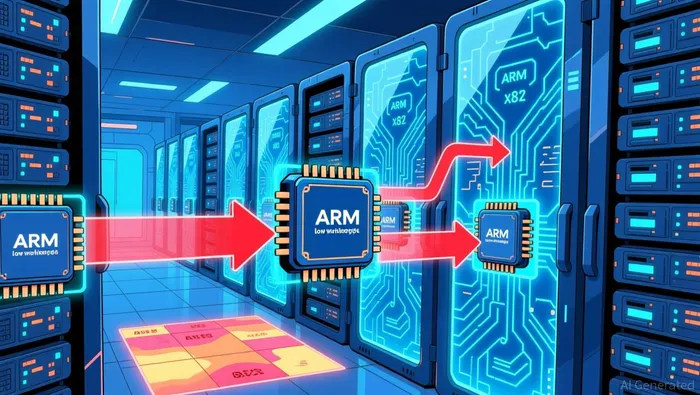
Equally significant is ARM's pivot toward direct chip production. Historically a pure-play IP licensing firm, ARM is now developing and selling its own AI accelerator chips for hyperscale data centers according to market reports. This shift, while risky, could unlock new revenue streams and reduce reliance on third-party manufacturers. As Raymond James noted, this transition may increase ARM's profit margins but could also dilute its valuation multiple by altering its business model.
AI-Driven Semiconductor Growth: A Tailwind for ARM
The AI semiconductor market is projected to grow at a compound annual growth rate (CAGR) of 23%, reaching $457 billion by 2030. This surge is fueled by generative AI's rise and the expansion of data centers, with GPU usage remaining dominant while AI ASICs and ARM CPUs gain traction according to industry data. ARM's position in this landscape is bolstered by its partnerships with hyperscalers and its focus on energy efficiency-a critical differentiator in an era where power consumption is a key constraint for AI workloads according to Reuters analysis.
ARM's ambition to capture 50% of the data center CPU market by 2025-up from 15% in 2024-reflects its confidence in this trajectory. However, analysts remain skeptical, with some estimating a more realistic target of 20–23% by year-end according to market forecasts. This ambition directly challenges Intel's dominance and AMD's growing influence, as both companies have made significant strides in the x86 server CPU market. In Q3 2025, AMD's x86 server CPU share reached 27.8%, while Intel's fell to 72.2% according to market data. ARM's Q3 revenue forecast of $1.23 billion, driven by AI demand, further underscores its competitive positioning.
Competitive Dynamics: ARM vs. Intel and AMD
The data center CPU market is a battleground for ARM, Intel, and AMD. Intel's Q3 2025 microprocessor unit share fell to 64.2%, while AMD and ARM gained ground, securing 22.1% and 13.7% of the market, respectively according to market analysis. AMD's Q3 revenue of $9.2 billion, driven by its EPYC and Instinct MI300X products, highlights its strength in the AI segment. Meanwhile, ARM's Q3 revenue of $1.23 billion, exceeding Wall Street estimates, signals its ability to compete on both performance and efficiency according to financial reports.
However, ARM's path to dominance is not without hurdles. Intel's recent investments, including $8.9 billion in equity stakes, and AMD's aggressive roadmap for AI-optimized CPUs pose significant challenges. Additionally, ARM's ambitious 50% market share target may prove aspirational, given the entrenched positions of its rivals and the complexities of transitioning to a fabless model.
Risks and Valuation Considerations
Despite its strategic strengths, ARM faces several risks. The semiconductor industry's valuation multiples remain elevated, with AI-driven stocks trading at premiums that may not be sustainable in a downturn. Moreover, ARM's shift to direct chip production could expose it to manufacturing risks and margin pressures, particularly if demand for AI semiconductors slows. Non-AI sectors, such as consumer electronics and software, also present headwinds, as these markets are less insulated from macroeconomic volatility according to Raymond James' analysis.
Conclusion: A High-Conviction Play in a Secular Boom
ARM's long-term upside is inextricably tied to the secular growth of AI and the semiconductor industry's shift toward energy-efficient, customizable silicon. While Raymond James' mixed signals and competitive pressures warrant caution, ARM's strategic pivots-particularly its embrace of chiplets and direct chip production-position it to capitalize on the AI-driven semiconductor boom. For investors with a multi-year horizon, ARM represents a compelling, albeit high-risk, bet on the future of computing.





Comentarios
Aún no hay comentarios