
ARKF and the Future of Thematic ETFs: Balancing Portfolio Management with High-Growth Potential
In the ever-evolving landscape of modern investing, thematic ETFs like the ARKARK-- Blockchain & Fintech Innovation ETF (ARKF) have emerged as both a beacon of innovation and a test of patience. As artificial intelligence (AI) and blockchain technologies redefine industries, ARKF's role in capturing these transformative trends has drawn significant attention-and scrutiny. This article examines ARKF's performance relative to traditional benchmarks like the S&P 500, its resilience during market turbulence, and the strategic value of its AI and blockchain focus, drawing on ARK Invest's research and real-world outcomes to assess its place in a diversified portfolio.
A Tale of Volatility and Resilience
ARKF's journey over the past five years has been marked by dramatic swings. In 2020, as the global economy reeled from the pandemic, the S&P 500 surged 18.40%, while ARKFARKF-- plummeted by 17.82%. This divergence reflected the ETF's heavy exposure to high-growth, disruptive technologies, which often underperform during liquidity crunches. However, ARKF's volatility proved to be a double-edged sword. By 2021, the ETF repeated its -17.82% loss, contrasting sharply with the S&P 500's 28.71% gain.
The 2022 crypto downturn, however, tested ARKF's mettle. The ETF slumped by 65.07%, far outpacing the S&P 500's -18.11% decline. Yet, this collapse masked a strategic pivot. As the crypto market faltered, ARKF shifted its focus toward AI-driven fintech firms like PayPal, Adyen, and Toast, while expanding holdings in Circle and Robinhood. This recalibration paid off in 2023, when ARKF rebounded with a 93.27% return, outperforming the S&P 500's 26.29%. By 2025, ARKF had gained 28.67%, slightly edging out the S&P 500's 22.78%.
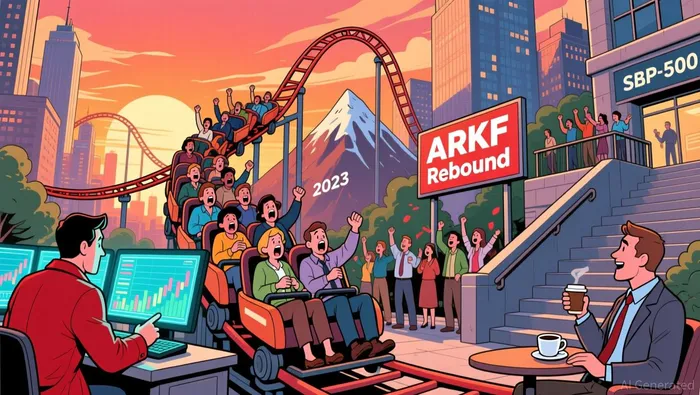
Thematic Alpha: AI and Blockchain as Growth Catalysts
ARKF's performance is inextricably tied to its thematic focus. ARK Invest's white papers underscore AI's potential to revolutionize productivity. For instance, generative AI tools like DALL-E-2 and ChatGPT are projected to boost knowledge worker productivity by over fourfold by 2030, potentially adding $200 trillion to global labor productivity. Similarly, blockchain's disruptive potential- highlighted in ARK's 2023 paper on Cointime Economics-positions ARKF to capitalize on decentralized finance (DeFi) and digital asset infrastructure.
These themes are not speculative. ARKF's portfolio includes companies like Square Inc. and MercadoLibre, which are already leveraging blockchain for cross-border payments and AI for customer analytics. The ETF's 2025 outperformance during the crypto downturn, despite Bitcoin's 7% decline, illustrates how strategic diversification within AI and fintech can mitigate sector-specific risks.
Strategic Allocation: Balancing Risk and Reward
While ARKF's volatility is undeniable-its 50-day volatility of 33.62% dwarfs the S&P 500's typical 10-15%-its role in a diversified portfolio hinges on strategic allocation. During the 2020 market crash, ARK's broader innovation ETF (ARKK) outperformed the S&P 500 by gaining 150% as investors flocked to high-growth tech stocks. However, the 2022 selloff, which saw ARKK drop 81% from its 2021 peak, underscores the risks of overexposure to speculative themes.
The key lies in balancing ARKF's high-growth potential with risk management. For instance, its 2023 rebound-tripling in value over three years-demonstrates the power of long-term conviction in innovation-driven sectors. Investors who weathered the 2022 downturn were rewarded with outsized gains, aligning with ARK's thesis that disruptive technologies often require patience to realize their full potential.
Conclusion: A Strategic Bet on the Future
ARKF's performance trajectory-from 2020's collapse to 2025's resilience-reflects the inherent risks and rewards of thematic investing. While its volatility may deter risk-averse investors, its strategic alignment with AI and blockchain positions it as a compelling vehicle for those seeking exposure to the next wave of innovation. ARK Invest's research, from AI productivity forecasts to blockchain use cases, provides a robust framework for understanding these themes' long-term value.
For investors willing to tolerate short-term turbulence, ARKF offers a unique opportunity to participate in the transformation of global industries. However, its role in a portfolio should be carefully calibrated, ensuring that its high-growth potential complements, rather than undermines, broader diversification goals. In an era where technological disruption is the norm, ARKF exemplifies the promise-and perils-of betting on the future.





Comentarios
Aún no hay comentarios