
Arhaus's Revenue and Profit Transparency: Evaluating Business Model Sustainability and Investor Confidence
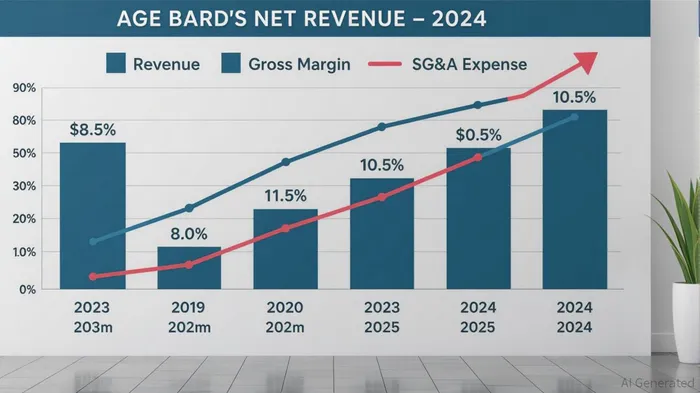
Investors evaluating ArhausARHS--, Inc. (NASDAQ: ARHS) must grapple with a paradox: the company's aggressive showroom expansion and robust revenue growth mask underlying margin pressures that could test the durability of its business model. According to the company's 2024 10-K filing, Arhaus reported $1,271 million in annual revenue, driven by 11 new showroom openings and 5 relocations, bringing its total to 103 locations by year-end [1]. Yet this growth came at a cost—gross margin contracted by 7.3% year-over-year, while selling, general, and administrative (SG&A) expenses surged 10.5%, outpacing revenue gains. These trends raise critical questions about the transparency of Arhaus's profitability and its ability to sustain long-term value creation.
Financial Transparency: A Tale of Two Metrics
Arhaus's financial disclosures highlight a divergence between top-line momentum and bottom-line resilience. While net revenue grew to $1,271 million in 2024, the 7.3% decline in gross margin—driven by higher material and logistics costs—suggests vulnerability to input inflation and pricing power constraints [1]. Meanwhile, SG&A expenses ballooned by 10.5%, reflecting increased marketing and operational costs tied to showroom expansion. Despite these headwinds, the company managed $133 million in adjusted EBITDA and ended the year with $198 million in cash, a debt-free balance sheet, and $69 million in net income [1].
This financial duality underscores a key challenge for investors: Arhaus's transparency in reporting operational costs and margin compression is commendable, but the lack of granular data on unit economics and customer acquisition costs limits a full assessment of scalability. For instance, while the company attributes showroom growth to “strategic relocations” and “enhanced customer engagement,” it does not quantify the incremental revenue or profitability of new locations [1]. Such opacity could deter capital allocation decisions, particularly in a sector where physical retail footprints remain capital-intensive.
ESG and Sustainability: A Mixed Picture
Arhaus's sustainability initiatives, though laudable, add another layer of complexity to its transparency profile. The company has pledged $10 million to The Nature Conservancy to protect 54,000 acres of Borneo rainforest and committed to planting one million trees via American Forests since 2017 [2]. These efforts, coupled with a “low controversy” rating on Sustainalytics, signal a commitment to environmental stewardship [3]. However, the absence of a standalone 2024 ESG report and subscription-based access to detailed ESG scores on platforms like S&P Global and CSRHub create a gap in accountability [2][4].
This partial transparency aligns with broader industry trends, where public ESG disclosures often prioritize headline-grabbing initiatives over measurable KPIs. For Arhaus, the challenge lies in balancing its green credentials with the financial realities of a manufacturing and retail business. While its rainforest preservation efforts mitigate climate risks, they do not address supply chain emissions or labor practices—areas where deeper disclosure would bolster investor confidence.
Investor Confidence: Balancing Optimism and Caution
The interplay between Arhaus's financial and ESG transparency ultimately shapes investor sentiment. On one hand, the company's debt-free status, cash reserves, and showroom expansion demonstrate fiscal prudence and growth ambition. On the other, margin declines and opaque unit economics introduce uncertainty. Data from TradingView and MarketBeat indicate mixed technical indicators, with some analysts highlighting Arhaus's EBITDA margins as a potential recovery catalyst, while others warn of overleveraged growth [4].
Investor confidence also hinges on Arhaus's ability to align its sustainability narrative with actionable metrics. While its partnerships with environmental organizations enhance brand equity, the lack of a 2024 ESG report—a document that could detail progress toward carbon neutrality or circular economy goals—leaves room for skepticism. In an era where ESG performance increasingly drives capital flows, such gaps risk deterring impact-focused investors.
Conclusion: A Model in Transition
Arhaus's business model reflects a transitional phase: it is expanding its physical footprint and revenue base while navigating margin pressures and evolving ESG expectations. For investors, the key takeaway is that transparency—both financial and sustainability-related—must evolve in tandem with growth. The company's 2024 results demonstrate resilience, but sustained investor trust will require more than quarterly earnings; it demands a clear roadmap for margin stabilization, cost discipline, and ESG accountability. Until then, Arhaus remains a compelling but partially opaque bet on the future of experiential retail.







Comentarios
Aún no hay comentarios