
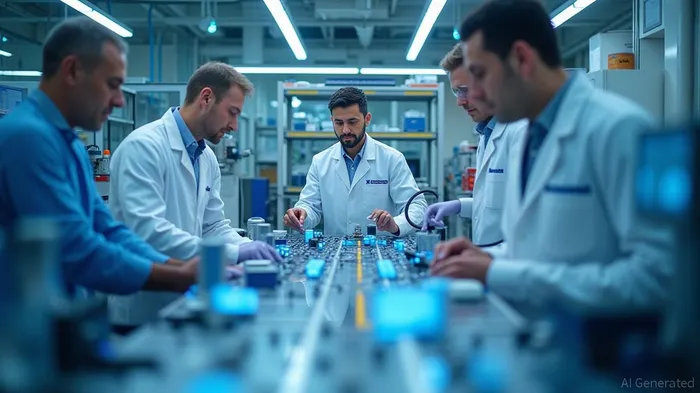
Argonne National Laboratory supports US companies in building advanced nuclear reactors with cutting-edge research and technology.
PorAinvest
domingo, 24 de agosto de 2025, 3:15 pm ET2 min de lectura
D--
One notable example is the project at a chemical plant in southeast Texas, which includes four small modular reactors (SMRs) being developed with the support of Argonne. These reactors are expected to be more flexible in site selection and scale, and less costly to build and operate. Argonne scientists are providing detailed computational fluid dynamics simulations to improve the understanding of fuel pebbles' thermal efficiency and reactor efficiency and safety under different conditions [1].
Maryland-based reactor developer X-energy is one of several American companies collaborating with Argonne to develop the next generation of nuclear energy systems. X-energy's reactors use a type of fuel called TRISO, known for its robustness and resistance to melting down in high-temperature reactors. Argonne scientists are providing detailed simulations of the fuel pebbles' behavior in the reactor core, enhancing the understanding of the fuel's thermal efficiency and reactor safety [1].
California-based Oklo is another company working with Argonne to explore ways to extract more power from used nuclear fuel. Oklo has used Argonne's Mechanisms Engineering Test Loop facility and Thermal Hydraulic Experimental Test Article pool-type sodium facility to validate reactor thermal hydraulic and safety analysis codes for their license application to the U.S. Nuclear Regulatory Commission [1].
Pennsylvania-based Westinghouse is also leveraging Argonne's suite of software and codes to promote safety and fuel performance analysis in liquid-metal-cooled nuclear reactors. These tools help determine coolant flow and temperature distributions, and analyze neutronics and fuel cycle characteristics [1].
In addition to these partnerships, Argonne's work benefits the U.S. nuclear industry at large. Recent industry collaborations include ARC Clean Energy, Constellation Energy, Dominion Energy, Electric Power Research Institute, Exelon, Framatome, General Atomics, General Electric-Hitachi Nuclear Energy, HolosGen, Kairos Power, Moltex Energy, TerraPower, Terrestrial Energy, and Westinghouse [1].
The development of advanced nuclear reactors is also being fast-tracked by the DOE, with executive orders aiming to have the first reactors begin generation within a year. This initiative includes ten companies with eleven reactor projects, although NANO Nuclear Energy (NASDAQ:NNE) is not currently included in this streamlined authorization [2].
NANO Nuclear Energy is focusing on microreactors, which produce less than 20 MW of power and are designed to be highly transportable. The company aims to create a vertically integrated reactor system with fuel enrichment, using lasers to produce fuel. NANO's reactor designs, ZEUS and ODIN, should produce 1-1.5 MW, enough power for about 800-1,000 homes or one small data center or a medium hospital. The company is also exploring mining as a key market due to the remote locations of mines and high energy needs [2].
While NANO Nuclear Energy has big promises, it is still in the R&D stage and has not yet achieved commercial viability. The company has six utility patent applications pending and nine patent applications related to its ALIP technology for small nuclear reactor cooling. However, the development timeline and costs are significant risks, and the company's market capitalization of $1.3 billion indicates its access to capital is somewhat limited compared to its larger peers [2].
In conclusion, U.S. companies are making significant progress in developing advanced nuclear reactors with the support of Argonne National Laboratory. These initiatives aim to address the fast-paced energy needs of an AI- and data-driven future, with a focus on flexibility, cost-effectiveness, and safety. However, the success of these projects will depend on factors such as funding, development timelines, and commercial viability.
References:
[1] https://www.morningstar.com/news/business-wire/20250822435901/as-us-companies-build-the-future-of-nuclear-argonne-lends-critical-support
[2] https://seekingalpha.com/article/4816260-nano-nuclear-energy-concepts-plan-with-many-patents
OKLO--
U.S. companies are developing advanced nuclear reactors with support from Argonne National Laboratory. Companies like X-energy and Oklo collaborate with Argonne to develop next-generation nuclear energy systems. Argonne provides computational fluid dynamics simulations, studies the dynamics of water and vapor in steam generators, and explores ways to extract more power from used nuclear fuel. Partnerships with other companies like Westinghouse and Dominion Energy aim to promote safety and fuel performance analysis in liquid-metal-cooled nuclear reactors.
U.S. companies are making significant strides in developing advanced nuclear reactors, with Argonne National Laboratory playing a crucial role in their progress. The U.S. Department of Energy's (DOE) Argonne National Laboratory is lending critical support to these initiatives, helping to innovate new reactor concepts that are more flexible, cost-effective, and efficient than traditional nuclear reactors.One notable example is the project at a chemical plant in southeast Texas, which includes four small modular reactors (SMRs) being developed with the support of Argonne. These reactors are expected to be more flexible in site selection and scale, and less costly to build and operate. Argonne scientists are providing detailed computational fluid dynamics simulations to improve the understanding of fuel pebbles' thermal efficiency and reactor efficiency and safety under different conditions [1].
Maryland-based reactor developer X-energy is one of several American companies collaborating with Argonne to develop the next generation of nuclear energy systems. X-energy's reactors use a type of fuel called TRISO, known for its robustness and resistance to melting down in high-temperature reactors. Argonne scientists are providing detailed simulations of the fuel pebbles' behavior in the reactor core, enhancing the understanding of the fuel's thermal efficiency and reactor safety [1].
California-based Oklo is another company working with Argonne to explore ways to extract more power from used nuclear fuel. Oklo has used Argonne's Mechanisms Engineering Test Loop facility and Thermal Hydraulic Experimental Test Article pool-type sodium facility to validate reactor thermal hydraulic and safety analysis codes for their license application to the U.S. Nuclear Regulatory Commission [1].
Pennsylvania-based Westinghouse is also leveraging Argonne's suite of software and codes to promote safety and fuel performance analysis in liquid-metal-cooled nuclear reactors. These tools help determine coolant flow and temperature distributions, and analyze neutronics and fuel cycle characteristics [1].
In addition to these partnerships, Argonne's work benefits the U.S. nuclear industry at large. Recent industry collaborations include ARC Clean Energy, Constellation Energy, Dominion Energy, Electric Power Research Institute, Exelon, Framatome, General Atomics, General Electric-Hitachi Nuclear Energy, HolosGen, Kairos Power, Moltex Energy, TerraPower, Terrestrial Energy, and Westinghouse [1].
The development of advanced nuclear reactors is also being fast-tracked by the DOE, with executive orders aiming to have the first reactors begin generation within a year. This initiative includes ten companies with eleven reactor projects, although NANO Nuclear Energy (NASDAQ:NNE) is not currently included in this streamlined authorization [2].
NANO Nuclear Energy is focusing on microreactors, which produce less than 20 MW of power and are designed to be highly transportable. The company aims to create a vertically integrated reactor system with fuel enrichment, using lasers to produce fuel. NANO's reactor designs, ZEUS and ODIN, should produce 1-1.5 MW, enough power for about 800-1,000 homes or one small data center or a medium hospital. The company is also exploring mining as a key market due to the remote locations of mines and high energy needs [2].
While NANO Nuclear Energy has big promises, it is still in the R&D stage and has not yet achieved commercial viability. The company has six utility patent applications pending and nine patent applications related to its ALIP technology for small nuclear reactor cooling. However, the development timeline and costs are significant risks, and the company's market capitalization of $1.3 billion indicates its access to capital is somewhat limited compared to its larger peers [2].
In conclusion, U.S. companies are making significant progress in developing advanced nuclear reactors with the support of Argonne National Laboratory. These initiatives aim to address the fast-paced energy needs of an AI- and data-driven future, with a focus on flexibility, cost-effectiveness, and safety. However, the success of these projects will depend on factors such as funding, development timelines, and commercial viability.
References:
[1] https://www.morningstar.com/news/business-wire/20250822435901/as-us-companies-build-the-future-of-nuclear-argonne-lends-critical-support
[2] https://seekingalpha.com/article/4816260-nano-nuclear-energy-concepts-plan-with-many-patents


Divulgación editorial y transparencia de la IA: Ainvest News utiliza tecnología avanzada de Modelos de Lenguaje Largo (LLM) para sintetizar y analizar datos de mercado en tiempo real. Para garantizar los más altos estándares de integridad, cada artículo se somete a un riguroso proceso de verificación con participación humana.
Mientras la IA asiste en el procesamiento de datos y la redacción inicial, un miembro editorial profesional de Ainvest revisa, verifica y aprueba de forma independiente todo el contenido para garantizar su precisión y cumplimiento con los estándares editoriales de Ainvest Fintech Inc. Esta supervisión humana está diseñada para mitigar las alucinaciones de la IA y garantizar el contexto financiero.
Advertencia sobre inversiones: Este contenido se proporciona únicamente con fines informativos y no constituye asesoramiento profesional de inversión, legal o financiero. Los mercados conllevan riesgos inherentes. Se recomienda a los usuarios que realicen una investigación independiente o consulten a un asesor financiero certificado antes de tomar cualquier decisión. Ainvest Fintech Inc. se exime de toda responsabilidad por las acciones tomadas con base en esta información. ¿Encontró un error? Reportar un problema


SOBRE NOSOTROS
Nuestra historiaAutores de noticiasBase de conocimientosPolítica de privacidadTérmino de usoDescargo de responsabilidad de corretaje de tercerosTérminos de uso de AIMEDivulgaciones de riesgos de AInvest AICarrerasCONTÁCTENOS
Email: support@ainvest.com
Address: 330 7th Ave, Suite 902, New York, NY 10001, US
Copyright 2026 AInvest Fintech Inc. All rights reserved.


Comentarios
Aún no hay comentarios