
argenx's Strategic Pipeline and Market Potential in Autoimmune Diseases: Leveraging First-Mover Advantage and Innovation Ecosystem in Rare Immunology Disorders
argenx has positioned itself as a leader in the development of first-in-class therapies for rare autoimmune and neuromuscular diseases, leveraging a robust pipeline and a collaborative innovation ecosystem. By targeting underserved patient populations with high unmet medical needs, the company is capitalizing on first-mover advantages in ultra-rare conditions while advancing differentiated treatments for broader autoimmune indications. This strategic approach, combined with its Immunology Innovation Program (IIP), underscores argenx's potential to reshape the competitive landscape in rare immunology.
Pipeline Highlights: Targeting Unmet Needs in Rare Autoimmune Diseases
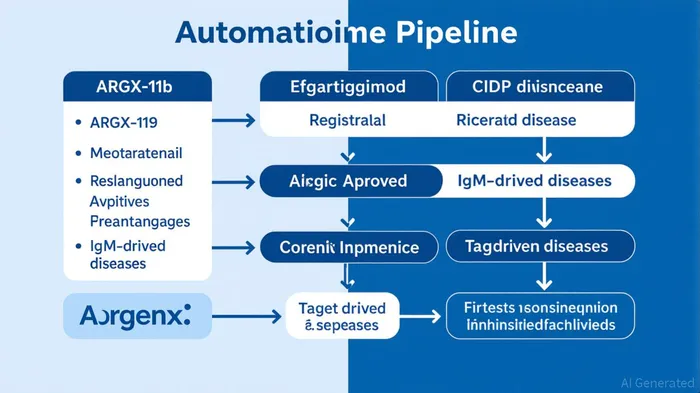
argenx's pipeline is anchored by Efgartigimod (marketed as VYVGART), which has already secured approval for generalized myasthenia gravis (gMG) and chronic inflammatory demyelinating polyneuropathy (CIDP) in the United States [1]. This FcRn-targeting therapy reduces pathogenic IgG antibodies, offering a novel mechanism for diseases driven by IgG-mediated pathology. Meanwhile, Empasiprubart, a C2 inhibitor, is under investigation for severe IgM-driven autoimmune disorders, addressing a niche but critical subset of patients [1].
The most compelling opportunity lies in ARGX-119, a first-in-class agonist antibody targeting muscle-specific kinase (MuSK), which is advancing toward a registrational study for congenital myasthenic syndromes (CMS) [3]. CMS is an ultra-rare group of congenital neuromuscular disorders with no approved therapies, and DOK7-related CMS accounts for approximately 24% of cases, affecting roughly 1.2 individuals per million [3]. The Phase 1b trial of ARGX-119 demonstrated favorable safety and tolerability, positioning it as a potential best-in-class treatment for this unmet need.
First-Mover Advantage in Ultra-Rare Diseases
argenx's focus on ultra-rare conditions like CMS provides a clear first-mover advantage. With no existing treatments and limited competition, ARGX-119 could secure a dominant market position if it achieves regulatory approval. The small but defined patient population, coupled with the high willingness to pay for orphan drug therapies, amplifies the commercial potential of such programs.
For broader indications like gMG and CIDP, VYVGART's approval has already established argenxARGX-- as a key player. While competitors exist in these markets, the drug's novel mechanism of action and favorable safety profile differentiate it from existing therapies [1]. Additionally, the company's expansion into IgM-driven diseases with Empasiprubart further diversifies its portfolio, targeting a segment where current treatments are limited and suboptimal.
Innovation Ecosystem: Collaboration as a Competitive Edge
argenx's success is underpinned by its Immunology Innovation Program (IIP), which fosters collaboration between academic researchers, antibody engineers, and industry experts to develop groundbreaking therapies [2]. This co-creation model accelerates the translation of scientific discoveries into clinical candidates, as seen with ARGX-119 and Empasiprubart. By leveraging external partnerships and internal expertise, argenx maintains a pipeline of differentiated therapies that address complex immunological pathways.
The company's ecosystem also extends to early-stage programs targeting IL-22R, MET, and GARP, which are being explored for inflammatory and autoimmune indications [2]. This diversified approach ensures a steady flow of innovation, reducing reliance on any single asset and enhancing long-term growth prospects.
Market Potential and Strategic Implications
While precise market size estimates for rare diseases like CMS remain limited, the prevalence of 1.2 cases per million and the absence of approved therapies highlight the urgency for innovative solutions [3]. For gMG and CIDP, the global market is projected to grow as demand for targeted therapies increases, with VYVGART's approvals providing a strong foundation for argenx's market penetration.
argenx's strategic focus on first-in-class therapies, combined with its collaborative innovation model, positions it to capture significant value in the rare autoimmune space. As the company advances its pipeline toward regulatory milestones, investors should closely monitor the registrational trial for ARGX-119 in CMS and the broader adoption of VYVGART in gMG and CIDP.
Conclusion
argenx's pipeline reflects a bold commitment to addressing unmet needs in rare immunology disorders through scientific innovation and strategic collaboration. With first-mover advantages in ultra-rare conditions and a differentiated approach to autoimmune disease mechanisms, the company is well-positioned to drive long-term value for stakeholders. As the field of immunology continues to evolve, argenx's ecosystem-driven model offers a blueprint for sustainable growth in an increasingly competitive therapeutic landscape.





Comentarios
Aún no hay comentarios