
Argentina's Peso Debt Crisis: Navigating Central Bank Policy and Systemic Risks for Emerging Market Investors
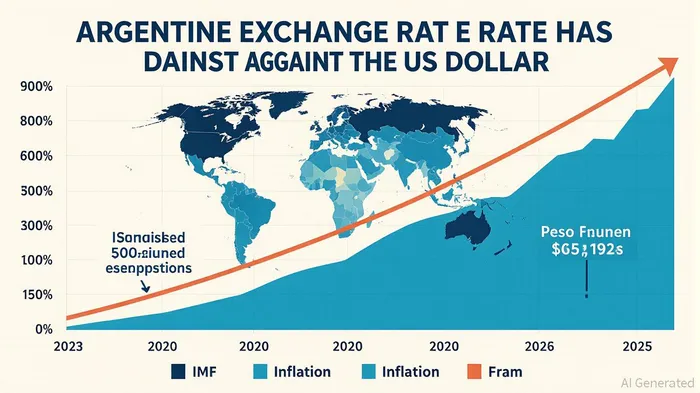
Argentina's economic journey in 2025 has been defined by a delicate balancing act: stabilizing a currency prone to volatility, managing a debt burden that remains among the highest in emerging markets, and navigating the political and structural challenges of a nation with a history of fiscal missteps. The International Monetary Fund (IMF)'s $20 billion Extended Fund Facility (EFF) program, approved in April 2025, represents a critical juncture. While the program has injected liquidity and signaled a shift toward fiscal discipline under President Javier Milei, it also underscores the systemic risks embedded in Argentina's banking sector and the broader implications for foreign investors in emerging market debt.
The Central Bank's Tightrope: Currency Volatility and Solvency Risks
The Argentine Central Bank (BCRA) faces a dual challenge: managing a wide exchange rate band (1,000–1,400 ARS/USD) to avoid a de facto dollar peg while accumulating $30 billion in international reserves to defend the peso. This framework, designed to reduce inflationary pressures and restore market confidence, has already shown mixed results. By July 2025, the peso had appreciated toward the stronger end of the band, but inflation remained stubbornly high at 8.7% year-over-year, with a spike of 3.7% in March 2025 raising concerns about policy credibility.
A key vulnerability lies in the banking sector's exposure to currency mismatches. Argentina's bi-monetary economy—where the U.S. dollar dominates savings and long-term assets—has left banks with significant foreign currency liabilities. The easing of capital controls, while intended to attract foreign investment, risks sudden outflows if the peso's overvaluation proves unsustainable. The BCRA's non-sterilized interventions (purchasing dollars at the lower band and selling them at the upper band) aim to stabilize liquidity, but these measures could deplete reserves if the peso depreciates sharply. With over $45 billion in foreign debt service due over the next three years, including $15 billion to the IMF, the central bank's ability to manage this balance will determine whether Argentina avoids a repeat of its cyclical crises.
Foreign Investor Exposure: Opportunities and Pitfalls
For foreign investors, Argentina's debt market presents a paradox. On one hand, the IMF-backed reforms have reduced country risk spreads by nearly 200 basis points, with the peso appreciating toward the stronger end of its band. On the other, the country's history of defaults and the political uncertainty of October 2025 midterm elections create a high-risk environment. The Milei administration's fiscal consolidation—shrinking the deficit from 5% of GDP in 2023 to a small surplus in 2024—has improved short-term stability, but structural challenges persist.
Emerging market investors must weigh Argentina's progress against its fragility. The BCRA's focus on monetary targeting and reserve accumulation is a positive signal, but the risk of policy reversals remains. A weak performance by Milei's party in the midterms could reignite fears of populist interventions, such as propping up the peso to curb inflation ahead of elections—a move that would likely trigger a currency correction and erode investor confidence.
Strategic Implications for Investors
For those considering exposure to Argentina's debt, a cautious, hedged approach is warranted. The following strategies merit consideration:
- Currency Hedging: Given the peso's volatility, investors should hedge against exchange rate risks using forward contracts or options. The wide band system introduces uncertainty, and a sudden depreciation could amplify losses in local-currency debt.
- Diversification Across Maturities: Prioritize short-to-medium-term bonds to mitigate refinancing risks. Argentina's $45 billion in debt service over three years necessitates a focus on instruments with manageable maturity profiles.
- Political Risk Insurance: The October 2025 elections represent a critical inflection point. Investors should consider political risk insurance to protect against abrupt policy shifts or capital controls.
- Monitoring Fiscal Discipline: Track the BCRA's reserve accumulation and inflation trends. A failure to meet reserve targets or a resurgence in inflation could signal a loss of market confidence.
Conclusion: A High-Stakes Gamble
Argentina's 2025 stabilization program is a bold experiment in economic reform, but its success hinges on the BCRA's ability to maintain credibility and the government's resolve to resist political pressures. For foreign investors, the opportunity lies in Argentina's potential to break its cycle of crisis, but the risks are equally profound. The coming months will test whether the country can transition from emergency financing to sustainable growth—or revert to its familiar patterns of instability. In this context, disciplined, diversified, and hedged strategies will be essential for navigating the uncertainties of Argentina's peso debt crisis.







Comentarios
Aún no hay comentarios