
Argentina's Currency Stabilization and Economic Reforms: Strategic Opportunities in Emerging Markets
Argentina's 2025 economic transformation represents a pivotal moment for emerging market investors. After decades of volatility, the country has embarked on a bold agenda of currency stabilization, fiscal discipline, and structural reforms, supported by a $20 billion IMF loan and a historic U.S. currency swap agreement. These measures, while ambitious, present both opportunities and risks for capital seeking high-growth, high-conviction plays in Latin America's most resource-rich economy.
Currency Stabilization: A New Regime
The cornerstone of Argentina's stabilization strategy is the dismantling of the cepo cambiario (currency controls) and the adoption of a flexible exchange rate regime. According to a Reuters report, the central bank has allowed the peso to trade within a defined band, aiming to restore market transparency and curb inflation. This shift, however, has not been without turbulence. The U.S. Treasury's $20 billion currency swap line-finalized in Q3 2025-has provided immediate liquidity, stabilizing the peso temporarily and signaling Washington's commitment to President Javier Milei's reform agenda, according to a CNBC report.
Yet, as noted by an IMF press release, the success of this regime hinges on Argentina's ability to maintain a zero primary fiscal deficit and avoid relapsing into inflationary pressures. The removal of capital controls, while a step toward financial liberalization, also exposes the economy to short-term capital flight, a risk highlighted by economists at the Atlantic Council.
Fiscal Discipline and Structural Reforms
Argentina's fiscal anchor is underpinned by a stringent consolidation program. The OECD Economic Survey of Argentina forecasts a primary fiscal surplus of 0.5% of GDP in Q1 2025, driven by spending cuts and revenue reforms. Complementing this is the RIGI regime-a 30-year fiscal guarantee offering tax incentives for large-scale investments in mining, energy, and infrastructure. This framework, as detailed in a Financial Express piece, aims to attract foreign direct investment (FDI) by reducing bureaucratic hurdles and offering reduced corporate tax rates for projects exceeding $200 million.
The potential payoff is significant. Argentina's lithium reserves and the Vaca Muerta shale formation position it as a critical player in the global energy transition. However, political polarization and lingering currency restrictions-such as residual limits on dollar transactions-remain obstacles to full capital inflow, according to the World Economic Forum.
Strategic Opportunities in Emerging Markets
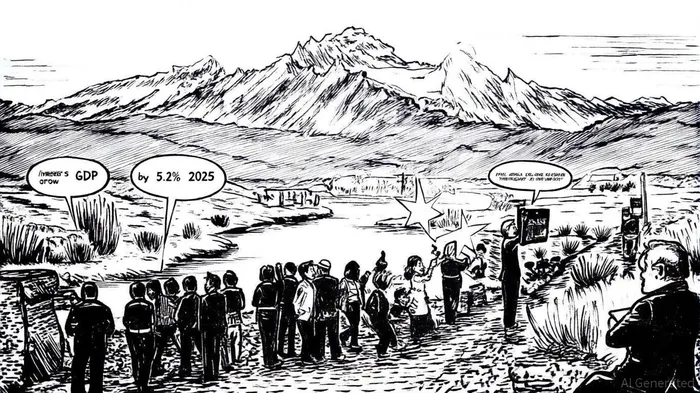
For investors, Argentina's reforms create a unique window to capitalize on undervalued assets in a high-growth sector. The OECD projects GDP growth of 5.2% in 2025, with inflation expected to fall from 50% in 2024 to 37% in 2025. This trajectory, if sustained, could attract capital to sectors like agriculture, energy, and infrastructure, where Argentina's comparative advantages are pronounced.
The U.S. currency swap and IMF support also signal a broader geopolitical shift. By stabilizing Argentina's financial system, Washington is indirectly bolstering its influence in South America, creating a favorable environment for U.S.-based firms seeking to partner with Argentine counterparts in energy and technology.
Risks and the Road Ahead
Despite these opportunities, risks loom large. Political uncertainty, particularly ahead of October 2025 midterm elections, could disrupt reform momentum. Additionally, the peso's volatility-exacerbated by Argentina's history of defaults-means foreign investors must hedge currency exposure carefully, as noted by CNBC.
The OECD and World Economic Forum caution that without sustained fiscal discipline and structural reforms, Argentina may revert to its cyclical crises. For now, however, the combination of IMF oversight, U.S. intervention, and Milei's market-friendly policies offers a rare blueprint for stabilization in an emerging market.
Conclusion
Argentina's 2025 reforms represent a high-stakes experiment in economic rebirth. For investors with a long-term horizon, the country's resource wealth, strategic location, and policy-driven stabilization present compelling opportunities. Yet, as with any emerging market play, success depends on navigating political risks and maintaining a disciplined approach to capital allocation. As the peso stabilizes and FDI flows increase, Argentina may yet emerge as a model for how fiscal rigor and foreign exchange defense can unlock growth in volatile markets.







Comentarios
Aún no hay comentarios