
Argentina's Currency Crossroads: Navigating Milei's Reforms and Trump's Diplomacy in a Volatile FX Landscape
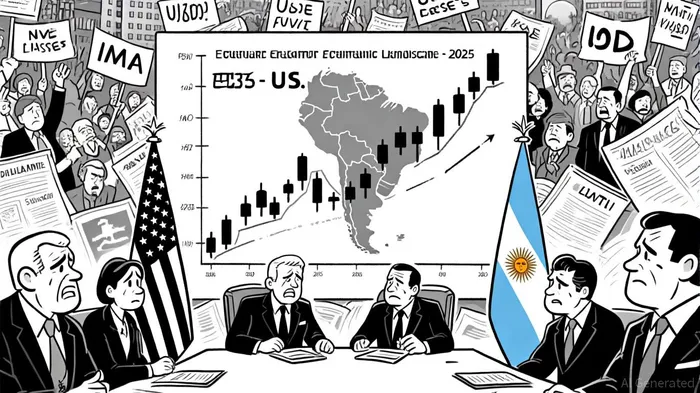
Emerging market currency volatility has long been a double-edged sword for investors, offering outsized returns amid uncertainty but demanding a nuanced understanding of geopolitical and economic crosscurrents. Argentina's 2025 experience under President Javier Milei epitomizes this duality, as his radical liberalization agenda collides with political fragility and external interventions from the Trump administration. For foreign exchange (FX) investors, the South American nation presents a high-stakes chessboard where structural reforms, diplomatic maneuvering, and market psychology converge.
Mixed Signals: Milei's Reforms and Their Consequences
President Javier Milei's economic strategy-centered on dismantling Argentina's infamous "el cepo" currency controls and embracing market-driven policies-has delivered both progress and peril. By securing a $20 billion IMF bailout and allowing the peso to float within a 1,000–1,400 ARS/USD band in April 2025, Milei's government initially boosted investor confidence. Central bank reserves surged to $36.8 billion, and Argentina's country risk index plummeted to 561 points in early 2025, signaling a rare moment of optimism [1]. However, by late September, the peso had depreciated to 1,505 ARS/USD on parallel markets, while the country risk index climbed to 1,429 basis points, reflecting renewed skepticism [2].
This volatility stems from conflicting signals. On one hand, Milei's administration has implemented austerity measures, cutting public spending and reducing subsidies, which led to a fiscal surplus and a sharp drop in monthly inflation from 25.5% in December 2023 to 2.7% in October 2024 [3]. On the other, these policies have exacerbated poverty, with 53% of Argentinians living in hardship by mid-2024 [3], fueling social unrest and legislative resistance. The administration's push for "endogenous dollarization"-encouraging U.S. dollar usage in domestic transactions-has further complicated matters, as the informal economy's reliance on parallel markets persists [4].
Trump's Diplomatic Lifeline: Stabilizing or Short-Term Fix?
The Trump administration's $20 billion currency swap agreement with Argentina, finalized in October 2025, has added another layer of complexity. This intervention, coupled with direct peso purchases by the U.S. Treasury, aimed to stabilize Argentina's FX markets ahead of October 26 midterm elections and reinforce Milei's market-oriented reforms [5]. According to a report by CNN, the move was framed as a "necessary measure to provide stability," with Secretary Scott Bessent emphasizing U.S. preparedness to "take whatever exceptional measures are warranted" [5].
The immediate effects were palpable: Argentina's Merval stock index surged by 5.3%, and 2035 bonds gained 4.5 cents, reflecting a temporary boost in investor confidence [6]. Yet critics argue the intervention prioritizes political alignment over economic fundamentals. U.S. soybean farmers and bipartisan lawmakers have condemned the swap as favoring Argentina's agricultural exports at the expense of American interests, while analysts warn it addresses liquidity crises without tackling structural issues like 166% annual inflation or a 15% real wage decline [6].
Opportunities Amid the Turbulence
For FX investors, Argentina's mixed signals create both risks and openings. The IMF's $20 billion program and Trump's support have injected liquidity, potentially cushioning the peso from a full-scale devaluation. The RIGI investment incentive program, designed to attract foreign capital, also offers long-term potential [7]. Meanwhile, Milei's repatriation of undeclared U.S. dollars-by eliminating tax reporting requirements-could gradually shift Argentina toward dollarization, reducing currency volatility over time [8].
However, these opportunities come with caveats. Political uncertainty looms large, as Milei's legislative setbacks and social unrest threaten to derail reforms. The peso's recent depreciation to 1,505 ARS/USD underscores the fragility of market confidence, particularly as Argentina's country risk index remains elevated. Investors must also weigh the ethical implications of supporting a government whose austerity measures have deepened inequality.
Conclusion: A High-Risk, High-Reward Proposition
Argentina's FX market in 2025 is a study in contradictions: a government committed to radical liberalization, a population grappling with austerity, and a U.S. administration pursuing geopolitical and economic interests. For investors, the key lies in balancing short-term liquidity gains from Trump's intervention and IMF support with long-term risks tied to political instability and structural economic challenges. While the peso's trajectory remains unpredictable, one thing is clear: Argentina's currency crossroads demand a strategy as agile as the market itself.







Comentarios
Aún no hay comentarios