
Argan's Emerging Role in AI Infrastructure: Undervalued Exposure in Japan's AI Revolution
Japan's AI revolution is accelerating at an unprecedented pace, driven by a confluence of government ambition, corporate innovation, and global collaboration. By 2025, the country has committed ¥10 trillion ($65 billion) to AI and semiconductor development through 2030, with ¥2 trillion allocated for 2024–2025 alone, according to an Introl analysis. This funding is directed toward next-generation chip research, domestic semiconductor production, and the construction of AI supercomputers. Meanwhile, private-sector giants like SoftBank and KDDI are building sprawling AI data centers, including a 440,000-square-meter facility in Osaka with an initial power capacity of 150 megawatts, scalable to 400 megawatts, as reported by RCR Wireless. MicrosoftMSFT--, too, has pledged $2.9 billion to expand its AI infrastructure in Japan, including advanced GPU deployments and an AI training program for three million workers, according to Microsoft Stories Asia.
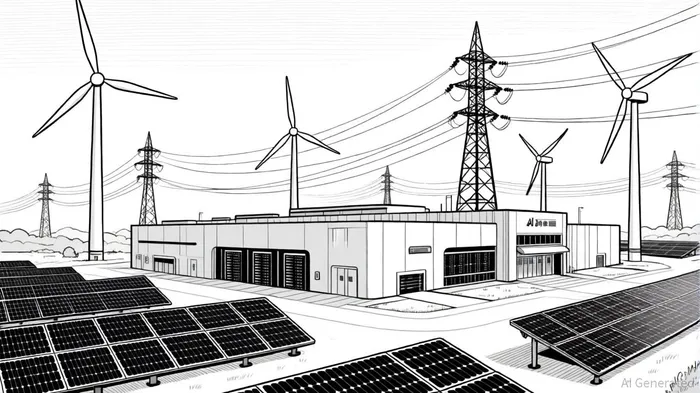
Yet, amid this surge in AI infrastructure, one critical enabler remains underappreciated: the energy sector. AI data centers are voracious consumers of power, with SoftBank's Osaka facility alone requiring infrastructure capable of scaling to 400 megawatts. Japan's "Watt-Bit Collaboration" initiative, launched in August 2025, aims to align data center expansion with renewable energy projects, ensuring these facilities are powered by clean energy, according to Energy Tracker Asia. This creates a unique opportunity for energy infrastructure providers like Argan, which has positioned itself at the nexus of the energy transition and AI-driven demand.
Argan's Strategic Positioning in the Energy Transition
Argan, a U.S.-based energy infrastructure developer, has demonstrated robust growth in 2025, with a record $1.9 billion project backlog and 23% year-over-year revenue growth, according to a StockTitan report. Its strategic focus on renewable energy, battery storage, and grid modernization aligns perfectly with Japan's AI infrastructure needs. While ArganAGX-- has not yet announced specific projects in Japan, its global expansion strategy-highlighted by the Kilroot project in Northern Ireland and a 40% target for renewable project backlog-suggests it is well-positioned to capitalize on Japan's energy demands, per a SWOTAnalysis profile.
The company's expertise in large-scale power projects, such as the 1.2 GW Sandow Lakes Power Station in Texas, underscores its ability to deliver the high-capacity, reliable energy required by AI data centers, as illustrated in Investing.com slides. Argan's emphasis on leveraging the U.S. Inflation Reduction Act (IRA) to fund clean energy projects further strengthens its appeal in markets like Japan, where decarbonization goals are tightly integrated with AI development, according to an Investors article.
Undervalued Exposure in Japan's AI Ecosystem
Japan's AI infrastructure boom is creating a surge in demand for energy solutions that Argan's capabilities uniquely address. For instance, SoftBank's Osaka data center requires not only massive power capacity but also advanced cooling systems and renewable energy integration-areas where Argan's experience in grid modernization and clean energy projects could provide value, as discussed in an Alo Japan article. Similarly, Microsoft's Azure High Performance Computing initiatives in Japan rely on stable, low-cost energy, a challenge Argan's renewable energy expertise could help mitigate, according to an Exp.com analysis.
Despite these opportunities, Argan's exposure to Japan's AI revolution remains undervalued by investors. The company's current focus is on U.S. markets, where it has a strong presence in solar, wind, and battery storage. However, Japan's strategic investments in AI infrastructure-coupled with its emphasis on public-private partnerships-present a compelling case for Argan to expand internationally. The absence of direct partnerships in Japan to date does not diminish its potential; rather, it highlights an untapped market where Argan's capabilities could fill a critical gap.
Conclusion: A Strategic Bet on the Future
Japan's AI revolution is not just a technological shift but a structural transformation of its energy landscape. As data centers become the backbone of this transformation, the need for reliable, sustainable energy infrastructure will only intensify. Argan, with its financial strength, technical expertise, and strategic focus on the energy transition, is uniquely positioned to benefit from this trend-even if its direct involvement in Japan remains unannounced.
For investors, the key insight is clear: Argan's undervalued exposure to Japan's AI infrastructure represents a high-conviction opportunity. As the country's AI ambitions crystallize into concrete projects, Argan's role in powering them could become a defining narrative for the company's next phase of growth.





Comentarios
Aún no hay comentarios