
Ardent Health's Revised $777.5M Term Loan Facility: A Liquidity Play in a Post-Pandemic Healthcare Landscape
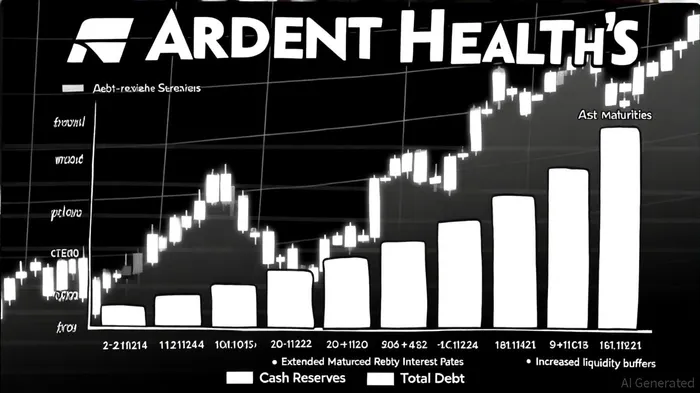
In the evolving post-pandemic healthcare landscape, liquidity management has become a lifeline for providers navigating rising operational costs, delayed reimbursements, and structural inefficiencies. ArdentARDT-- Health's recent amendment of its $777.5M term loan facility—reducing the interest rate by 50 basis points and extending the maturity to September 2032—reflects a strategic recalibration to bolster financial flexibility while aligning with broader industry trends[1]. This move, coupled with a $100M prepayment of its Term Loan B Facility in June 2024, underscores the company's disciplined approach to debt optimization amid a sector grappling with cash flow pressures[2].
Debt Restructuring: A Win-Win for Ardent and Lenders
The revised term loan facility, now priced at Term SOFR plus 2.25% (down from 2.75%), is projected to cut Ardent's annual interest expenses by $3.9M[1]. By extending the maturity to 2032, the company gains a critical runway to manage near-term obligations while avoiding a wave of debt maturities concentrated in 2028–2029. This extension also aligns with the healthcare sector's broader shift toward long-term debt to stabilize cash flow, as noted by Kaufman Hall's 2025 Healthcare Credit Outlook[3].
Ardent's prior debt structure, with $1.1B in total debt and a cash-to-debt ratio of 0.38x as of June 30, 2025, already signaled a focus on liquidity preservation[2]. The $100M prepayment in 2024 eliminated quarterly principal payments, freeing up $25M annually in cash flow—a move that resonates with industry leaders prioritizing days cash on hand (DCO) amid rising labor and supply costs[4].
Contextualizing Ardent's Strategy in a Challenged Sector
The healthcare industry's post-pandemic environment is marked by uneven recovery and persistent headwinds. According to Becker's Hospital Review, 2025 has seen a 20% increase in Chapter 11 filings compared to 2024, with entities like MCR Health and CarePoint Health exiting bankruptcy[5]. Meanwhile, Medicare's 2.83% physician fee schedule cut for 2025 exacerbates revenue pressures[6]. In this context, Ardent's debt restructuring is not just a financial maneuver but a defensive strategy to insulate itself from sector-wide volatility.
Ardent's approach mirrors industry-wide trends toward outpatient expansion and technology-driven efficiency. The company has allocated $69M in 2025 for AI-enabled scribe tools and virtual nursing, aiming to reduce administrative burdens and improve margins[7]. These investments align with McKinsey's 2025 healthcare forecast, which highlights ambulatory care and automation as key growth drivers[8].
Risks and Opportunities
While Ardent's liquidity position appears robust—with $294M in available revolver capacity and $541M in cash as of June 2025[2]—the company's net leverage ratio of 1.2x remains elevated compared to peers. Critics may question whether the $3.9M annual savings from the term loan amendment justifies the long-term extension of debt. However, in a low-interest-rate environment, locking in favorable terms for a decade could prove advantageous if short-term rates rise again.
The broader healthcare sector's focus on AI and outpatient care also presents opportunities. Ardent's planned five urgent care centers and two imaging centers by year-end 2025[7] position it to capitalize on the shift to non-acute care, a trend expected to grow as payers and patients prioritize cost-effective solutions[9].
Conclusion
Ardent Health's revised term loan facility and proactive debt prepayment exemplify a liquidity strategy tailored to the post-pandemic healthcare landscape. By reducing interest burdens, extending maturities, and investing in operational efficiency, the company is navigating a sector defined by financial fragility and structural change. As the industry continues to grapple with reimbursement cuts and operational inflation, Ardent's disciplined capital structure may serve as a blueprint for sustainable growth.





Comentarios
Aún no hay comentarios