
Arctic Strategic Infrastructure Development: Geopolitical-Driven Opportunities in Logistics and Resource Sectors
The Arctic is no longer a frozen frontier. As climate change accelerates ice melt and global powers vie for influence, the region is transforming into a critical hub for logistics, resource extraction, and geopolitical strategy. By 2025, the Arctic's thawing landscape has unlocked new shipping routes, mineral-rich territories, and strategic corridors that are reshaping global trade and power dynamics. For investors, this represents a unique intersection of risk and reward-where environmental, political, and economic forces collide.
Geopolitical Dynamics: A New Cold War in the North
The Arctic's strategic value is no longer theoretical. Russia has cemented its dominance through the Northern Sea Route (NSR), with applications for its use surging by 50% between 2023 and 2025. Moscow's state-directed approach to resource extraction-centered on rare earth elements, nickel, and critical minerals-has positioned it as a gatekeeper for global supply chains. Companies like Rosatom and Nornickel are central to this strategy, operating in regions like Yakutia and Krasnoyarsk Krai. Meanwhile, China's "Polar Silk Road" initiative has deepened its Arctic footprint, with partnerships in Greenland's rare earth projects (e.g., Shenghe Resources' stake in the Kvanefjeld mine) and recurring shipping lines with South Korea.
The United States, meanwhile, is adopting a more cautious but increasingly assertive stance. The 2022 National Strategy for the Arctic Region emphasizes balancing resource security with environmental protection and Indigenous rights. However, the U.S. faces infrastructure gaps: its icebreaker fleet remains far smaller than Russia's, and Arctic port development lags. To counter this, the Biden administration has prioritized partnerships with Nordic nations and investments in dual-use infrastructure, such as the U.S. Export-Import Bank's $120 million loan to Greenland's Tanbreez rare earth mine. Canada, too, is doubling down on Arctic infrastructure through its Arctic Infrastructure Fund, funding all-season roads, airports, and ports with a focus on military and economic resilience.
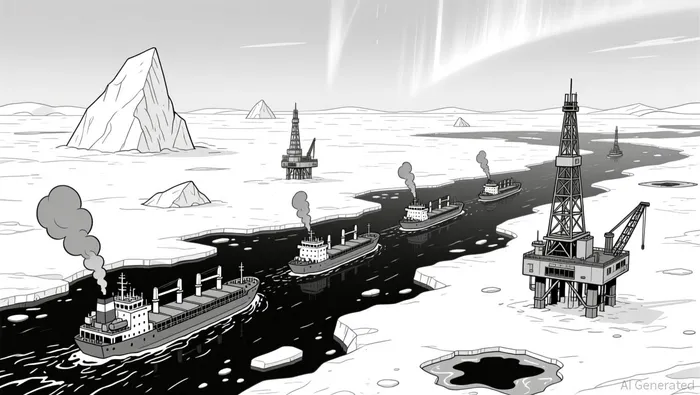
Climate Change: The Unstoppable Catalyst
The Arctic's transformation is being driven by a force no government can control: climate change. The NSR's ice-free window has expanded from 90 days in 2010 to 120–150 days in 2023, slashing shipping times between Asia and Europe by up to 40%. This has made the NSR a preferred route for Sino-Russian trade, with cargo volumes projected to surpass 80 million tons annually by 2025. For logistics firms, the Arctic's shorter transit times and lower fuel costs present a compelling case for rerouting supply chains.
Yet this thaw comes with risks. Permafrost degradation and coastal erosion threaten infrastructure resilience, while environmental groups warn of irreversible ecological damage. The U.S. National Oceanic and Atmospheric Administration (NOAA) has called for science-based decision-making to balance economic development with sustainability. Investors must weigh these challenges against the potential rewards of Arctic logistics and resource projects.
Key Players and Investment Trends
The Arctic's resource sector is attracting capital from unexpected corners. China's dominance in rare earth processing-critical for electric vehicles and semiconductors-has spurred Western efforts to diversify supply chains. The U.S. and Canada are leading this charge, with Greenland's Tanbreez and Kvanefjeld mines becoming focal points of geopolitical competition. The UAE, meanwhile, has signaled interest in Arctic marine infrastructure and energy projects in Alaska, adding another layer of complexity to the region's investment landscape.
Russia's state-led consolidation of Arctic mineral assets is equally noteworthy. By integrating extraction, processing, and transportation under centralized control, Moscow aims to dominate global markets for critical minerals like silicon carbide and rare earth elements. This strategy is not without vulnerabilities: Western sanctions and environmental scrutiny could disrupt operations, but for now, Russia's Arctic ambitions are proceeding unimpeded.
Challenges and the Path Forward
The Arctic's strategic potential is undeniable, but its development is fraught with challenges. Geopolitical tensions between the U.S., China, and Russia risk destabilizing the region, while environmental concerns could delay projects or trigger regulatory pushback. Indigenous communities, whose rights are enshrined in the U.S. and Canadian strategies, are also key stakeholders in Arctic development.
For investors, the path forward requires a nuanced approach. Infrastructure projects must prioritize resilience against climate impacts, while resource extraction must align with sustainability goals. Partnerships-whether between governments, corporations, or Indigenous groups-will be critical to navigating the Arctic's complex web of interests.
Conclusion
The Arctic is no longer a peripheral region but a central arena for global competition. As infrastructure projects accelerate and resource extraction intensifies, the region's geopolitical and economic significance will only grow. For investors, the Arctic offers high-stakes opportunities in logistics, critical minerals, and strategic infrastructure-but only for those who can navigate its environmental, political, and ethical challenges. The next decade will determine whether the Arctic becomes a model for sustainable development or a flashpoint for global conflict.







Comentarios
Aún no hay comentarios